What is a honeypot token, and how do you spot one before you buy?
One wallet deployed 979 honeypot contracts in ten weeks. How the trap blocks your sell, and the four checks that catch it beforehand.
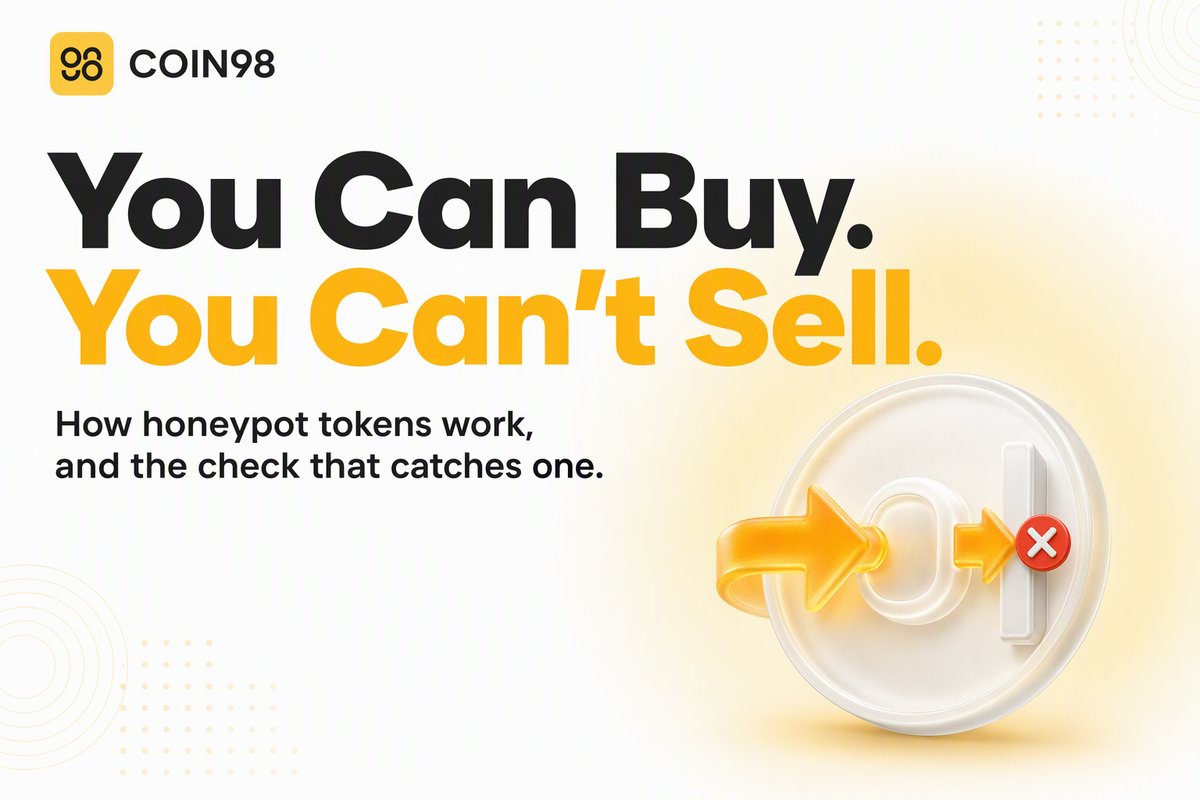
The buy goes through in seconds. That's the part of the trade everyone tests. A honeypot token is one whose smart contract lets you buy but blocks you from selling — the trap isn't in the price, it's written into the code before the token ever launches. These are built in bulk: a single wallet funded 979 addresses that each deployed a honeypot contract between 24 August and 31 October 2023, roughly one new trap every half hour. Here's how the block is built, why the chart still looks healthy while it's happening, and the four checks that catch one in about a minute.
Last updated: September 2026
What a honeypot token is
A honeypot token is a token you can buy and then can't sell, because the contract itself refuses the sale. Nothing is broken and nothing is stolen in the usual sense. The money is spent on something designed to have no exit, and the contract enforces that rule on every wallet except the ones the deployer chose.
The three ways a contract blocks a sell
The mechanisms are simpler than they sound, and there are really only three in common use.
The blacklist. Buyers get added to a list of addresses that aren't allowed to sell, often behind a function with a harmless-looking name. The deployer's own wallets stay off the list, so the token trades normally for them.
The balance rewrite. The contract quietly resets a holder's recorded balance to a token or two. Your wallet may still show the full amount, but the contract disagrees, and the sale is built from the contract's number.
The impossible minimum. The contract only permits a sale above a set threshold, and the threshold is set beyond reach. One documented case required selling more than the holder's entire balance plus a further 34,644 tokens — and buying more only pushed the bar higher.
A fourth variation doesn't block the sale at all. It permits it and applies a sell tax so large that almost nothing comes back. Some contracts launch with a normal tax and raise it once enough money is in.
Honeypot, rug pull, or pump and dump?
These three get used interchangeably and they're not the same thing. The difference decides whether you could have sold at all.
| What the scammer does | Can you sell? | |
|---|---|---|
| Honeypot | Writes a sell restriction into the contract | No — the transaction is refused |
| Rug pull | Removes the liquidity backing the token | Yes, in principle, but there's nothing left to sell into |
| Pump and dump | Inflates the price, then sells into the buyers | Yes — at a far worse price |
Of the three, only a honeypot takes the exit away entirely. The sell was never available, at any price, from the moment the contract was deployed.
Why the trap works
Honeypots work because the two things a buyer naturally checks — the chart and the buy — both look fine. Volume is real, the candles are green, and the purchase confirms normally. The only broken part is the one nobody tests before committing money.
The volume is real; the sells aren't
The reliable tell is the ratio between buys and sells. On a token with hundreds of buys and almost no completed sells, the sells aren't missing because holders are optimistic. They're missing because they aren't possible. An all-green chart with a near-zero sell count is the single clearest signal a honeypot leaves behind, and it sits in public transaction history where anyone can read it.
Industrial scale, not one-off scams
These are deployed in bulk. Beyond the 979 contracts traced to one funding wallet in late 2023, a February 2024 operation ran at least nine linked honeypot tokens through five Telegram channels with paid promoters, taking roughly $3.2 million.
The base rate on token launchpads is the reason a check is worth running every time. Of more than seven million tokens issued on one Solana launchpad between January 2024 and the report in May 2025, only about 97,000 — 1.3% — held even $1,000 of liquidity, and 98.6% showed rug-pull or pump-and-dump characteristics. That covers one launchpad rather than the whole market, and the platform disputed the methodology. The order of magnitude still holds: a new token is more likely to be a trap than a project.
The broader scam economy is growing alongside it. Crypto scams of all kinds received at least $14 billion on-chain during 2025, and the average payment per victim rose from $782 in 2024 to $2,764 in 2025.
How to check a token before you buy
Four checks, in this order, catch the large majority of honeypots — and none of them takes longer than reading the token's social media posts, which is what most people do instead.
1. Read the sell side of the trade history
Open the token's contract address on the chain's block explorer and look at the last hundred transactions. You want completed sells from ordinary wallets, spread over time. Buys with no matching sells is the pattern to walk away from.
In Coin98 Super Wallet, you can reach the right explorer without copying addresses by hand: tap the "⋯" icon on the main screen, choose View All Wallet Addresses, then tap the scan icon beside an address to be redirected to that chain's explorer, where you can paste the token's contract address into the search box.
2. Check who still controls the contract
On EVM chains, look for functions that let an owner change transfer behaviour after launch — blacklists, adjustable taxes, transfer pausing. On Solana, check the token's mint authority and freeze authority. A live freeze authority means holder accounts can be frozen, after which the tokens can't be sold or transferred at all, while buying keeps working for everyone else. Legitimate launches usually revoke both, and both are visible on-chain.
One important limitation: a "verified contract" badge only means the published source code matches what's deployed. It says nothing about what the code does.
3. Simulate the sell, then test it
Honeypot checkers run a simulated buy and sell against the contract and report the taxes and whether the sell reverts. They're the fastest single check available, and we'd suggest treating a failed simulation as final.
A clean result is weaker evidence than it looks. Contracts with delayed activation pass scans at launch and switch the blacklist on later, once volume builds. A clean scan shows the trap isn't armed yet, not that it doesn't exist. If you're going ahead anyway, buy a small amount and sell part of it straight back before committing anything meaningful. That round trip tests the only thing that matters.
4. Look at liquidity, not market cap
Market cap on a new token is supply multiplied by a price almost nobody has traded at. Liquidity is the money actually in the pool, and it sets what you can realistically get out. Check whether the pool is locked and for how long, and compare the pool size to the position you're considering.
| Check | What it catches | What it misses |
|---|---|---|
| Buy/sell history | Active honeypots with trapped holders | Tokens too new to have history |
| Contract controls | Blacklists, adjustable taxes, live freeze authority | Traps hidden in unverified code |
| Sell simulation | Blocked sells and extreme sell taxes | Delayed-activation contracts; chains the tool doesn't cover |
| Liquidity check | Thin pools and imminent rug pulls | Honeypots with genuinely funded pools |
No single row covers the others, so the four work best as a set. For the trade itself, SwapX in Coin98 Super Wallet routes through multiple DEX aggregators across Ethereum, BNB Smart Chain, Polygon, Solana, Arbitrum, Base and Sui, and its Smart Routing finds the most efficient path across liquidity sources. Routing decides your price. It can't make a blocked sell go through, and no wallet can. If you want to run a chart or scanner tool before trading, the DApp Browser opens dApps across more than 100 blockchains without leaving the wallet. For anyone buying new tokens regularly, our Solana meme coin guide covers the wider set of habits this fits into.
If you're already holding one
Stop retrying the sell. Every failed attempt still costs gas, and the contract will refuse the next one for the same reason it refused the last. Buying more to average down makes the position larger, not more sellable.
A failed sell usually isn't a wallet problem
Swaps fail for ordinary reasons, and it's worth ruling them out first. Coin98 documents five: not enough of the native coin for gas, not enough of the token you're selling, thin liquidity or a sharp price move on a small-cap token, a gas setting too low to confirm before timing out, and reverted transactions where every change is rolled back.
If your gas and balance are fine, the pool has depth, and the sell still reverts every time while other people's buys keep confirming — that pattern isn't on the list of ordinary failures. That's the contract refusing.
Clean up the approval and move on
Buying a token means approving a router to spend it, and that approval outlives the trade. Wallet Health in Coin98 Super Wallet scans eight categories, including every token and NFT approval across your wallets, and returns a 0–100 score — anything from 0 to 30 is flagged as high risk. Reviewing that list is worth doing after any purchase you regret, and our guide to dApp permissions and token approvals explains what each approval actually grants.
One thing not to do: don't follow up on offers to "recover" the funds. Recovery services targeting people who've just lost money are their own category of scam, covered in our guide to what to do after a crypto scam. Unsolicited tokens that appear in your wallet and can't be sold are usually a separate trick — see dusting attacks and airdrop scams for what those are doing.
Frequently asked questions
Is a honeypot token the same as a rug pull? No. A rug pull removes the liquidity behind a token, so it collapses in value but remains sellable in principle. A honeypot blocks the sell transaction itself while liquidity is still sitting in the pool. In a rug pull you sell into nothing; in a honeypot you never get to sell at all.
Can I get my money back from a honeypot token? Realistically, no. The restriction lives in the contract, and only the deployer can change it. Sending the token to a different wallet doesn't help either: these contracts commonly blacklist the transfer itself, so the receiving wallet inherits the same block. The practical move is to stop spending gas on retries and review the approvals you granted.
Do honeypot checkers catch everything? No. They simulate a buy and sell and report what happens, which catches contracts where the trap is already active. They don't catch delayed-activation contracts that behave normally at launch and switch a blacklist on once volume builds, and many only cover EVM chains. Treat a failed check as decisive and a clean one as partial.
Does an audit or a verified contract mean a token is safe? Neither is a safety guarantee. Verification only confirms the published source matches the deployed bytecode — the code can still contain a blacklist. An audit is more meaningful, but it covers a specific version at a specific date, and an owner with permission to change tax or transfer rules can alter behaviour afterwards.
Why did my buy work but my sell fail? Because the contract treats them differently. Buys are permitted for everyone, since that's how money comes in. Sells are filtered by a blacklist, a balance rule, a minimum size, or a tax so high it consumes the proceeds. The chart keeps moving because buying still works.
Should I use a separate wallet for buying new tokens? It's a reasonable habit. A honeypot token can't drain your other assets on its own, but buying unknown tokens means granting approvals to unfamiliar contracts, and keeping those approvals away from a wallet holding long-term funds limits what any one of them can reach.
The short version
A honeypot token is a contract with the exit removed. It won't look wrong on a chart, and it won't warn you at the point of purchase — the only reliable signal sits in the sell history, the contract permissions, and a test sale you run yourself. Before your next trade in an unfamiliar token, run those checks in Coin98 Super Wallet, and pair them with the habits in our complete guide to avoiding crypto scams.