What to Do If You’ve Been Scammed in Crypto: An Immediate Action Guide
Crypto transactions are irreversible — but fast action still matters. Here's exactly what to do in the first 60 minutes after being scammed.
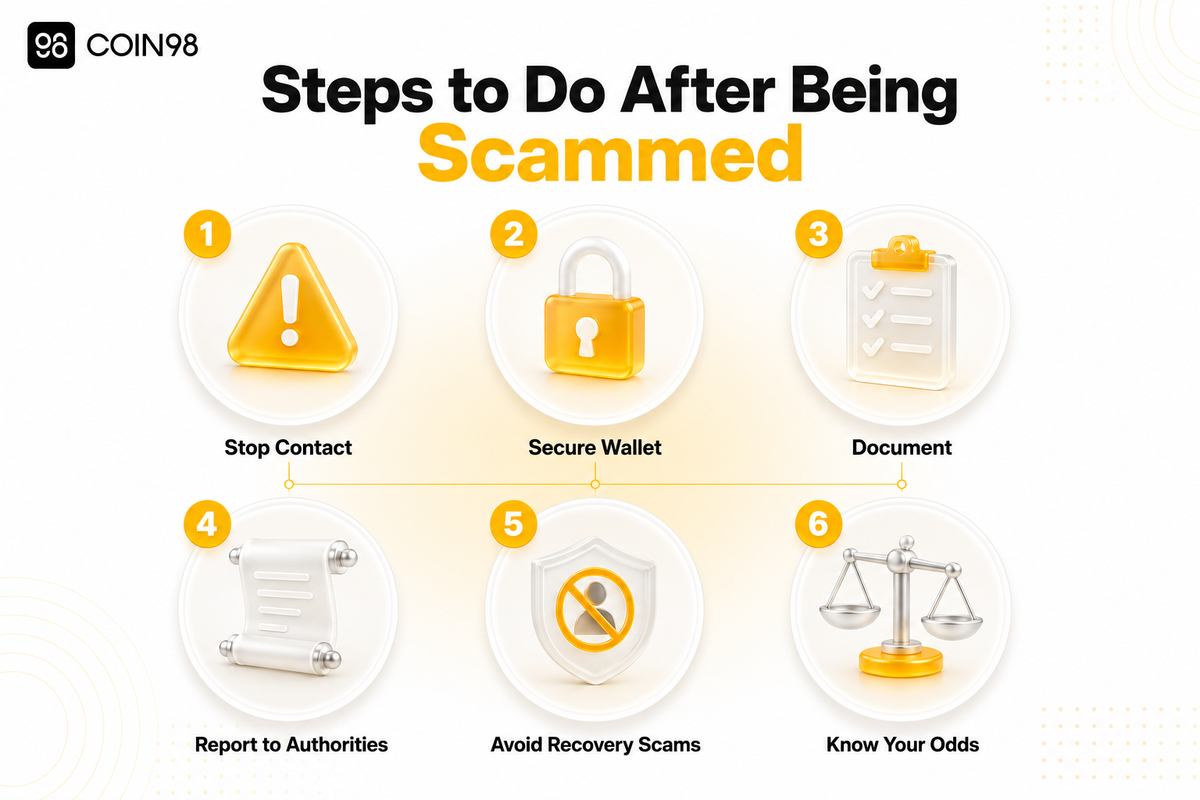
Discovering you've been scammed is disorienting — but the next 60 minutes matter more than you might expect. Crypto transactions themselves are irreversible, but the exchange accounts, wallets, and communication channels a scammer uses are not. Fast, documented action gives law enforcement the evidence they need and may limit further damage. This guide walks you through exactly what to do, in order.
Step 1 — Stop All Contact and Stop Sending Funds
Cut off the scammer entirely. Do not send any more money, even if they tell you a final payment is required to "unlock" your funds or "pay taxes" on profits. This is a standard pressure tactic used to extract additional value from victims after the initial loss.
Block every account the scammer used — messaging apps, email, and social media — but do not delete the conversation history. You will need those records.
If the scam involved a fake trading platform or investment dashboard, stop interacting with it entirely. Any "withdrawal fee" request is another extraction attempt.
Step 2 — Secure Your Remaining Assets
Move whatever is still in your wallet to a new, clean wallet with a freshly generated seed phrase — one that has never been entered anywhere. If a scammer had access to your current wallet (seed phrase compromised, malicious approval signed), that wallet is permanently at risk.
At the same time: - Change passwords on your crypto exchange accounts, email, and any financial account linked to your crypto activity - Enable authenticator-based 2FA on every account if you haven't already - Revoke token approvals if the scam involved connecting your wallet to a malicious dApp — use Etherscan's Token Approvals tool (or the equivalent for your chain) to review and revoke active permissions - Check for new login sessions on your exchange accounts and terminate any you don't recognize
Step 3 — Document Everything Before Memory Fades
Law enforcement investigations run on evidence. The quality of documentation you create in the first few hours directly affects what investigators can work with. Capture and preserve:
| What to document | Why it matters |
|---|---|
| Transaction hashes (TXIDs) | Unique blockchain identifiers — the primary evidence for forensic tracers |
| Wallet addresses (sender and recipient) | Needed to trace fund movement across the chain |
| Exact amounts and cryptocurrency types | Required for IC3 complaint and exchange reports |
| Transaction timestamps | Helps match to broader patterns investigators may already be tracking |
| All communication screenshots | Establishes contact, method, and identity claims |
| Platform names, URLs, phone numbers | Helps attribute to known scam operations |
| How you were first contacted | Helps classify the scam type for investigators |
Write down everything you remember about the contact sequence while it's fresh — the wording used, the timeline, how trust was established. Investigators often match individual reports to larger operations; your detail may be the piece that connects a case.
Step 4 — Report to the Right Authorities
Reporting will not guarantee fund recovery, but it creates the official record that law enforcement needs to pursue scammers, issue public warnings, and potentially seize assets tied to the operation.
Below are some authorities you may consider reporting the scam to. Be sure to research the appropriate agencies in your country or jurisdiction, as reporting procedures vary by location.
FBI Internet Crime Complaint Center — ic3.gov
File at ic3.gov with all transaction and communication details. The FBI's IC3 received reports of $11.4 billion in cryptocurrency fraud from Americans in 2025 alone, according to its annual report — your report contributes to pattern data that drives investigations.
Submitted information is analyzed and may be referred to federal, state, local, or international law enforcement. The IC3 does not contact filers directly after submission.
FTC — reportfraud.ftc.gov
Report separately to the FTC at reportfraud.ftc.gov. The FTC uses complaints to track scam patterns and build enforcement actions against repeat operators.
SEC — sec.gov/tcr
If the scam involved someone soliciting you to invest in a crypto project, security, or fund, file a tip with the SEC at sec.gov/tcr. Investment fraud falls within SEC jurisdiction.
Your Exchange or Platform
Contact the exchange or wallet provider where you held the crypto. Exchanges can flag recipient addresses, freeze accounts associated with fraudulent activity, and provide transaction logs that support investigations. This is especially valuable if the scammer's wallet routes through a centralized exchange — those funds can be frozen before they are cashed out.
Local Law Enforcement
File a police report even if your local department has limited crypto expertise. Banks, insurers, or credit bureaus often require one to document identity theft alongside the fraud.
Step 5 — Avoid Recovery Scams
After a crypto scam, victims become a target for a second round of fraud. The FBI issued an explicit public warning in 2025 about fictitious law firms and "crypto recovery specialists" who contact scam victims offering to retrieve stolen funds — for an upfront fee.
These recovery services are almost universally scams. Warning signs:
- They contact you unsolicited via social media, Telegram, or email
- They charge fees in cryptocurrency before beginning work
- They claim "special tools" that bypass blockchain encryption
- They guarantee a specific recovery amount or timeline
- They claim law enforcement connections they cannot verify
If you choose to consult legal counsel, find a licensed attorney independently — not through anyone who reached out to you claiming knowledge of your specific loss.
Step 6 — Understand the Realistic Odds of Recovery
Crypto transactions are irreversible. What determines whether partial recovery is possible:
Better odds: - The scammer's wallet receives funds at a centralized exchange that responds to law enforcement requests - The theft was large enough and recent enough for an active investigation - The scammer is linked to a known operation investigators already have on file
Lower odds: - Funds moved through self-custody wallets, mixers, or privacy protocols - The theft was small relative to the cost of legal action - Significant time passed before reporting
Law enforcement does seize crypto in large fraud cases. Chainalysis's 2026 Crypto Crime Report highlighted the UK recovery of 61,000 Bitcoin as a notable 2025 example. Individual victims rarely receive direct restitution quickly, but large operations are pursued over time. Filing your report means your loss is part of the official record that can support those actions.
Protect Your Next Wallet
Once you have addressed the immediate situation, focus shifts to preventing it from happening again. The Coin98 AI Wallet includes fraud detection as a built-in feature — the Cypheus AI layer flags suspicious transactions and patterns before you confirm them, across 150+ blockchains. Coin98 is non-custodial: your keys remain yours, and Coin98 never has access to your funds.
FAQ
Q: Can I get my crypto back after being scammed? Recovery is possible but uncommon for direct wallet theft. The best-case scenario is that the scammer's funds route through a centralized exchange that responds to law enforcement requests — in that case, the exchange can freeze the assets before they are withdrawn. Self-custody wallet losses that move through mixers or privacy protocols are rarely recovered. Filing promptly with IC3 and your exchange maximizes the chance that any recoverable funds are identified before they disappear.
Q: What information do I need to file an IC3 report? The IC3 asks for: the cryptocurrency addresses involved, transaction hashes (TXIDs), exact amounts and types of cryptocurrency, timestamps of transactions, how you were first contacted, the platform or method used, and any communication records — screenshots, chat logs, and emails. More detail is always better; investigators often match individual reports to larger operations.
Q: Are there legitimate crypto recovery services? A small number of legitimate blockchain forensics firms and attorneys handle crypto fraud cases, but they operate very differently from fraudulent "recovery specialists." Legitimate firms do not cold-contact victims, do not charge upfront fees in cryptocurrency, and are verifiably licensed or registered. If you are considering professional help, locate firms independently — not through anyone who contacts you claiming to know about your specific loss.
Q: Should I tell anyone else about what happened? Notify your bank if any linked bank accounts were involved, and place a fraud alert with credit bureaus (Equifax, Experian, TransUnion) if personal information was shared. If you were introduced to the scammer by someone in your network — a common pattern in pig butchering scams — let that person know discreetly; they may be a victim too.
Conclusion
Being scammed with crypto is a loss that cannot be undone on the blockchain — but the steps above give your report the best possible foundation for law enforcement action and prevent further damage to the accounts and assets you still hold. File with IC3 and your exchange as quickly as possible, document everything, and treat any unsolicited recovery offer as a scam.
When you are ready to set up your next wallet with better built-in protection, the Coin98 AI Wallet is available free at coin98.com.
Last updated: June 2026
Word count: 1,538 words