How to Protect Yourself from Crypto Scams: A Complete 2026 Guide
Crypto scammers stole $17 billion in 2025 — these 9 practical steps help you prevent yourself from most attacks in 2026.
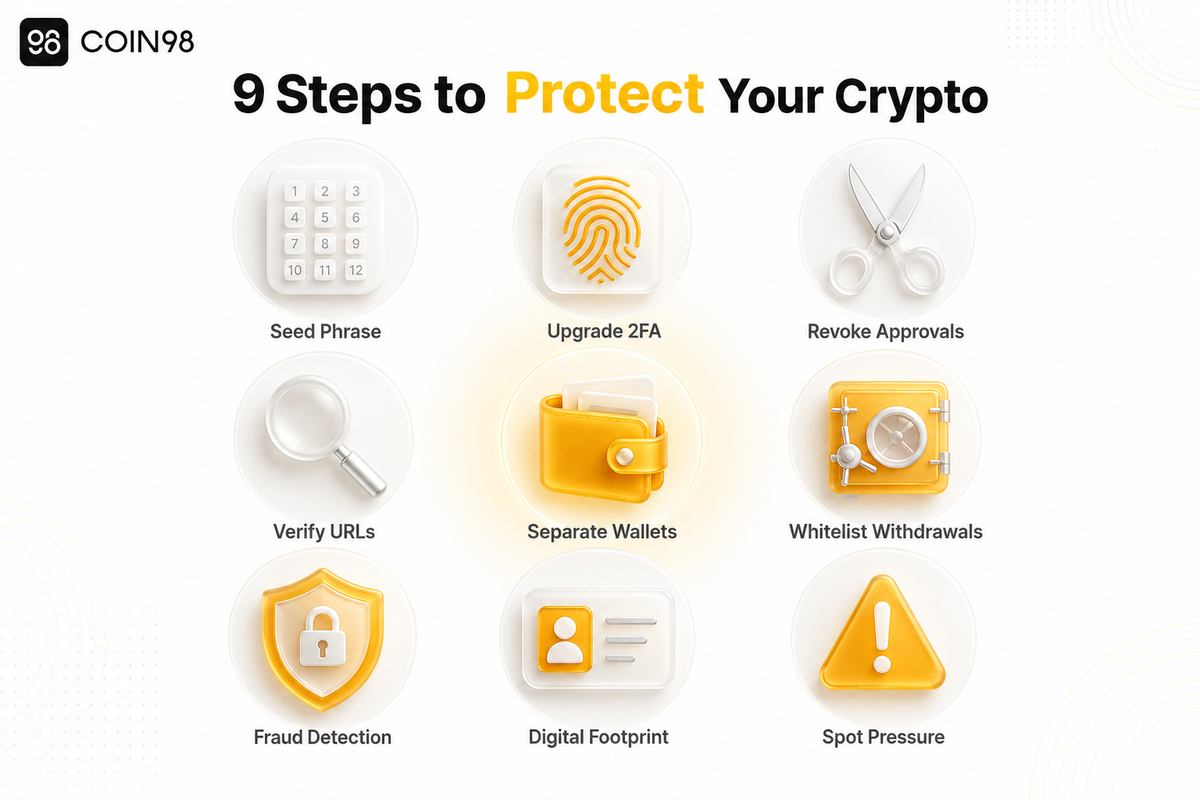
Crypto scammers stole $17 billion from users worldwide in 2025, according to Chainalysis's 2026 Crypto Crime Report — and the tactics have never been more sophisticated. If you hold crypto, you are a target. The good news: most successful scams exploit predictable gaps in behavior, not unbreakable technical exploits. This guide focuses on the nine practical steps that close those gaps — each one mapped to a specific attack vector active in 2026.
Why Crypto Scams Have Never Been More Dangerous
The 2025 threat landscape was defined by three forces: scale, AI, and irreversibility.
Chainalysis estimates at least $14 billion in confirmed on-chain scam inflows in 2025, with total projected losses reaching $17 billion. Americans alone reported $11.4 billion in cryptocurrency fraud to the FBI's Internet Crime Complaint Center. Impersonation scam clusters — where attackers pose as exchanges, support teams, or government agencies — grew 1,400% year-over-year, with the average victim losing $2,764, up from $782 in 2024.
AI has made scams dramatically more scalable. AI-enabled operations generated 4.5 times more per attack than traditional methods, according to Chainalysis. The FBI logged 22,364 AI-related fraud complaints tied to crypto in 2025, causing $893 million in reported losses.
The underlying vulnerability that makes crypto fraud so damaging: blockchain transactions are irreversible. Unlike credit card fraud, there is no dispute window, no chargeback, and no central authority that can freeze or recover funds. Prevention is the only reliable strategy.
Know the Attack Landscape First
Before diving into the steps, it helps to know what you are defending against. Most 2026 attacks fall into six types: phishing and wallet drainers, impersonation scams, SIM-swap attacks, pig butchering investment fraud, malicious token approvals, and AI-powered deepfake scams. We've covered each in detail — including how they work and real loss figures — in our Coin98 blog posts on common social engineering attacks targeting crypto users and common attacks targeting wallet users in 2026. The short version: nearly every successful attack either steals your seed phrase, tricks you into signing a malicious transaction, or builds false trust before extracting funds. The nine steps below are mapped directly to closing those three vectors.
How to Protect Yourself: 9 Practical Steps
1. Keep your seedphrase safe
Your seed phrase (also called a recovery phrase) is the master key to your entire wallet. Anyone who has it can drain all your funds — instantly, irreversibly, from anywhere in the world. Protecting it is not optional.
Back it up offline, even if your wallet is on your phone
When you create a digital wallet, you are shown a seed phrase once — write it down immediately. The app itself is just a convenience layer; the seed phrase is the actual wallet. If you lose your phone, reinstall the app, or get locked out, that written phrase is the only way to recover your funds.
- Write it on paper and store it somewhere only you can access — a home safe, a locked drawer, or a trusted location
- Make a second copy and keep it in a different place in case of fire, theft, or flooding
- Laminate the paper to protect it from water and wear
NEVER:
- Type your seed phrase into any device, app, or website
- Email or text it to yourself
- Store it in a password manager or notes app
- Take a photo or screenshot — images sync automatically to iCloud and Google Photos
- Enter it on any website, even one that looks like your wallet's official page
- Share it with anyone claiming to be support staff on Discord, Telegram, or any platform
Legitimate wallet support will never ask for your seed phrase. No exceptions.
2. Replace SMS 2FA with an Authenticator App or Hardware Key
SMS-based two-factor authentication is controlled by your mobile carrier, not you — which is exactly what SIM-swap attackers exploit. SMS 2FA losses totalled $410 million in 2025, according to data cited in Coin98's security research.
Upgrade path, in order of strength:
| Method | Strength | Notes |
|---|---|---|
| SMS code | Weak | Vulnerable to SIM swap |
| Authenticator app (TOTP) | Strong | Google Authenticator, Authy, or Raivo — app-based, not phone-number-based |
| Passkey / biometric | Very strong | Tied to your device hardware, resistant to phishing |
| Hardware security key | Strongest | Physical key required for login; cannot be remotely intercepted |
We suggest switching every exchange and email account to an authenticator app at minimum. For accounts holding significant value, a hardware security key is worth the investment.
3. Audit and Revoke Token Approvals Every Month
When you interact with DeFi protocols, you grant smart contracts permission to spend tokens on your behalf. Those permissions stay active indefinitely unless you revoke them — and a contract that was safe when you first approved it may be exploited later. 59% of H1 2025 crypto losses traced back to access-control failures of this type, according to Coin98's security research.
How to revoke approvals:
- Visit a revoke tool
- Connect your wallet or paste your address
- Review active approvals and revoke anything you no longer need
- Confirm the transaction — each revoke costs a small gas fee
For a full walkthrough, see: How to Revoke Wallet Permissions and Why You Should Do It Monthly
4. Verify Every URL and Use Anti-Phishing Browser Extensions
Phishing sites are the delivery mechanism for wallet drainers. A fake site looks identical to the real one — the only visible difference is the URL, and even that difference can be a single character or a homoglyph.
URL verification habits: - Type official URLs directly or navigate from saved bookmarks — never follow links in DMs, emails, or social posts to connect your wallet - Check for exact domain spelling before connecting: uniswap.org ≠ unlswap.org; coin98.com ≠ c0in98.com - Verify the SSL certificate (padlock icon) is issued to the correct organization, not just present
5. Enable Withdrawal Whitelisting and Delays on Exchanges
Most major centralized exchanges offer two under-used security features that significantly limit damage if your account credentials are compromised.
Withdrawal address whitelisting: Restricts withdrawals to a pre-approved list of wallet addresses. Adding a new address triggers an email verification step and a 24-hour cooling-off period — meaning even if an attacker gains access to your account, they cannot withdraw to their own address immediately.
Withdrawal delays: Some exchanges allow you to configure a 24–48 hour delay on all withdrawals above a threshold, giving you a window to detect unauthorized access and freeze the account before funds leave.
We suggest enabling both on any exchange where you hold meaningful assets. The small friction is worth the protection window they create.
6. Separate Wallets by Purpose
A single wallet used for everything means one compromised approval or phishing interaction exposes your entire portfolio. Compartmentalization limits the blast radius of any single mistake.
Suggested three-wallet structure:
| Wallet | Purpose | Connection frequency |
|---|---|---|
| Cold storage (hardware) | Long-term holdings — 80–90% of total assets | Rarely; only to move large amounts |
| Hot wallet | Active DeFi, dApp interaction, daily transactions | Regular; exposed to web3 |
| Testing / burner wallet | Connecting to new or unfamiliar protocols | Frequently; funded with only what you need for that session |
Keep your cold-storage wallet completely disconnected between uses. Move only the amount you need for a specific interaction into the hot wallet, then move it back. This pattern means the worst case from a phishing incident is losing the contents of your hot wallet — not your entire portfolio.
7. Use a Wallet with Built-In Fraud Detection
The Coin98 AI Wallet, powered by the Cypheus Assistant, includes fraud detection as a named feature — the AI layer analyzes transaction patterns and flags suspicious activity before you confirm. Coin98 supports 150+ blockchains and thousands of dApps while remaining fully non-custodial: Coin98 never holds or has access to user funds. For users managing assets across many chains, built-in transaction risk analysis is a meaningful safety layer on top of personal verification habits.
8. Audit Your Digital Footprint
Many phishing and impersonation attacks are targeted — the attacker already knows your email address, the exchanges you use, or your approximate wallet balance before they contact you. Reducing your exposed information lowers your profile as a target.
Practical steps: - Check whether your email has appeared in a data breach at haveibeenpwned.com — if it has, change the password on every service using that email immediately - Use a unique email address for each exchange — a separate alias (via SimpleLogin, Apple Hide My Email, or similar) means a breach at one exchange does not expose your login on others - Avoid publicly linking your wallet address to your real identity on social media - Consider a dedicated device for high-value crypto activity — one that is not used for general browsing, social media, or email
9. Recognize Pressure as the Universal Red Flag
Every social engineering attack — regardless of type — relies on the same psychological mechanism: pressure that overrides careful thinking. Urgency, fear, excitement, scarcity, and flattery are all variations on the same lever.
We suggest pausing for at least 60 seconds before any action that was prompted by an unsolicited message or a surprising claim. Ask: did I initiate this, or did something come to me? Legitimate platforms do not:
- Contact you unsolicited about your wallet or account security
- Request your seed phrase, private key, or 2FA code
- Promise guaranteed investment returns
- Require immediate action to avoid losing funds
- Use celebrity endorsements to promote investment opportunities
A simple internal rule — "if it came to me, verify before I act" — blocks the majority of 2026's most profitable attack types.
Red Flags: Quick Reference
| Signal | What it likely means |
|---|---|
| "Your wallet is at risk — act now" | Urgency-based impersonation |
| Request for seed phrase or private key | Always a scam, no exceptions |
| Guaranteed high returns | Ponzi, rug pull, or pig butchering |
| Unsolicited airdrop or token gift | Malicious approval or phishing link |
| Celebrity/influencer investment push | Deepfake or compromised account |
| Support contacts you first | Impersonation |
| Token approval request from unknown contract | Possible wallet drainer |
| URL with slight misspelling | Phishing domain |
FAQ
Q: Can I recover my crypto if I fall victim to a scam? Recovery of funds after a crypto scam is uncommon but not impossible. Blockchain transactions are irreversible, so direct recovery from a scammer's wallet requires law enforcement action. Report immediately to the platform where you purchased the crypto (they can flag the recipient address), file a complaint with the FBI's Internet Crime Complaint Center (IC3) at ic3.gov, and report to your local financial regulator. Law enforcement has successfully seized funds in large cases — Chainalysis noted the recovery of 61,000 Bitcoin in the UK as a notable 2025 example — but individual recovery depends heavily on the scale and traceability of the theft.
Q: Is a hardware wallet still necessary in 2026? For users holding more than they can afford to lose, a hardware wallet remains the most reliable defense against remote compromise. Software wallets on connected devices are exposed to browser extensions, malware, and phishing; a hardware wallet requires physical button confirmation for every transaction, which prevents remote signing attacks. We'd suggest treating a hardware wallet as a worthwhile investment once your holdings exceed a few months of income.
Q: What is a token approval and why is it dangerous? A token approval is permission you grant to a smart contract to spend a specific token on your behalf. DeFi protocols require these approvals to function — without one, a DEX cannot execute a swap. The danger is that unlimited approvals remain active indefinitely. If the contract is later exploited or was malicious from the start, it can drain your approved token balance without any further action from you. Reviewing and revoking old approvals regularly is a straightforward way to close this exposure.
Q: How do I tell if a crypto support account is real? Legitimate support for any wallet or exchange will never contact you first via Telegram, Discord, or X DM. All real support interactions are initiated by the user through verified channels — official websites and in-app help features. If someone contacts you claiming to be support and asks for any information about your wallet or account, we'd recommend treating it as an impersonation attempt and blocking the account without engaging.
Conclusion
Crypto scammers stole $17 billion in 2025 — not because wallets are technically weak, but because users are targeted through trust, urgency, and information gaps. The nine steps above — offline seed phrase storage, upgrading 2FA, monthly approval audits, URL verification with anti-phishing extensions, withdrawal whitelisting, wallet separation, a fraud-detecting wallet, digital footprint reduction, and pressure recognition — close the specific gaps that fund the vast majority of 2026's attacks. Start with the one you haven't done yet.
For a wallet that makes these protections easier to maintain, the Coin98 AI Wallet combines fraud detection, multi-chain coverage, and self-custody in a single app — available free at coin98.com.
Last updated: June 2026
Word count: 1,710 words