Legacy, SegWit, or Taproot: which Bitcoin address type to use
Bitcoin addresses start with 1, 3, bc1q or bc1p. All of them send to each other, but the one you spend from can cut fees by more than a third.
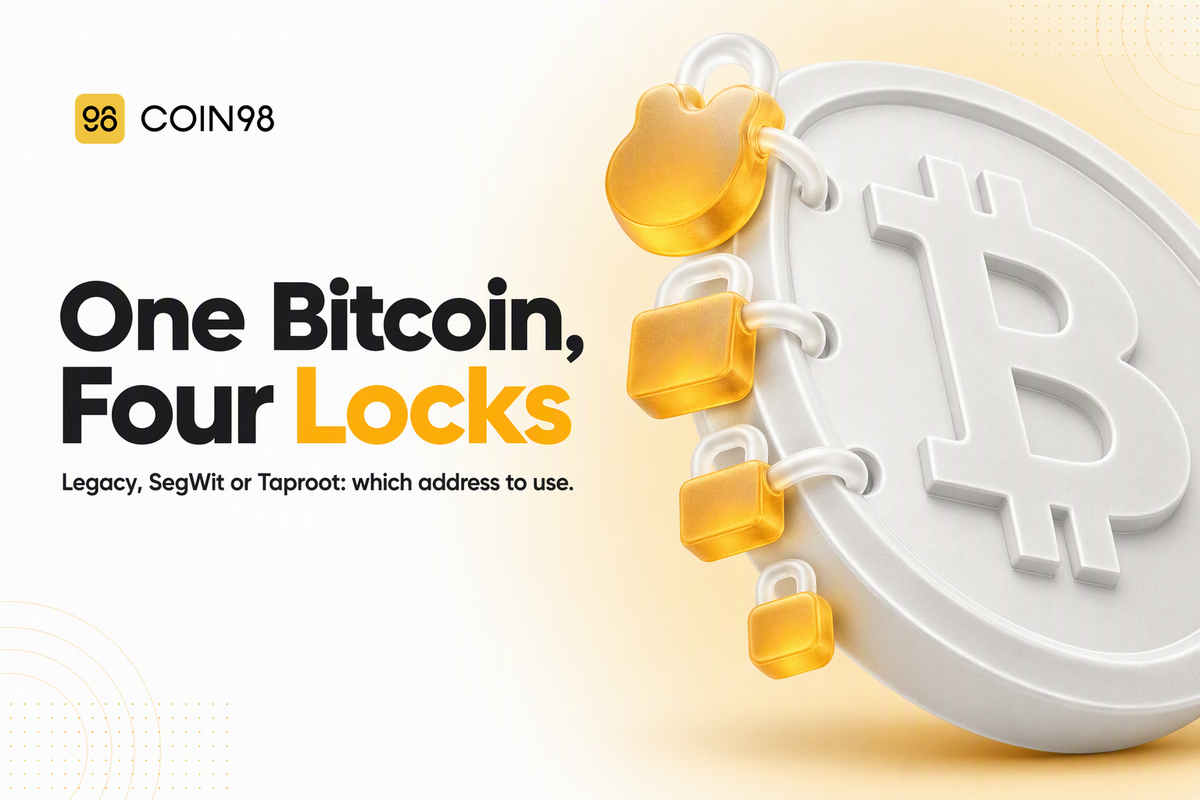
Your Bitcoin address starts with a 1. Your friend's starts with bc1q. An exchange gave you one starting with 3, and a Taproot address starts with bc1p. They're all Bitcoin, on the same network, and any of them can send to any other. Bitcoin address types are just different versions of the lock on your coins, added over 12 years of upgrades, and the one you spend from can cut your fees by more than a third. Here's what each prefix means, which one to use, and what's going on when your address or balance seems to change.
Last updated: October 2026
What the start of a Bitcoin address tells you
The first few characters of a Bitcoin address tell you its type, meaning the set of rules that decides how the coins sent to it can later be spent. Each new type was added by a network upgrade, and the older ones never stopped working.
| Prefix | Common name | Introduced | Encoding |
|---|---|---|---|
| 1… | Legacy (P2PKH) | 2009 | Base58 |
| 3… | Nested or wrapped SegWit (P2SH) | 2012 (SegWit wrapping from 2017) | Base58 |
| bc1q… | Native SegWit (P2WPKH) | 2017 | Bech32 |
| bc1p… | Taproot (P2TR) | November 2021 | Bech32m |
A good way to picture it: the coins are the same, and only the lock differs. Newer locks put less data on the blockchain when you spend, and that's why they cost less.
Legacy (1…)
The original Bitcoin format. It still works everywhere and is the format our documentation describes as commonly supported by exchanges. Spending from it costs the most, because the signature data counts fully toward the transaction's size.
Nested SegWit (3…)
Addresses starting with 3 use a script format from 2012. When SegWit arrived in 2017, it was wrapped inside this format so that services still on old software could pay it. It sits between Legacy and Native SegWit on fees. You'll mostly see it on exchanges and older wallets, and it's also used for some multisig setups.
Native SegWit (bc1q…)
Native SegWit moved signature data into a separate, discounted part of the transaction. It uses the Bech32 format: all lowercase, without the easily confused characters "1", "b", "i" and "o" after the prefix, and with a checksum that's guaranteed to catch any error affecting up to 4 characters. Bech32 addresses are sometimes just called "bc1 addresses".
Taproot (bc1p…)
Taproot, activated in November 2021, uses a newer signature scheme (Schnorr) and a slightly updated encoding called Bech32m. Its main benefits are cheaper spending when a transaction has many inputs, and better privacy for complex setups: a multisig or time-locked spend can look the same on-chain as an ordinary single-signature payment. It's also the format most Ordinals inscriptions live on: roughly 73% of inscription-related UTXOs are Taproot outputs.
Which Bitcoin address type should you use?
For most people, Native SegWit (bc1q) is the right default. It's cheaper than Legacy and Nested SegWit, and almost every modern wallet and exchange can send to it. Taproot is worth choosing for specific reasons, but it isn't a must-have upgrade for ordinary payments.
Coin98 Super Wallet offers both Legacy and Bech32 Bitcoin addresses, and we encourage using the Bech32 wallet for cheaper transaction costs and faster transaction speed than Legacy.
Native SegWit is the right default
Fees are where address types make the clearest difference. For a standard payment with one input and two outputs, the size of the transaction, which is what you pay for, changes like this:
| Address type | Typical payment size | Saving vs Legacy |
|---|---|---|
| Legacy (1…) | 226 vB | baseline |
| Nested SegWit (3…) | 167 vB | ~26% |
| Native SegWit (bc1q…) | 141 vB | ~38% |
| Taproot (bc1p…) | 154 vB | ~32% |
At the same fee rate, the same payment from a bc1q address costs about 38% less than from a Legacy address. Our guide to how Bitcoin transaction fees are calculated walks through the fee-rate side of the formula.
When Taproot is worth it
Taproot is cheaper per input, not per typical payment. Each Taproot input takes about 57.5 vB against 68 vB for Native SegWit, but Taproot outputs are larger. That's why a simple one-input payment comes out slightly bigger. Taproot pulls ahead when you spend many inputs at once (for example, consolidating lots of small deposits), when you use multisig, or when you hold Ordinals.
Its use has swung with inscription activity. Taproot's share of Bitcoin transactions went from about 1–2% in late 2022 to a peak of roughly 76% in May 2023, then settled to around 21.68% in 2025 and 15–20% in 2026. In April 2025, Taproot outputs made up about 34% of all unspent outputs by count but held only about 0.75% of the BTC by value. That's a sign that most of those outputs are small, inscription-related ones, not long-term savings.
If you hold Ordinals or BRC-20 tokens, check which address your wallet uses for them before moving anything. Our Bitcoin wallet guide covers how they appear in Coin98 Super Wallet.
What to do with an old Legacy address
Coins on a 1… address are as safe as coins on any other type. You simply pay more when you spend them. If you hold a meaningful balance there, moving it to a bc1q address in your wallet is an ordinary transaction to yourself: you pay one network fee, and you'll pay less on every spend after that. We suggest doing it when fee rates are low, not when the network is congested.
Sending between address types
Any Bitcoin address type can send to any other. A Legacy address can pay a Taproot address, and a bc1q address can pay a 1… address. The network treats them all as Bitcoin, and the recipient doesn't need to do anything.
Every type can pay every other type
The type that matters for your fee is the one you're spending from, since inputs make up most of a transaction's size. Sending to a Legacy address doesn't make your payment noticeably more expensive. What you can't do is send Bitcoin to an address on another blockchain. Our receive guide recommends checking that the network matches on both ends before you share an address.
When an exchange says your address is invalid
If an exchange or older wallet rejects a bc1p address, its software doesn't recognise Taproot's Bech32m format yet. Bech32m was designed so that older software would reject these addresses instead of accepting them wrongly. The withdrawal fails at the address check, so no Bitcoin leaves your account. Your options:
- Use a bc1q (Native SegWit) receiving address instead, which is supported almost everywhere.
- Check whether the platform lists Taproot withdrawals as supported, and try again later.
- Withdraw to a bc1q address first, then move the coins to Taproot yourself if you need to.
Check the address before you send
Bech32's checksum makes typos in bc1 addresses very likely to be caught, but it can't tell you whether the address belongs to the right person. Malware can replace a copied address with an attacker's, which we cover in our guide to clipboard hijacking. When you enter a recipient in Coin98 Super Wallet, the app checks the address and generates an anomaly report before you confirm, and BTC is one of the supported chains. We still recommend comparing the first and last several characters against the source every time.
Why your address or balance seems to change
There are two common reasons a Bitcoin address or balance seems to change. Some wallets show a new receiving address after every payment, and a seed phrase restored in a different wallet can produce a different set of addresses. Neither one means your coins are gone.
Why some wallets show a new address after each payment
Many Bitcoin wallets give you a fresh address after each payment you receive, and they send leftover "change" from a payment to a new address you also own. That's a privacy habit. It comes from how Bitcoin tracks coins as separate pieces, which our UTXO explainer covers. Old addresses still belong to you and can still receive.
Coin98 Super Wallet works differently for Bech32: since version 10.2, its Bech32 address stays unchanged after each transaction, so the address you shared last month is still the one shown today.
Why a restored seed can show a zero balance
A seed phrase doesn't hold one Bitcoin address. It's the starting point for several families of addresses, one per type, each reached by a different route called a derivation path. The same 12 or 24 words produce a Legacy family (1…), a Nested SegWit family (3…), a Native SegWit family (bc1q…) and a Taproot family (bc1p…), with no overlap between them. It's the same idea that lets one seed cover many chains, one level further down.
So if you restore a seed in a wallet that opens a different family from the one your coins are in, it shows zero and gives no warning. Our FAQ on a restored wallet showing a zero balance lists this as one cause: the seed phrase was restored under the wrong standard. Here's how to work through it:
- Find an old receiving address. Its prefix tells you which family your coins are in.
- Choose the matching option when you import. Coin98 Super Wallet offers a New Standard (the default) and an Old Standard for Bitcoin, the latter under advanced options.
- Scan other addresses from the same seed. The app shows the address at index 0 by default. Asset Scan checks every address derived from the seed on Bitcoin, shows the combined balance, and lets you consolidate it into one address.
We also suggest writing down which wallet and address type you used next to your seed phrase backup. Those few words can save hours later.
Frequently asked questions
Which Bitcoin address type is best for beginners? Native SegWit, starting with bc1q. It's cheaper to spend from than Legacy or Nested SegWit, and almost every wallet and exchange can send to it. Taproot is a good choice for specific uses like Ordinals or multisig, but it isn't necessary for everyday payments.
Can I send Bitcoin from a bc1 address to an address starting with 1 or 3? Yes. Every Bitcoin address type can send to every other, and the recipient receives ordinary Bitcoin. The only real limit is software: some older platforms can't send to bc1p Taproot addresses yet and reject them as invalid.
Will I lose Bitcoin if an exchange rejects my Taproot address? No. The rejection happens when the address is checked, before anything is sent, so your balance stays where it was. Use a bc1q address for that withdrawal instead.
Is Taproot cheaper than Native SegWit? It depends on the transaction. Each Taproot input is smaller, so transactions that spend many inputs are cheaper. A simple one-input payment is slightly larger with Taproot because its outputs are bigger.
Does my address type affect security? Every type in use today is secure for holding Bitcoin. The practical risks are elsewhere: a leaked seed phrase, a replaced address, or sending to the wrong network. Taproot adds a privacy benefit for complex setups, not extra protection for a simple wallet.
What happens if I make a typo in a bc1 address? The Bech32 checksum is designed to catch any error affecting up to 4 characters, so a wallet will almost always reject a mistyped bc1 address instead of sending to it. It can't catch an address that's valid but belongs to someone else, so compare characters against the source before confirming.
The short version
Bitcoin address types differ in their lock, not their coin. They all send to each other, and newer ones cost less to spend from. Native SegWit (bc1q) is the sensible default, Taproot (bc1p) pays off for multi-input spends and Ordinals, and an old Legacy address just costs more. Coin98 Super Wallet gives you a Bech32 Bitcoin address that stays the same after each transaction, plus Asset Scan if a restored balance ever looks wrong.