What to Do When a DeFi Protocol Shuts Down
Over 40 DeFi protocols wound down in early 2026. What to withdraw first, and the approval cleanup almost everyone skips.
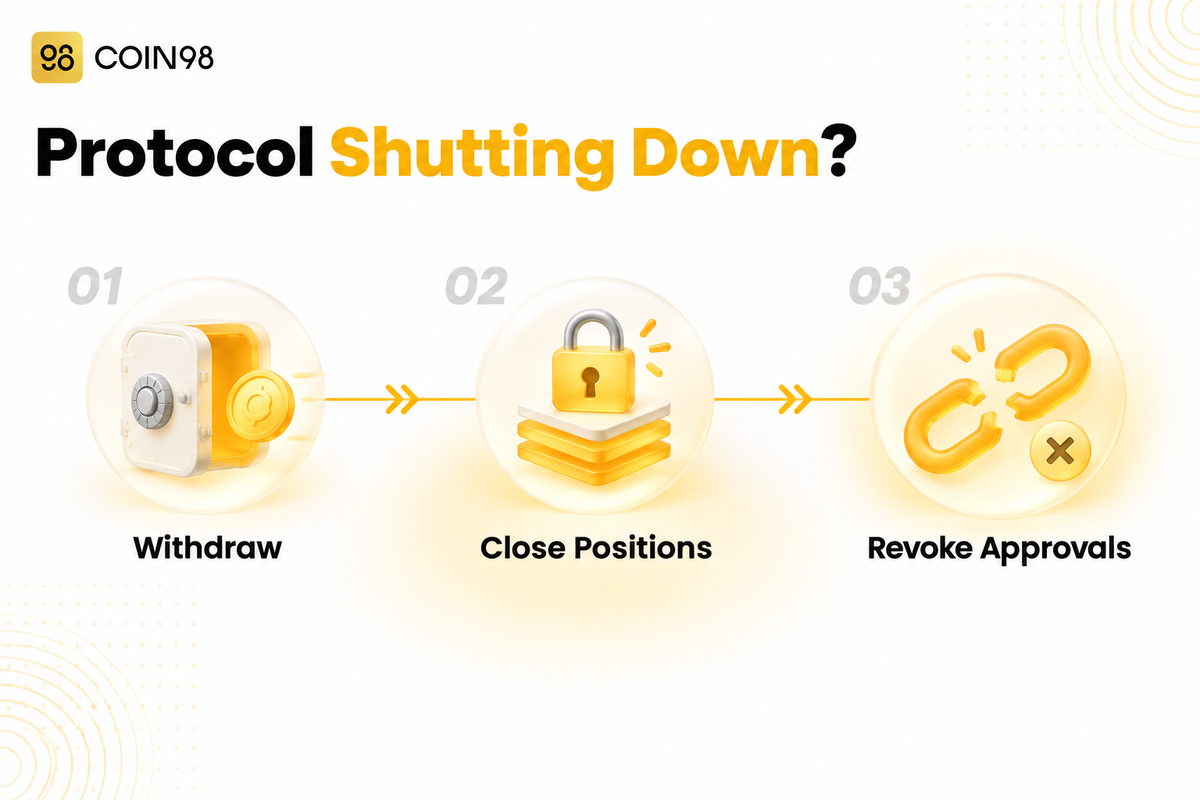
When a DeFi protocol shuts down, your funds stay on-chain and stay reachable — as long as you withdraw before the protocol's own restrictions take effect, and clean up afterwards. What closes the window is technical, not legal: read-only mode and paused contract functions, not a change in who owns the assets. This is no longer rare — more than 40 protocols "ceased operations or moved to wind-down mode" between January and early May 2026 alone, according to Crypto Times, in a year that also saw over $770 million stolen in DeFi hacks through April. The withdrawal is the obvious part. The part most people skip — revoking the approvals they granted to a protocol that no longer has anyone maintaining it — is the part that comes back to bite.
First, understand what is actually shutting down
In almost every wind-down, the company shuts down and the smart contracts keep running. Those are two different things, and confusing them is what causes panic.
A DeFi protocol is usually three layers: a front end (the website you click), the smart contracts (the code holding the money), and a company or team paying for the first one. When the money runs out or the strategy changes, the front end goes dark. The contracts, being code on a public blockchain, generally do not.
The Odos wind-down is a clean example of how a well-run one is communicated. The DEX aggregator announced on 23 July 2026 that its app would move to read-only on 27 July and shut down permanently on 30 July, and stated plainly that "Odos is non-custodial: your assets remain yours and on-chain." Its ODOS token continues to exist on-chain, and its DAO is a separate entity from the operating company that is winding down.
That "non-custodial" distinction is the one worth internalizing. If you hold the keys, a shutdown is a deadline; if someone else holds them, a shutdown is a risk. Our explainer on custodial vs non-custodial wallets covers where a given product sits, and what a smart contract is explains why the code outlives the website.
The stages of a typical wind-down
Most announcements follow the same sequence, and knowing it tells you how much time you have.
| Stage | What changes | What you can still do |
|---|---|---|
| Announcement | New signups and new positions disabled | Everything else — withdraw, close, swap |
| Restricted | New orders or new borrows blocked; LTV often set to 0% | Close positions, withdraw |
| Read-only | No new transactions through the app | View balances and history only |
| Shutdown | Front end offline | Direct contract interaction only, if the withdrawal functions are still available |
ZeroLend's February 2026 wind-down shows the middle stages in practice: the lending protocol set most markets to 0% loan-to-value so no new borrowing could happen, and told users to withdraw quickly. The team cited "thin margins and high risk profile of lending protocols," alongside price-data providers pulling support and liquidity drying up on smaller chains.
The gap between the announcement and read-only mode is your actual window, and it can be short. Odos gave four days.
The withdrawal checklist
These work best in order, because some steps block others.
- Find everything you're exposed to. Before touching anything, list every position: deposits, LP tokens, staked assets, borrows, pending limit orders, and vesting claims. A wallet-level scan is faster than memory here — Coin98 Wallet Health runs eight checks across your wallets and surfaces dApp connections and token approvals you may have forgotten, scoring the result from 0 to 100.
- Check who still controls the contracts. On the block explorer, look at the contract's owner or admin address, and check the project's governance posts for whether admin rights were renounced or sit with a multisig. An active admin can pause functions or upgrade the contract while you are still unwinding — which is an argument for moving early rather than waiting out the notice period.
- Repay borrows first. Collateral is usually locked until the debt is cleared. If the protocol has already dropped LTV to zero, you cannot borrow more to help — repay from elsewhere. Our DeFi lending guide covers how collateral and LTV interact.
- Unstake and unwind LPs. These often carry cooldown periods measured in days. Starting them the moment you read the announcement beats starting them the night before the deadline.
- Claim anything claimable. Unclaimed rewards, airdrops and fee shares typically die with the front end.
- Withdraw the base assets. Only now do the simple withdrawals.
- Check every chain, not just the busy one. Multi-chain protocols leave dust — and sometimes more than dust — on networks you have not opened in a year.
- Confirm you hold native gas tokens on each chain, then check the math. A withdrawal you cannot pay for does not happen — and on an expensive chain, recovering a small position can cost more than it is worth. When sweeping dust across several networks, consolidating through a bridge or a wallet that batches transactions beats a separate round trip per chain.
- Revoke approvals. Covered in its own section below, because it is the one people skip.
What if the front end is already gone?
The contracts may still be live, and you can usually call them directly through a block explorer. If the withdrawal function exists and has not been disabled, connecting your wallet to the explorer's contract interface and calling it works the same way the website did — the website was only ever a friendlier button.
That "if" carries weight, because several things can close the door while the contracts are still technically alive. Functions can be paused. Withdrawals can be disabled outright. Upgradeable contracts — the proxy pattern most protocols use — can be pointed at a new implementation, so an address you interacted with last year may not behave the way it did. Anything behind a timelock or an admin key remains a decision someone else gets to make. Some assets end up stranded regardless: ZeroLend's positions on low-liquidity chains needed scheduled contract updates before users could get them out, which means the timing was in the team's hands, not the user's.
Two safety rules if you go this route. Take the contract address from an official archival source — the shutdown announcement, a verified GitHub release, or a governance post — not a search result or a shared screenshot, since fake addresses and cloned interfaces work better once the real site is gone. And make the first interaction a small test, ideally from a hardware wallet or one holding little else.
The general lesson is that acting during the announced window is dramatically easier than acting after it. Ionic's shutdown following an $8.6 million exploit is the cautionary version — the team directed users to withdraw through the official interface before finalization, with no compensation program for anyone who did not.
The step almost everyone skips: revoke your approvals
An approval you granted to a dead protocol stays live forever unless you revoke it. Coin98's own documentation states the mechanic plainly: "dApp and token approvals do not expire automatically."
This matters more after a shutdown than before one. A live protocol has a team watching for problems; an abandoned one has unmaintained contracts and, potentially, an admin key nobody is guarding. Your approval — often an unlimited one — is still pointing at that address. If you are unclear on what you granted, our explainer on token approvals covers what an allowance actually permits.
In the Coin98 Super Wallet, the Wallet Approval tool handles it in four steps:
- Open Menu → Services → Wallet Approval (or Discover → Services → Wallet Approval).
- Select the network and the wallet you used for DeFi.
- Tap the [x] next to the contract you want to cut off.
- Confirm, and wait for the transaction to process.
Three practical notes. Revoking costs gas on each chain, so keeping a little native token available for it helps. Timing matters too: revoke after you have finished unwinding, not before, since some positions depend on a standing allowance to a staking or vault contract and cutting it early can leave you unable to complete the exit. And because approvals accumulate quietly, doing this as a monthly habit rather than a post-shutdown scramble is the better version — our guide on revoking wallet permissions monthly makes the case. While you are there, it is worth also disconnecting the dApp from your wallet's active connections.
Special case: the wallet was created inside the app
If you signed up with an email or social login and the protocol generated a wallet for you, that wallet is the thing at risk — not just the position. The safest response is to move the assets to a wallet you already control, or to export the private key or seed phrase while the app still works.
Between the two, moving the assets out is the cleaner option — to a hardware wallet if you have one, otherwise to a software wallet you already back up. An exported key from a discontinued product is a liability you now have to store safely — parked in a notes app or a cloud drive, one dead product becomes a permanent exposure. A transfer to a wallet you already back up is simply done. If you are importing rather than transferring, Coin98's docs cover viewing and exporting your seed phrase or private key.
How to see a shutdown coming
Wind-downs are rarely sudden from the inside, and the public signals are usually visible months ahead.
- Collapsing volume or TVL. Odos's monthly volume fell to roughly $169 million in July 2026 from a peak near $7.8 billion in December 2024, per crypto.news.
- Infrastructure partners leaving. ZeroLend named price-data providers withdrawing support as a factor — when oracles stop covering a protocol, its risk management degrades.
- A hack with no recapitalization. Step Finance closed in February 2026 after a $27 million exploit and failed rescue funding, per Crypto Times. An exploit plus silence about reimbursement is a strong signal.
- Parameter changes that quietly reduce functionality. Markets moved to 0% LTV, deposits capped, rewards ended.
- A quiet team. Governance forums going dormant and support channels slowing down usually precede the announcement.
None of these individually means "leave now." Two or three together are worth acting on, especially given how thin the margins in this sector have become — DeFi recorded 47 exploit incidents in the first four and a half months of 2026 against 28 in the same stretch of 2025, a 68% increase in attack frequency, per Crypto Times.
FAQ
If a protocol shuts down, do I lose my money? Usually not, provided the protocol is non-custodial and the withdrawal functions are still available when you go to use them. Non-custodial means the assets sit in contracts you can access with your own keys, not on a company balance sheet. The real losses come from missing the window, having assets stranded on a chain the team has to manually address, or losing an app-generated wallet.
Can I still withdraw after the website goes offline? Often yes, by calling the smart contract directly through a block explorer, provided the withdrawal function is still active and unpaused. It is more technical than using the app, and you need the contract address from an official source. Withdrawing during the announced window is far simpler.
Do I really need to revoke approvals if I already withdrew? Yes, and it is the most commonly skipped step. Approvals do not expire on their own, so an allowance granted to an abandoned contract stays open indefinitely. Since a shut-down protocol no longer has a team monitoring it, that standing permission is a risk with no upside.
What happens to the protocol's token? Tokens typically continue to exist on-chain independently of the company. Odos stated its token continues on-chain and its DAO operates separately from the operating entity. Liquidity and price support, however, tend to thin out quickly after a wind-down.
Will I be compensated if I lose funds? Rarely. A protocol shutting down after an exploit usually lacks the resources to reimburse anyone — Ionic wound down after an $8.6 million exploit without announcing a compensation plan. Treating a shutdown notice as your only recovery mechanism is the realistic posture.
How much time do these deadlines usually give? It varies, and it can be short. Odos announced on 23 July 2026, went read-only four days later, and closed on 30 July — one week end to end. Reading the announcement for the read-only date, not just the final date, tells you when you actually stop being able to act.
The takeaway
A DeFi protocol shutting down is a deadline, not a loss — as long as you treat it as one. Map every position across every chain, unwind in the right order (repay, unstake, claim, withdraw), keep gas available where you need it, and then do the step nobody enjoys: revoke the approvals pointing at contracts nobody is maintaining anymore. If you would rather not reconstruct that list from memory, Coin98 Wallet Health scans your wallets for lingering approvals and dApp connections and scores what it finds.
Last updated: July 2026