Pig butchering scams: how the long con is built, step by step
It starts with a wrong-number text and ends with a fee to withdraw. How pig butchering scams work, step by step, and the red flags at each stage.
It starts with a text meant for someone else. "Hi, is this Linda? Are we still on for dinner?" You reply to say it's the wrong number, and a friendly chat begins. Weeks later, your new friend is showing you how they make money trading crypto. That's how a pig butchering scam usually begins, and it's one of the costliest frauds in crypto: Americans reported losing $7.2 billion to crypto investment fraud in 2025. This guide walks through each step of the scam, the red flags at each one, and what to do if you're already in one.
Last updated: October 2026
What is a pig butchering scam?
A pig butchering scam is a long-running fraud in which a scammer builds a friendship or romance with you over weeks, then persuades you to "invest" in crypto on a fake platform. The platform shows growing profits, but the money is gone the moment you send it. When you try to withdraw, you're asked to pay fees or taxes first, and then the scammer disappears.
It's one of the most common forms of crypto investment fraud, the costliest type of internet crime reported in the US in 2025, at $7.2 billion. Total reported crypto-related losses that year reached $11.4 billion. Our overview of social engineering in crypto covers the related tricks.
Why it's called pig butchering
The name comes from the scammers themselves. The victim is the "pig." The weeks of friendly chat and fake profits are the "fattening." The final demand for money, and the disappearance that follows, is the "butchering." It sounds brutal because the scam is.
Who runs these scams
Most pig butchering scams aren't run by lone individuals. They come from organised operations, often in large compounds in Southeast Asia, where many of the people typing the messages were trafficked and forced to work from scripts. In October 2025, US authorities moved to seize about 127,271 bitcoin, worth roughly $15 billion at the time, from one such network, Prince Group. It was the largest forfeiture action in the Justice Department's history.
That's worth knowing for one reason: the person you're talking to follows a script built to work on careful, intelligent people. Falling for it isn't a sign of being foolish.
How a pig butchering scam works, step by step
A pig butchering scam works in six steps: contact, friendship, the pitch, the fake platform, fake profits, and the fee to withdraw. Each step looks normal on its own. The table shows what happens and where you can still walk away.
| Step | What happens | Your exit point |
|---|---|---|
| 1. Contact | A "wrong number" text, dating-app match, or social media message | Don't continue a chat with a stranger who reached the wrong number |
| 2. Friendship | Daily messages, shared interests, lifestyle photos, no video calls | Notice if they won't video call or meet |
| 3. The pitch | They mention crypto trading profits, often from a relative or mentor | Any investment tip from an online-only friend is a stop sign |
| 4. The platform | They guide you to an app or site you've never heard of | Check the platform independently before sending anything |
| 5. The profits | Your balance grows fast, and a small withdrawal works | Try to withdraw most of it, not a small test amount |
| 6. The fee | You're told to pay a tax, fee or "penalty" to withdraw | Stop paying. The money is already gone |
Steps 1–2: the wrong number and the friendship
The first message is usually harmless: a wrong-number text about a meeting, a match on a dating app, or a message on a messaging app or professional network. If you reply politely, they keep chatting.
For weeks, the conversation is just friendly. They share photos of travel, food, and nice cars. They seem to share your interests and values. They message every day. What they avoid is a live video call or meeting in person, and there's always a reason why.
Steps 3–4: the pitch and the platform
Once trust is built, crypto comes up. They don't ask you for money. They mention how well they're doing, often thanks to an uncle or mentor with an "insider" strategy, and offer to show you.
They'll usually ask you to buy crypto on a real exchange first, which feels reassuring. Then they ask you to send it to a trading platform or app they recommend. That platform is fake. It may copy the look of a real exchange, use a website address one letter off from a real one, or come as an app installed from a link. Our guides to fake dApps and fake wallet apps show how these copies are built.
Steps 5–6: the profits and the fee
The fake platform shows your balance rising quickly. Early on, you may be allowed to withdraw a small amount, which proves to you that it's real. Then you're encouraged to invest more, sometimes by selling other investments or borrowing.
When you try to take out a larger amount, the problems start. Your account is "frozen," or you're told to pay a tax, an early-withdrawal fee, or a penalty first. If you pay, a new fee appears. When you stop paying, the platform, and your friend, disappear.
Pig butchering red flags
The clearest red flag of a pig butchering scam is being asked to pay before you can withdraw your own money. By then, though, the money is gone, so it's worth knowing the earlier signs.
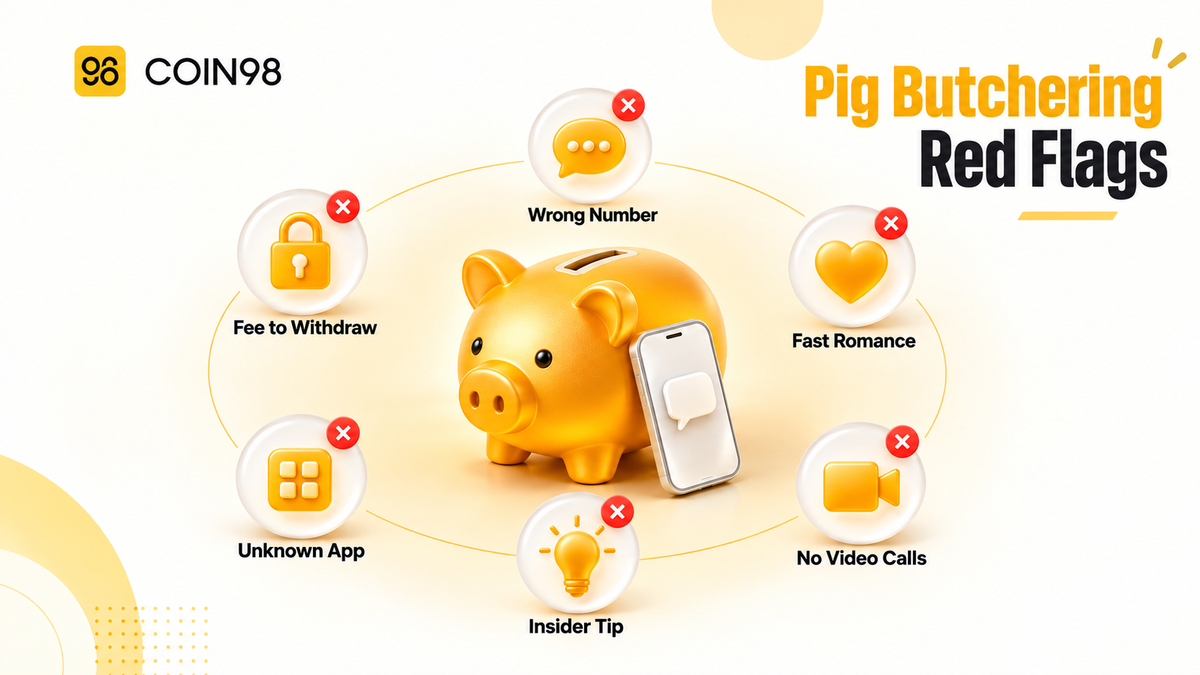
Red flags at each stage
- A stranger who reached you by mistake and keeps the conversation going.
- Someone who seems almost too compatible, with lots in common and fast emotional closeness.
- No video calls or meetings, always with an excuse.
- Investment talk from an online-only friend, especially "guaranteed" or unusually high returns.
- A platform you can't find independently, with no physical address or a web address that's slightly misspelled.
- Pressure to move fast or invest more, including selling other assets or borrowing.
- Fees, taxes or "penalties" to withdraw. Legitimate platforms typically take fees from your balance, rather than asking you to send new money first.
How to check a trading platform is real
Before you send crypto anywhere, search for the platform yourself, rather than following a link someone sent you. Check how long its website has existed, whether it appears on well-known lists of exchanges, and whether people report being unable to withdraw.
A self-custody wallet gives you a simple test. In Coin98 Super Wallet, your funds stay under your own keys. Coin98 doesn't hold your keys, and there's no "release fee" to move your own funds. When anyone asks you to send crypto out of your wallet to an address they control so it can "earn," treat that as the moment to stop and verify.
What to do if it's happening to you
If you think you're in a pig butchering scam, stop sending money, including any fee or tax to release your funds. Then save the evidence and report it. Paying more doesn't unlock anything. It only adds to the loss.
Stop, document, report
- Stop all payments and stop replying. Don't tell the scammer you know. They may try a new story.
- Save the evidence. Keep the chat history, the platform's web address, wallet addresses, transaction hashes, amounts and dates.
- Report it. In the US, report to the FBI's Internet Crime Complaint Center (IC3) and the FTC. Tell the exchange you bought crypto on, since it may be able to help freeze funds. Our guide to what to do if you've been scammed lists where to report in more detail.
- Secure your wallet. If you connected your wallet to the fake platform, disconnect it with Super Wallet's Manage Connection feature. If you shared a seed phrase or signed anything you didn't understand, follow the steps for a compromised wallet and move what's left to a new one.
Watch for the second scam
Victims are often contacted again by fake "recovery" services, lawyers or even people posing as officials, offering to get the money back for an upfront fee. We strongly recommend against paying anyone who contacts you first with a recovery offer. Law enforcement doesn't charge victims a fee to investigate.
Helping someone who won't believe it
Many victims don't realise they're being scammed. Since early 2024, the FBI has contacted more than 8,000 people who were in the middle of these scams, and in 2025, 78% of those it reached didn't know. If it's someone you love, avoid arguing about the relationship. Ask them to try withdrawing their full balance. A fee demand is often the proof they need.
FAQ
What is a pig butchering scam?
A pig butchering scam is a fraud in which a scammer builds trust over weeks through friendship or romance, then convinces the victim to invest crypto on a fake platform. The platform shows fake profits until the victim tries to withdraw, at which point fees are demanded and the scammer disappears.
How do pig butchering scams start?
Most start with an unexpected message: a "wrong number" text, a dating-app match, or a message on social media or a messaging app. The first weeks are just friendly conversation, with no mention of money.
Why did my first withdrawal work?
Letting you withdraw a small amount is part of the scam. It makes the platform look legitimate and encourages you to deposit more. Larger withdrawals are blocked or come with fee demands.
Should I pay the tax or fee to withdraw my funds?
No. A demand to pay a tax, fee or penalty before you can withdraw is the clearest sign of a pig butchering scam. Paying doesn't release the funds; it usually leads to another demand.
Can I get my money back from a pig butchering scam?
Recovery is difficult, but report it quickly to the FBI's IC3, the FTC and the exchange you used, because authorities sometimes trace and seize funds. Be wary of anyone who contacts you offering recovery for a fee.
How is pig butchering different from a romance scam?
It often starts like one, but the goal is different. A classic romance scam usually asks for money directly, such as for an emergency. A pig butchering scam never asks for a gift. It gets you to "invest" on a platform the scammer controls.
Conclusion
A pig butchering scam works because each step looks normal: a friendly stranger, a trading tip, a platform that seems to pay out. The tell comes at the end, when you're asked to pay to get your own money back. Keep crypto in a wallet you control, like Coin98 Super Wallet, and treat any request to send it to a stranger's platform as a reason to stop and check.