Custodial vs Non-Custodial Wallets: What's the Difference?
Who controls your private keys determines everything in crypto. Custodial wallets hand that control to a third party — non-custodial wallets keep it with you. This guide breaks down the real differences, trade-offs, and which approach fits your situation.
The single question that determines how safe your crypto is: who controls your private keys?
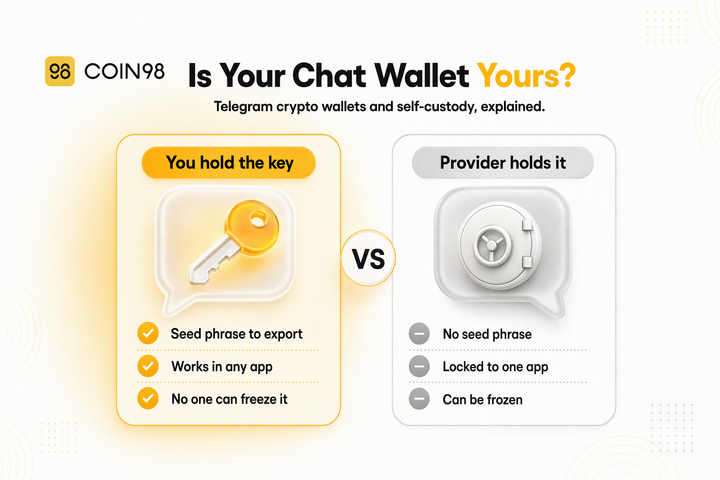
If a third party controls them, you have a custodial wallet. If you control them, you have a non-custodial wallet. That distinction determines who can freeze your funds, what happens if the platform is hacked, and whether your assets are truly yours.
Approximately 28% of US adults — around 65 million people — now hold digital assets, according to BitGo's 2024 research. Most started with a custodial wallet on an exchange without fully understanding the difference. This guide explains both wallet types, compares their trade-offs, and helps you decide which approach fits your situation.
What is a custodial wallet?
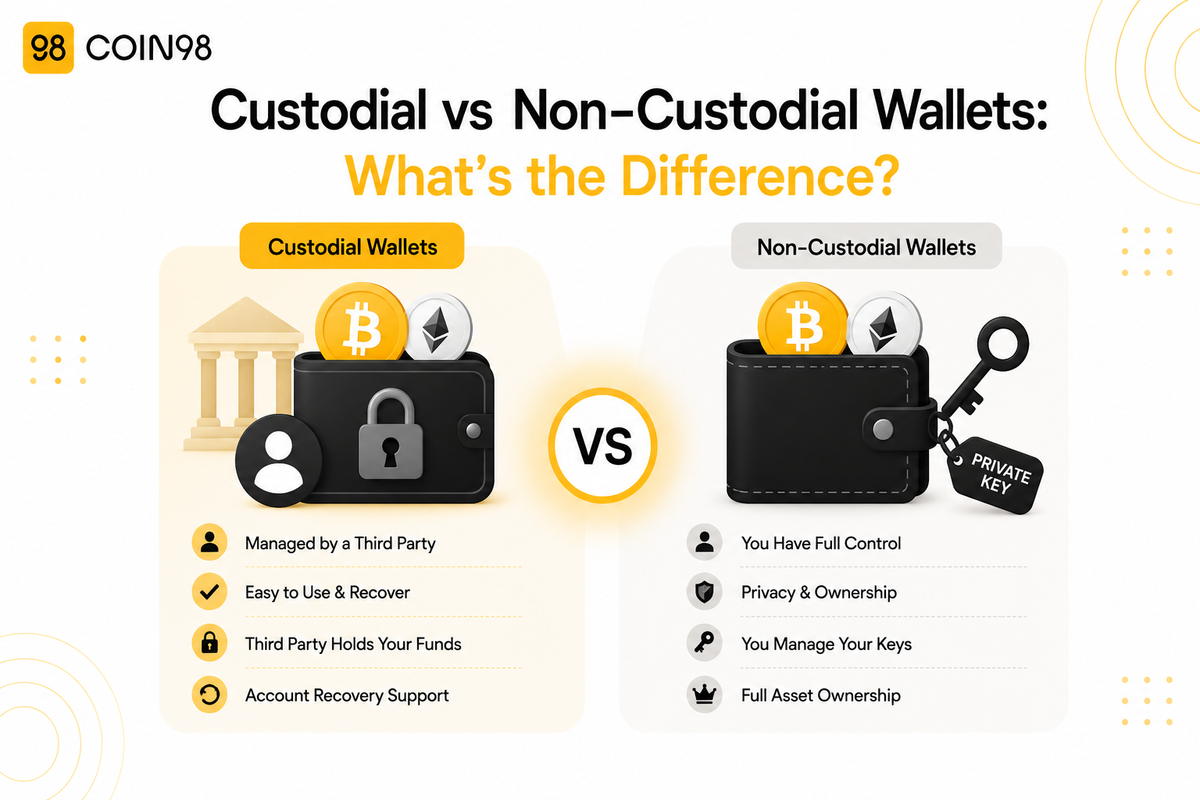
A custodial wallet is one where a third party — an exchange or platform — holds your private keys on your behalf. You log in with a username and password; the platform manages the underlying cryptographic credentials that authorize transactions on the blockchain.
This structure closely mirrors traditional banking. You have a balance you can view and spend, but the institution controls the underlying assets. The phrase "not your keys, not your coins" exists precisely because of this arrangement: if the platform is hacked, becomes insolvent, or freezes withdrawals, your access to funds depends entirely on the platform's survival and cooperation.
Pros of custodial wallets
- Simple setup — no seed phrase to manage, no technical configuration required
- Account recovery — lost your password? A support team can help restore access
- Integrated trading — buy, sell, stake, and swap within a single interface
- Professional security infrastructure — larger platforms maintain dedicated security teams and cold storage systems
Risks of custodial wallets
- Platform risk — exchange hacks and insolvencies have collectively cost users billions of dollars. When a custodial platform fails, account holders typically become unsecured creditors with limited recovery options
- Withdrawal restrictions — platforms can freeze accounts, limit withdrawals, or comply with government orders to block access to funds
- Identity requirements — custodial wallets require KYC/AML verification, which reduces financial privacy
- Limited DeFi access — most custodial wallets cannot interact directly with decentralized protocols or smart contracts
Custodial wallets are well suited for: active traders who prioritize convenience, users new to crypto who are still building familiarity, and anyone who values account recovery support over full ownership.
What is a non-custodial wallet?
A non-custodial wallet gives you — and only you — control of your private keys. When the wallet is created, a seed phrase (typically 12 or 24 words) is generated directly on your device. That seed phrase is the root cryptographic secret from which all private keys are derived. No company or server holds a copy.
This is what self-custody means. Your funds exist on the blockchain, accessible only to whoever holds the keys. No platform failure, exchange hack, or regulatory action can affect funds in a non-custodial wallet — unless the attacker gains access to your keys directly.
Coin98 Super Wallet is a non-custodial wallet: your seed phrase is generated locally on your device and never transmitted to Coin98's servers. You retain full ownership at all times, with no intermediary between you and your assets.
Pros of non-custodial wallets
- True ownership — your assets cannot be frozen, seized, or restricted by a platform
- Full DeFi and Web3 access — connect directly to decentralized protocols, NFT platforms, and dApps
- Privacy — no mandatory identity verification required
- No counterparty risk — your security does not depend on a third party staying solvent or cooperative
Risks of non-custodial wallets
- Sole responsibility — if your seed phrase is lost, destroyed, or stolen, the funds are permanently inaccessible; there is no support team that can recover them
- Irreversible errors — sending assets to the wrong address or wrong blockchain cannot be undone
- Learning curve — managing seed phrases, network fees, and wallet security requires more knowledge than using an exchange account. We suggest reviewing common mistakes when storing your seed phrase and private key before getting started
A 2024 survey found that 48% of crypto holders expressed a desire for stronger security and fraud protections — a signal that the responsibility of self-custody is one many holders are still working to manage confidently, according to Kraken research.
Non-custodial wallets are well suited for: users who want full ownership of their assets, long-term holders, DeFi participants, and anyone whose holdings exceed what they are comfortable leaving on a third-party platform.
Custodial vs non-custodial: side-by-side comparison
| Custodial | Non-custodial | |
|---|---|---|
| Who holds the private keys | Third-party platform | You |
| Recovery if access is lost | Account recovery via support | Only possible with seed phrase |
| Platform / counterparty risk | High — platform failure affects funds | None |
| DeFi / Web3 access | Limited or unavailable | Full |
| Privacy | Requires KYC/AML identity verification | No mandatory verification |
| Ease of use | High — beginner-friendly | Moderate — requires key management |
| Best for | Trading, beginners, convenience | Long-term holding, DeFi, full ownership |
Which wallet should you choose?
For most active crypto holders, the practical answer is: both.
A custodial account on an exchange handles active trading — the convenience of fast swaps and fiat on/off-ramps is reasonable for funds you are actively moving. A non-custodial wallet handles longer-term storage and DeFi activity — funds you are not planning to trade soon are worth keeping in self-custody where no platform failure can affect them.
A practical rule of thumb: keep on a custodial platform only what you would be comfortable losing to a platform failure. Move the rest to self-custody.
For the self-custody side of this arrangement, Coin98 Super Wallet is worth considering. It supports 150+ blockchains, connects directly to DeFi protocols and dApps, and includes an encrypted cloud backup feature — your seed phrase is encrypted on your device before any backup is stored, meaning Coin98's servers never hold the plaintext phrase. For users with larger holdings, Coin98 also supports Ledger hardware wallet integration, which moves private key storage entirely to an offline hardware chip — the most secure option currently available for individual holders.
It is also worth noting that an emerging category — MPC (multi-party computation) wallets — fragments private keys across multiple parties, combining some convenience of custodial wallets with the security properties of self-custody. This category is still developing, but represents a middle path worth watching.
Install Coin98 Super Wallet only from the official source.
Frequently Asked Questions
What does "not your keys, not your coins" mean?
It means that whoever controls the private keys controls the assets. In a custodial wallet, the platform holds the keys — not you. If the platform is hacked, becomes insolvent, or freezes withdrawals, you cannot independently access your funds. With a non-custodial wallet, you hold the keys and your access does not depend on any third party's cooperation or survival.
Is my crypto safe in a custodial wallet?
It depends on the platform's security practices and financial stability. Larger platforms maintain professional security infrastructure, but no custodial arrangement is immune to hacks or insolvency. According to BitGo, exchange-based custody carries counterparty risk that self-custody eliminates entirely. We suggest not keeping more funds in a custodial wallet than you would be comfortable losing to a platform-level failure.
Can I lose my crypto with a non-custodial wallet?
Yes — through loss or exposure of your seed phrase or private key, not through a platform failure. If your seed phrase is lost and your device is also lost or broken, the funds are permanently inaccessible. We strongly suggest backing up the seed phrase before funding any non-custodial wallet. Coin98 Super Wallet's encrypted cloud backup feature provides an additional recovery option alongside a physical backup.
Which wallet is better for beginners?
Non-custodial wallets are arguably simpler to get started with. There is no sign-up form, no identity verification, and no waiting for KYC approval — you create the wallet, save your seed phrase in a safe place, and you are ready to use it immediately. Custodial exchanges, by contrast, typically require email verification, identity documents, and sometimes days of review before you can access your funds.
The one responsibility a non-custodial wallet places on the user upfront is the seed phrase — it must be written down and stored safely before funding the wallet. With that step done, the experience is straightforward. Coin98 Super Wallet is designed with exactly this in mind: a clean setup flow, no account required, and an encrypted cloud backup option to help protect the seed phrase from day one.
What is a hybrid approach?
Using both wallet types simultaneously: a custodial account for active trading and convenient fiat access, and a non-custodial wallet for longer-term holdings and DeFi activity. Many experienced crypto holders maintain this structure. Coin98 Super Wallet fits naturally into the self-custody side of that arrangement, supporting both everyday DeFi use and long-term secure storage.
Summary
Custodial and non-custodial wallets are not competing — they serve different purposes. Custodial wallets optimize for convenience; non-custodial wallets optimize for ownership and security. Understanding which to use, and when, is one of the most important foundations for managing crypto safely.
For non-custodial storage, Coin98 Super Wallet — available at coin98.com/wallet — supports over 150 chains, encrypted cloud backup, and Ledger hardware wallet integration for users who want the highest level of key security without giving up ease of use.