Should You Split Funds Across Multiple Crypto Wallets?
Chainalysis logged 158,000 personal wallet compromises in 2025. Splitting funds across two or three wallets caps what one bad signature costs.
For most people, yes — and two or three is usually the right number, not ten. Running multiple crypto wallets does not make any single wallet harder to drain. What it changes is how much a bad signature costs you. Chainalysis counted 158,000 personal wallet compromises in 2025, nearly triple the 54,000 recorded in 2022, affecting more than 80,000 unique victims. Splitting funds is the cheapest way to make sure one of those incidents takes a slice instead of everything. Here is how to size the split, what belongs in each wallet, and where the idea stops paying off.
What splitting funds actually protects you from
Splitting limits blast radius. It does not prevent the compromise itself.
That distinction matters because it tells you which risks a second wallet solves and which it does not. A separate wallet helps when the loss is contained to one set of keys: a malicious approval you signed on a new dApp, a drainer site that caught you at the wrong moment, a phone that got compromised. It does not help if your seed phrase leaks and every wallet in your app derives from it, and it does nothing about a protocol failing underneath you.
The scale of the problem is worth being precise about. Chainalysis reports $3.4 billion in total crypto theft during 2025, of which $713 million came from individuals rather than services — down from $1.5 billion in 2024, even as incident counts rose. The honest read is that more people were hit for smaller amounts. Solana users made up the largest single-network group, at roughly 26,500 victims.
The practical takeaway from that data: the typical loss event is one person, one wallet, one bad interaction. That is exactly the shape of risk that compartmentalization handles well.
How many crypto wallets should you have?
Two or three covers most people. Past three or four, the dominant failure mode tends to shift from theft to self-inflicted loss.
Backpack's wallet guide sorts setups by user type, and it is a reasonable starting frame:
| User type | Suggested setup |
|---|---|
| Beginner | One hot wallet plus a backup |
| Active trader | One hot, one hardware, one mobile |
| Long-term holder | One hardware wallet plus a cold backup |
| Power user | Multiple hot wallets and multiple cold wallets |
Changelly's guide lands in the same place from a different direction — one wallet for beginners with small holdings who are not touching dApps, two as the standard cold-plus-hot setup, three or four for active traders and frequent dApp users. It also suggests keeping 80–90% of holdings in cold storage, with the hot wallet carrying only what you are actively moving.
Those percentages are best read as a starting ratio rather than a rule. The number that actually matters is the one you would be upset to lose in a single afternoon, and that figure is personal.
What goes in each wallet
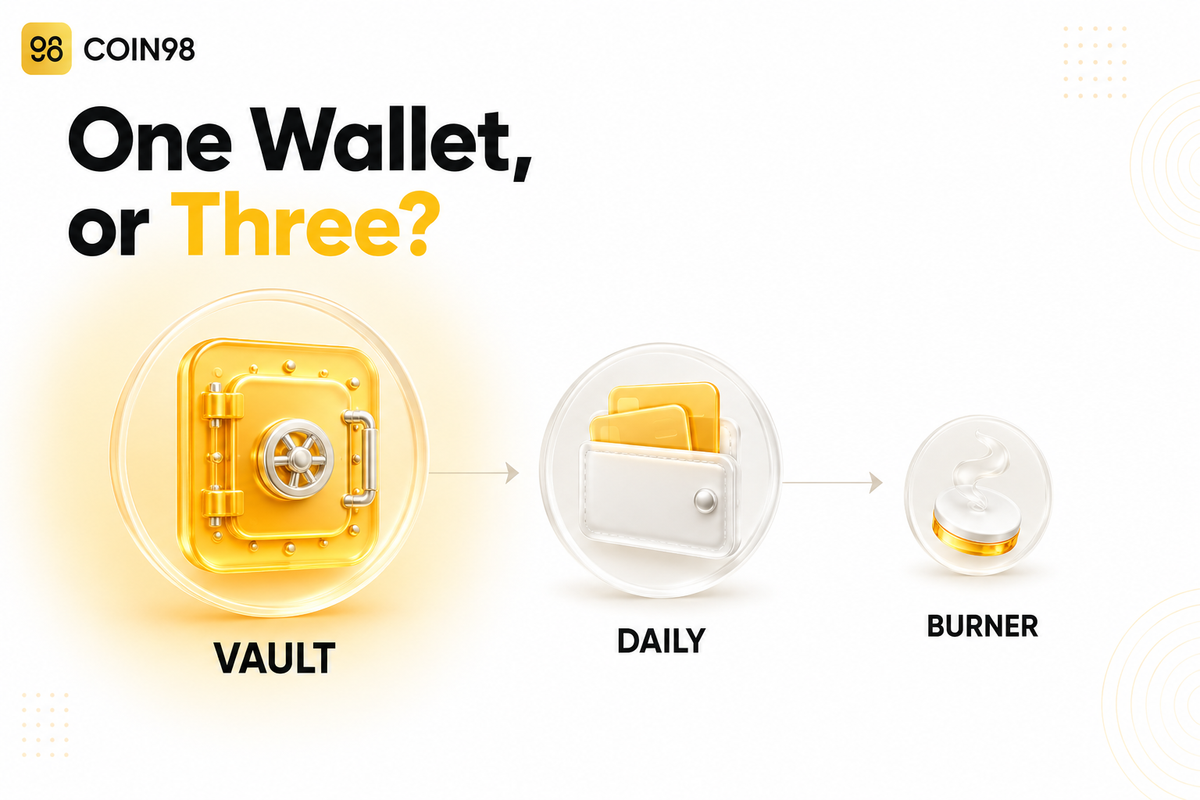
We suggest assigning a job to each wallet before funding it. Wallets without a defined purpose end up holding a bit of everything, which defeats the point.
| Tier | Job | What it holds | What it connects to |
|---|---|---|---|
| Vault | Long-term storage | The majority of your holdings | Nothing, ideally — no dApps, no unfamiliar contracts |
| Daily | Swaps, transfers, routine DeFi | Trading-sized amounts only | Established protocols you have used before |
| Burner | Mints, new dApps, airdrop farming, unknown links | Gas plus the amount at stake | Anything — that is the point |
Our own guide to storing crypto safely frames the first two tiers well: treat a hot wallet like the cash in your pocket and cold storage like a savings account. The vault tier is where a hardware wallet earns its price, because signing happens on a device that never exposes the key to your browser.
A few placement questions come up repeatedly:
- NFTs tend to belong with the vault if they are valuable and with the burner if you are minting speculatively.
- Chain separation is rarely necessary on its own. A multichain wallet derives addresses across networks from one seed phrase, so a "Solana wallet" and an "Ethereum wallet" created from the same phrase share a single point of failure.
- Airdrop farming is the clearest case for a dedicated wallet. Farming means signing for many unfamiliar protocols, which is precisely the exposure you would not want pointed at savings.
The burner wallet, and when to retire it
A burner is a wallet you are willing to lose. DEXTools defines it as "a temporary low-value wallet used to interact with contracts, apps, mints, or links" you do not trust enough to touch with your main wallet.
Three habits make burners work:
- Fund it per transaction. Send gas plus the amount you intend to spend, rather than keeping a working balance parked there.
- Review its approvals. A burner accumulates permissions fast — our explainer on token approvals covers what each one actually grants.
- Retire it on schedule. Once a burner holds meaningful value or a long history of connections, it is not a burner anymore. Move the assets out and start a fresh one.
Worth being clear about the limit: a burner contains risk, it does not remove it. DEXTools makes the same point — a disposable wallet is not a substitute for reading what you are signing, and it does not justify leaving real money in a high-exposure wallet.
The costs nobody mentions
More wallets mean more backups, more surface for human error, and more chances to misplace something.
- Seed phrase sprawl. Each independent wallet is another phrase to store, verify, and protect. Our guide to seed phrases is worth a read before you create the third one, because backup discipline has to scale with the wallet count.
- Fragmented visibility. Holdings spread across five wallets are harder to value, harder to rebalance, and easier to forget.
- Transfer friction. Moving between your own wallets costs gas and adds a step where an address can be pasted wrong.
- Uniform discipline required. Every additional wallet needs the same care as the first. Changelly's guide is blunt about this trade-off, and it is the strongest argument against going past three or four.
There is also a privacy caveat people underestimate. Splitting wallets improves privacy only if the wallets stay unlinked, and moving funds directly from one to another leaves on-chain evidence that ties them together. Chainalysis describes address clustering as "grouping cryptocurrency addresses that are controlled by the same entity, based on evidence found on the blockchain" — self-transfers are exactly the kind of evidence those tools are built to read.
How to set up a second wallet in Coin98 Super Wallet
Adding a wallet takes about a minute. Per our documentation on creating a multichain wallet:
- Tap Add Wallet at the top right of the home screen.
- Choose Create a New Wallet.
- Select Multichain and pick a 12- or 24-word seed phrase length.
- Name the wallet — this is where labels like "Vault," "Daily," and "Burner" pay off.
- Back up the seed phrase, confirm the three risk acknowledgements, and create the wallet.
One monitoring tip: a watch-only wallet lets you track a cold wallet's balance and transaction history from your phone without exposing its keys. It cannot send transactions or reveal a private key, which makes it a safe way to keep an eye on the tier you deliberately do not touch.
Keeping the split healthy
A split decays if you never review it. Value drifts into the daily wallet, approvals pile up on the burner, and after six months the tiers stop meaning anything.
Wallet Health in Coin98 Super Wallet is built for this review. It runs a multi-point scan across eight categories — Wallets, Contacts, Connections, Interacted URL, Favorite dApps, Favorite Tokens, Approval and Cloud Backup — and returns a Health Score from 0 to 100, colour-coded red below 31, orange to 90, and green above. Unrevoked approvals and risky dApp connections surface with an immediate fix, and Dust Sweeper consolidates the small balances that accumulate across wallets.
We suggest pairing that scan with a monthly approval review and a quick check that each wallet still holds what its label says.
FAQ
How many crypto wallets should I have? Two or three suits most people: one cold wallet for long-term holdings and one hot wallet for daily activity, with a burner added if you interact with new protocols. Changelly's guide recommends the same range, reserving three to four for active traders and frequent dApp users. Past four, the added complexity tends to cost more than the extra separation gains.
Does each wallet need its own seed phrase? For the split to actually contain a compromise, yes. Wallets derived from the same seed phrase share a single point of failure — if that phrase leaks, every wallet under it is exposed at once. Separate phrases mean separate backups to protect, which is the real cost of the approach.
Is a burner wallet the same as a hot wallet? No. "Hot" describes connectivity — the keys live on an internet-connected device. "Burner" describes intent: a wallet built to be disposable, funded minimally, and retired once it has accumulated exposure. A burner is always hot, but most hot wallets are not burners.
Can people tell that two of my wallets belong to me? Often, yes. Blockchain analytics firms group addresses into clusters using on-chain evidence, and a direct transfer between two of your wallets is a strong signal. Withdrawing to both from the same exchange account can connect them off-chain as well. If unlinkability matters to you, we'd suggest avoiding direct transfers between wallets you want kept separate.
What percentage should sit in cold storage? A common guideline is 80–90% in cold storage with the remainder in a hot wallet for active use. We would treat that as a starting ratio rather than a target — the better question is how much you could lose from the hot wallet without it changing your plans.
Does splitting funds protect me from a scam I fall for? It limits the damage rather than preventing it. If you approve a malicious contract from your burner, the loss is capped at what that wallet holds. The same signature from a wallet holding your savings is a far worse afternoon — which is the entire argument for the split.
The takeaway
Multiple crypto wallets are worth the effort for a specific reason: they cap what a single mistake can cost. With 158,000 personal wallet compromises recorded in 2025, the realistic threat is not an exotic exploit but one bad signature on an ordinary day. Two or three wallets with clear jobs — a vault you rarely touch, a daily wallet sized to your actual activity, and a burner for anything unfamiliar — handle that risk without turning your setup into a bookkeeping project. Each one takes about a minute to create in Coin98 Super Wallet, and Wallet Health will tell you when the split has started to drift.
Last updated: August 2026