What is Ethereum? A beginner's guide to how it works
Ethereum runs smart contracts, not just payments — here's how it works, why ETH has no supply cap, and how to buy and store it safely.
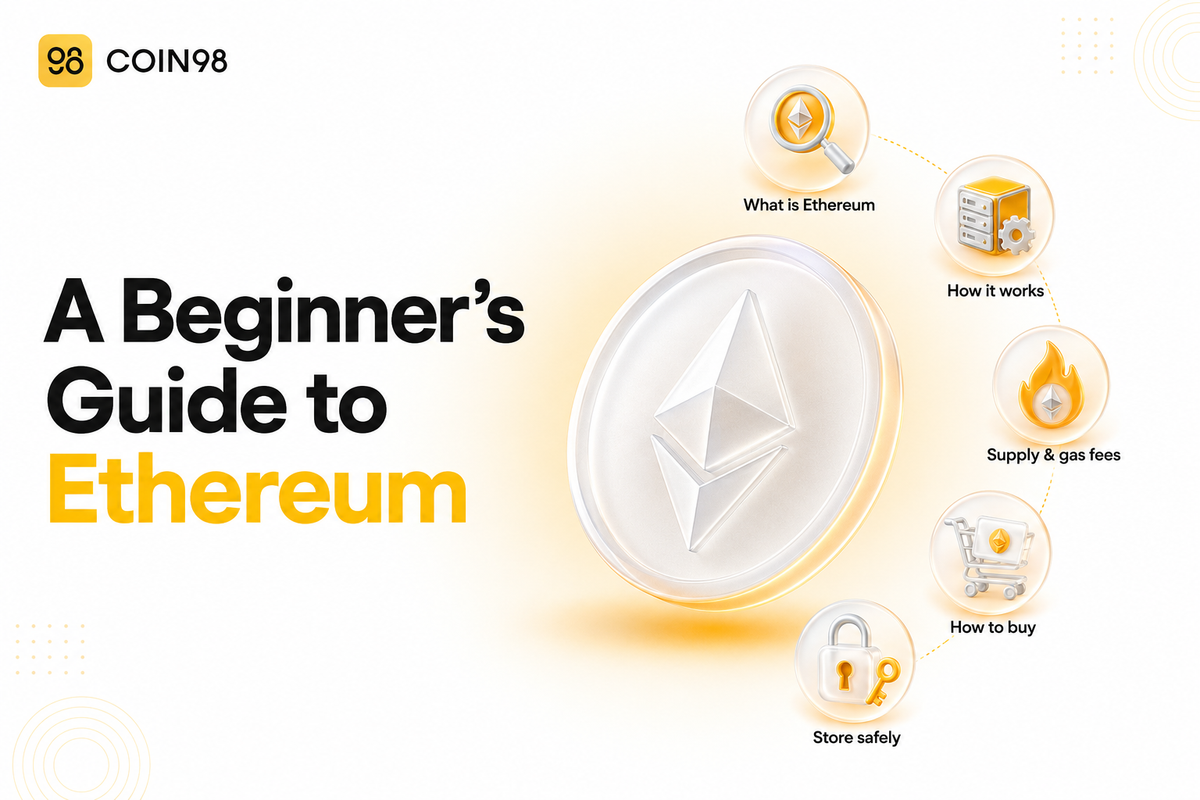
Ethereum is a decentralized network of computers that runs code the same way it moves money — without a bank, company, or government in the middle. Rather than just transferring digital cash like Bitcoin, Ethereum can run self-executing programs called smart contracts, which is why ethereum.org describes it as "a global digital infrastructure that anyone can use." As of May 2026, roughly 39 million ETH — about 32% of the supply — is locked in staking to help secure that network. This guide explains what Ethereum actually is, how it works under the hood, why its supply behaves differently from Bitcoin's, and how to buy and store your first ETH safely.
What is Ethereum?
Ethereum is a decentralized blockchain platform for money and applications, powered by its native currency, ether (ETH). Unlike a currency-only network, Ethereum lets developers deploy smart contracts — open-source programs that create digital assets and decentralized applications (dApps) running continuously, accessible to anyone with an internet connection, according to ethereum.org's official documentation.
Ethereum launched in July 2015, built from a 2013 white paper by Vitalik Buterin proposing a blockchain flexible enough for more than payments. On September 15, 2022, the network completed "the Merge," switching its consensus mechanism from proof-of-work mining to proof-of-stake — a change that made Ethereum roughly 99.98% more energy efficient, according to MIT Technology Review's coverage of the upgrade. Today millions of people hold assets and interact with dApps on Ethereum without going through a bank, per ethereum.org.
How does Ethereum work?
Ethereum works by having thousands of independent computers, called nodes, agree on one shared record of account balances and smart contract activity. When someone sends ETH or interacts with a dApp, the transaction enters a public queue, gets bundled into a block by a validator, and is checked against the same rules by every other node on the network, per ethereum.org's official explanation.
A smart contract is code stored on the blockchain that runs automatically once its conditions are met — no company or intermediary executes it on your behalf. This programmability is what powers Ethereum's decentralized finance (DeFi) ecosystem: total value locked in Ethereum DeFi protocols grew from roughly $4 billion to more than $18 billion over the course of 2021 alone, a 350% increase, according to data reported by Decrypt, before the wider DeFi market across all chains went on to peak near $180 billion later that year.
Validating this activity requires staking instead of mining. Validators lock up ETH as collateral and are chosen to propose and check new blocks; processing transactions correctly earns ETH, while cheating costs part of their stake, per ethereum.org. This is also how new ETH enters circulation — there's no central authority printing it, only validators earning rewards for participating correctly.
Why doesn't Ethereum have a 21 million cap like Bitcoin?
Ethereum has no fixed maximum supply, unlike Bitcoin's hard-coded 21 million ceiling. Instead, ETH's supply moves up and down based on two forces working against each other: new ETH issued as validator rewards, and ETH permanently destroyed through transaction fee burning, according to ethereum.org's official supply explainer.
The burning mechanic comes from EIP-1559, a fee-market change introduced with the London hard fork on August 5, 2021. Every Ethereum transaction now has a base fee that's burned outright, plus an optional tip paid to the validator who processes it. Before EIP-1559, all fees went to whoever mined the block; afterward, only the tip does, while the base fee disappears from supply entirely.
| Metric | Figure |
|---|---|
| Maximum ETH supply | None — dynamic, not fixed |
| Total ETH supply (mid-2026) | ~121,700,000 ETH |
| ETH staked | ~39,000,000 ETH |
| Share of supply staked | ~32% |
| Active validators | ~1,220,000 |
| Net staking yield (after provider fees) | ~2.0–2.2% |
| Fee-burning mechanism | EIP-1559 (since August 2021) |
Staking and supply figures are recorded as of May 26, 2026.
When network activity is high enough that burned fees outpace new validator issuance, ETH's supply can shrink for a period — a dynamic some in the community nickname "ultrasound money," contrasting it with Bitcoin's fixed, predictable issuance schedule, per ethereum.org's supply page, which notes burn rates "can surpass issuance" during high-demand periods like NFT launches or heavy DeFi activity. The practical takeaway for a beginner: Ethereum's scarcity, unlike Bitcoin's, depends on how busy the network is rather than a hard-coded limit.
How to buy Ethereum for the first time
There are two practical paths to your first ETH, and they both end with the same result: ether sitting in a wallet you control.
- Buy on an exchange, then withdraw. Set up an account on a regulated exchange, complete identity verification, fund it from your bank or card, then withdraw the ETH to a wallet where you hold the private key.
- Buy directly inside a non-custodial wallet app. Some wallets, including Coin98 Super Wallet, support buying crypto with fiat directly in the app, landing the ETH in a wallet you already control instead of requiring a separate withdrawal step.
Either way, expect identity verification (KYC) before completing a purchase on a regulated platform, and expect a fee that varies by payment method. You don't need to buy a whole ETH — it can be purchased and held in fractional amounts. On Ethereum, it's worth keeping a small separate ETH balance for gas, since gas fees are paid in ETH even when you're sending a different token, and a wallet with zero ETH on hand can't cover the fee for its next transaction.
How to store Ethereum safely
For day-to-day convenience, a multi-chain wallet avoids running a separate app for every network you hold assets on. Coin98 Super Wallet, for example, supports more than 100 blockchains — including Ethereum — under a single 12- or 24-word seed phrase, so the same backup that protects your ETH also covers any other supported chain you hold, according to Coin98's documentation. We'd suggest writing the seed phrase down on paper rather than storing it digitally, and avoiding photos or cloud notes of it, since anyone who obtains those words gains the same control over the wallet that you have. For a step-by-step walkthrough — choosing between hot and cold storage, backing up your seed phrase, and knowing what to do if a wallet is ever compromised — see our practical guide to storing crypto safely.
FAQ
What is Ethereum in simple terms? Ethereum is a decentralized network that runs smart contracts — self-executing code — in addition to handling its native currency, ether (ETH). No bank or company controls it; thousands of independent computers verify activity through staking instead.
Is Ethereum safe to use? Ethereum's core network has run continuously since 2015 and moved to a more energy-efficient proof-of-stake model after the Merge in September 2022, but safety at the user level depends on how the private key, seed phrase, and dApp token approvals are managed. Losing a seed phrase or leaving an unlimited approval active on a risky contract is a more common way people lose funds than a flaw in Ethereum itself.
How is Ethereum different from Bitcoin? Bitcoin has a fixed 21 million coin supply and is designed mainly as digital money and a store of value. Ethereum has a dynamic, partly-burned supply and is designed to run programmable smart contracts and dApps — different goals on similar decentralized-network foundations.
What is a gas fee on Ethereum? Gas is the fee paid to process a transaction or run a smart contract on Ethereum, measured in units of computational work. Since EIP-1559, it's split into a base fee that gets burned and an optional tip that goes to the validator, and it's paid separately from whatever token or asset is being sent.
Do I need a different wallet for Ethereum than for other crypto? Not necessarily. A multi-chain wallet like Coin98 Super Wallet holds Ethereum alongside 100+ other blockchains under one seed phrase, which is simpler than running a dedicated Ethereum-only app if you hold other assets too.
The bottom line
Ethereum's core idea is a decentralized network that does more than move money — it runs smart contracts that power DeFi, NFTs, and thousands of dApps, secured by validators staking ETH instead of miners burning electricity. Its supply has no fixed cap and instead balances validator rewards against the EIP-1559 burn, with roughly 32% of all ETH currently staked to keep the network running. Coin98 Super Wallet's multi-chain support lets you buy ETH directly and store it under the same seed phrase as 100+ other blockchains, with built-in visibility into the token approvals that come with using Ethereum dApps. Explore Coin98 Super Wallet to set up your first wallet.
Last updated: June 2026