Beyond Revoking Approvals: Coin98 Wallet Health vs Revoke.cash Compared
Revoke.cash covers 100+ chains for approvals; Coin98 Wallet Health checks 8 risk types and fixes them in-app.
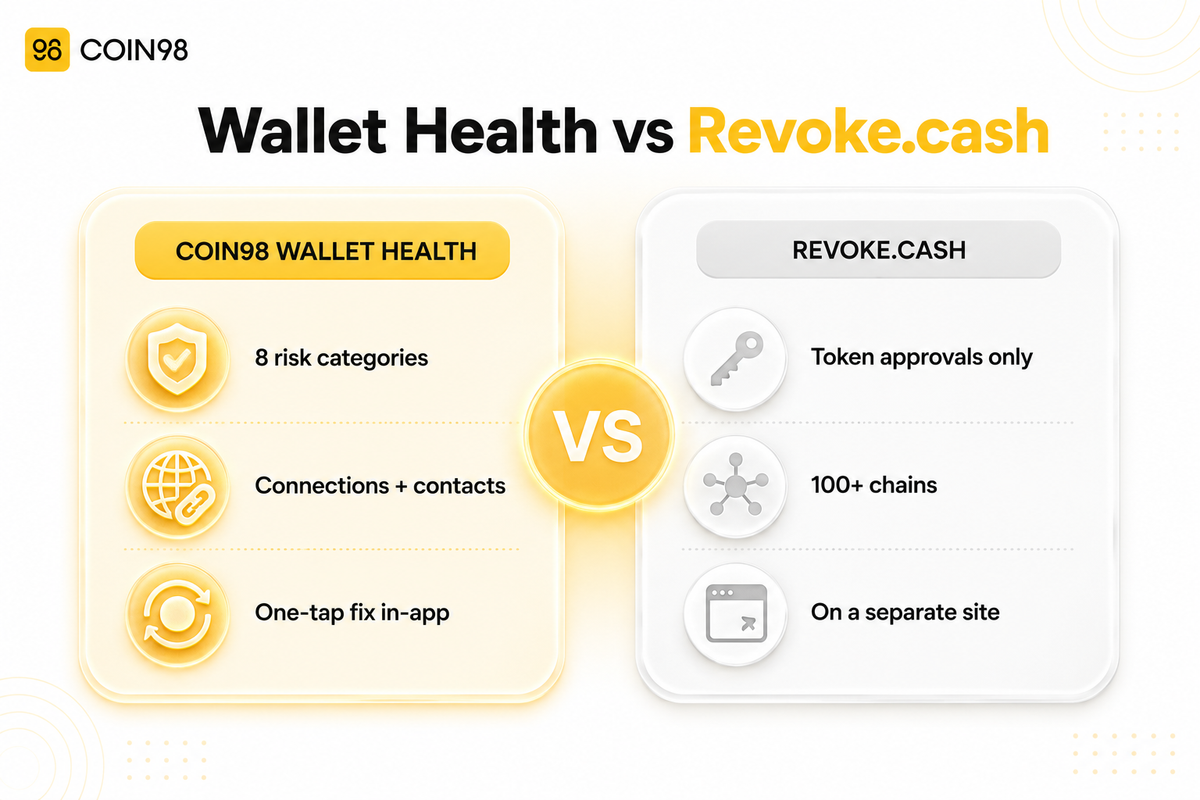
If you've ever worried about an old permission draining your wallet, you've probably met Revoke.cash — and you may now be wondering how Coin98's built-in Wallet Health compares. The short answer: Revoke.cash is a specialist that does one job across 100+ chains, while Wallet Health is a generalist that checks eight risk categories and fixes them inside your wallet. Which "protects more" depends on whether your risk is only stale token approvals or the wider mix of bad connections, risky contacts, and missing backups that drainers exploit. In 2025, phishing drainers still took $83.85 million from roughly 106,000 people, according to Scam Sniffer — so getting this choice right matters. This guide compares the two head-to-head.
The quick verdict
Revoke.cash wins on raw chain coverage; Wallet Health wins on breadth of protection and one-tap fixes.
- Choose Revoke.cash if you interact with many EVM chains and want a single-purpose, open-source approval revoker you can point at any address.
- Choose Wallet Health if you want approvals plus dApp connections, suspicious contacts, and backup status checked and fixed in the same app you already hold your assets in.
- They're not mutually exclusive — many careful users run both, and we explain when that makes sense below.
Both tools address the same underlying danger: a token approval is a permission you grant a smart contract to move specific tokens, and as Revoke.cash puts it, "if you give a smart contract permission to spend your tokens, it can spend them at any time." The difference is how much of your total exposure each tool actually sees.
What Revoke.cash does
Revoke.cash is a free, open-source tool for finding and revoking token approvals across more than 100 networks. You connect a wallet (or paste any public address), it lists every active allowance a contract holds over your tokens, and you revoke the ones you no longer trust. It also offers a browser extension, a permit-signature checker, and an exploit checker for known-compromised contracts.
Its strength is focus and reach. Because it does one thing, it does it broadly: Revoke.cash advertises approval management on "over 100 networks," far more than any single wallet scans natively. For a power user spread across dozens of EVM chains, that coverage is hard to beat.
Its limit is also focus. Revoke.cash checks approvals — not your dApp connections, not your saved contacts, and not whether your wallet is backed up. And because it's a separate website, revoking still means connecting your wallet to an external site and signing there, then returning to your wallet to continue.
What Coin98 Wallet Health does
Coin98 Wallet Health is a built-in security and asset-optimization tool inside Coin98 Super Wallet that scans eight risk categories, scores your wallet 0–100, and lets you fix issues without leaving the app. According to our documentation, one scan covers Wallets, Contacts, Connections, Interacted URLs, Favorite dApps, Favorite Tokens, Approvals, and Cloud Backup.
For the approval problem specifically, Wallet Health does exactly what Revoke.cash does — it surfaces active token and NFT permissions and lets you revoke the risky ones with a tap. But it also flags three threat types a pure approval checker can't: unrevoked approvals, risky dApp connections, and suspicious contacts. As our docs note, "dApp and token approvals do not expire automatically," so both stale approvals and lingering connections stay dangerous until you clear them.
The trade-off is chain coverage. Wallet Health scans 5 blockchains on the Free tier and 10 on Pro and Ultra — thorough, but a smaller set than Revoke.cash's 100+.
Head-to-head comparison
Here's how the two line up on the factors that decide "which protects more."
| Factor | Coin98 Wallet Health | Revoke.cash |
|---|---|---|
| What it checks | 8 categories: approvals, connections, contacts, URLs, favorites, backup | Token approvals + permit/exploit checks |
| Revoke approvals | ✅ In-app, one tap | ✅ On-site |
| dApp connections | ✅ Flags & revokes | — |
| Suspicious contacts | ✅ Flags | — |
| Backup / recovery check | ✅ Cloud Backup category | — |
| Risk score | ✅ 0–100 Health Score | — |
| Chains covered | 5 (Free) / 10 (Pro & Ultra) | 100+ networks |
| Where you act | Inside your wallet | External website |
| Cost | Free tier; Pro/Ultra add resolution & auto-scan | Free, open-source |
| Needs seed phrase / private key | No | No |
Neither tool ever needs your seed phrase or private key, and on both, revoking is a normal on-chain transaction you sign yourself — so custody of your funds never changes hands.
Coverage: the real difference
The headline gap isn't quality — it's what each tool is looking at. Revoke.cash inspects one attack surface (approvals) across many chains; Wallet Health inspects many attack surfaces across fewer chains.
That matters because approvals aren't the only way wallets get drained. Coin98's own 2026 threat breakdown shows losses coming from risky connections and social-engineered transfers as well as approvals. A tool that only checks approvals gives you a clean bill of health on one-third of the picture. If your wallet is still connected to a phishing site or holds a poisoned contact address, an approval-only scan won't tell you.
So "which protects more" comes down to your exposure:
- Only ever sign approvals on major DeFi apps? An approval checker covers most of your risk.
- Connect to new dApps, save addresses, and hold assets long-term? A multi-category scan catches risks the approval checker never looks for.
Convenience: friction changes behavior
The tool you actually use every month beats the more powerful tool you forget about. Security habits fail on friction, not features.
Revoke.cash requires opening a site, connecting your wallet, checking, then switching back — a deliberate, separate task. Wallet Health lives in the wallet you already open daily, and its 0–100 score turns "am I safe?" into a glance. On Ultra, a 24/7 auto-scan runs the check for you and sends real-time alerts, closing the gap between a risky approval and the moment you'd otherwise notice it. Lower friction tends to mean more frequent checks, and frequency is what keeps stale approvals from piling up — which is why we suggest revoking on a regular cadence rather than only after a scare.
Cost and safety
Both tools are free to start and both are non-custodial, so cost isn't the deciding factor — capability tiers are.
Revoke.cash is free and open-source across its core features. Coin98 Wallet Health offers scanning on the Free tier, while in-app risk resolution (revoking) is a Pro feature and 24/7 auto-scan is Ultra-only; Pro runs $9.99/month and Ultra $29.99/month at the time of writing. On the safety question, the answer is reassuring for both: neither asks for your seed phrase, and every revoke is an on-chain transaction you approve. The main caution with any external site — Revoke.cash included — is to confirm you're on the genuine domain before connecting, since fake "revoke" sites are themselves a known phishing lure.
Which should you use?
Match the tool to your risk profile, and don't feel obligated to pick just one.
- Multi-chain power users who touch 20+ EVM chains: Revoke.cash's 100+ network coverage is the pragmatic base layer for approvals.
- Everyday Coin98 users who want protection without extra steps: Wallet Health covers more risk types and fixes them in-app.
- The cautious middle: run Wallet Health as your routine monthly checkup for the chains you actually use, and reach for Revoke.cash if you need to clean up approvals on a niche chain Wallet Health doesn't cover yet.
There's no penalty for using both — they read the same on-chain data and neither takes custody.
FAQ
Is Revoke.cash safe to connect my wallet to? Revoke.cash is a reputable, open-source tool, and connecting to it does not expose your seed phrase or private key — revoking is a transaction you sign yourself. The real risk is imitation sites: always confirm you're on the genuine revoke.cash domain, since fake revoke pages are a common phishing tactic.
Does Coin98 Wallet Health replace Revoke.cash? For the chains it scans (5 on Free, 10 on Pro/Ultra), Wallet Health does everything Revoke.cash does for approvals, plus connections, contacts, and backup. Revoke.cash still wins if you need approval cleanup on one of the 100+ chains it supports that Wallet Health doesn't yet cover.
Do either of these tools cost money to revoke an approval? The tools themselves are free to check, but revoking is an on-chain transaction on both, so each revoke costs a small gas fee on the relevant network. Revoking never touches your token balances — only a contract's permission to move them.
Which one protects more? For total wallet exposure, Wallet Health protects more because it checks eight risk categories, not just approvals. For sheer chain reach on the approval problem specifically, Revoke.cash covers more networks. The safest setup for many users is both.
How often should I run either tool? We'd suggest a check whenever you finish using a new dApp, and a routine scan at least monthly. Coin98 Ultra's 24/7 auto-scan automates this so you don't have to remember.
The bottom line
Revoke.cash and Wallet Health aren't really rivals — one is a wide-reaching approval specialist, the other an in-wallet generalist that scores and fixes eight kinds of risk. If your only concern is approvals across many chains, Revoke.cash is excellent. If you want your approvals, connections, contacts, and backup checked and repaired in one place — with a score that makes safety a glance instead of a chore — run a Coin98 Wallet Health scan and see where your wallet stands.
Last updated: July 2026