What is crypto copy trading, and is it worth the risk?
Fewer than half of copy-trading followers profit over 90 days. Here's how the model works, what it really costs, and how to evaluate a platform.
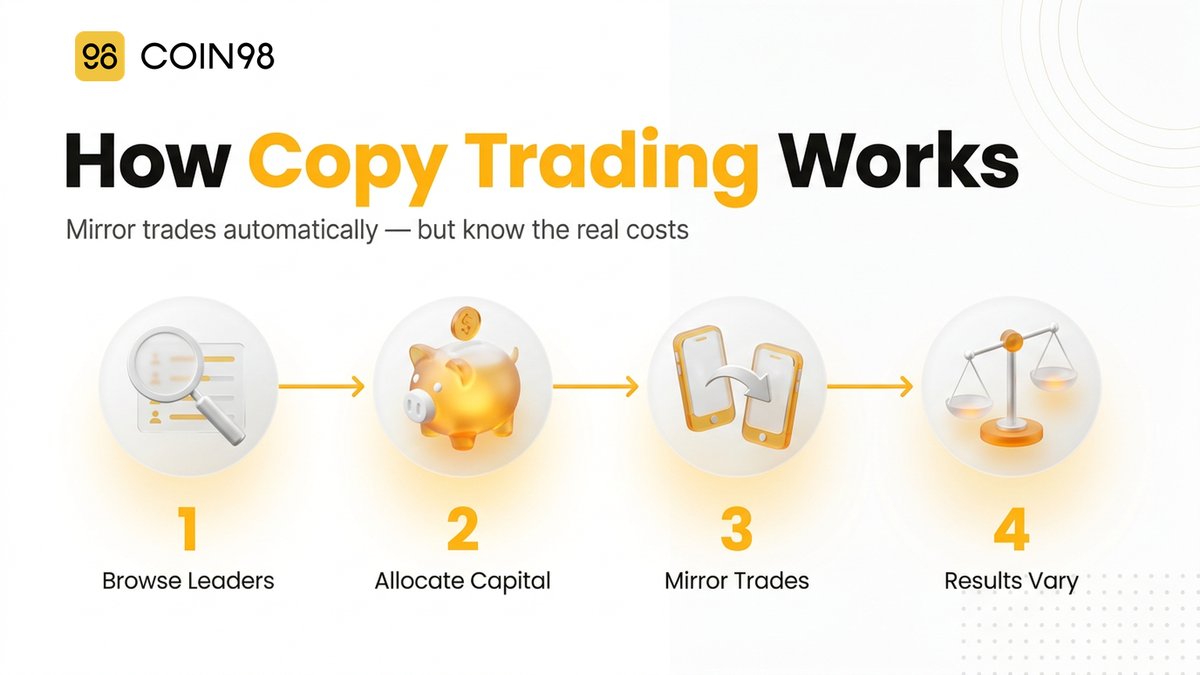
Copy trading lets you mirror another trader's positions automatically — every open, every close, scaled to your own capital. It sounds like a shortcut past the learning curve, and in a narrow sense it is: you don't need to read charts or time entries. But a 2025 multi-exchange study of more than 100,000 copy-trading outcomes found that fewer than half of followers ended a 90-day window in profit. This article breaks down how the mechanic works, what it costs after every fee layer, what the performance data actually shows, and how to evaluate a platform before committing funds.
How crypto copy trading works
Crypto copy trading is an automated system that replicates one trader's buy and sell decisions in your account, with position sizes scaled proportionally to your allocated capital. If a leader manages $100,000 and you allocate $1,000, your positions are 1/100th the size of theirs. When they open a long ETH-USDT perpetual, your account opens the same trade at the same leverage within seconds.
The leader/follower model
The process follows four steps:
- Browse and select. Platforms publish leaderboards showing each trader's return history, win rate, maximum drawdown, and follower count. You pick a leader based on these metrics.
- Allocate capital. You decide how much to commit. The leader doesn't have direct access to your funds — they trade on their own account, and the platform mirrors their orders into yours.
- Automatic mirroring. Every position the leader opens appears in your account, scaled to your allocation. Some platforms let you set your own stop-loss or maximum position size as an override.
- Synchronized closing. When the leader exits, your position closes too. You can also disconnect manually at any time.
CEX vs DeFi copy trading
| Feature | Centralized (CEX) | Decentralized (DeFi) |
|---|---|---|
| Custody | Platform holds your funds | You keep your keys in a self-custody wallet |
| Fee transparency | Profit share + spread markups, sometimes opaque | On-chain, fully visible |
| Typical profit share | 10–30% of your gains | ~10% flat |
| Execution speed | Fast, internal matching | Depends on chain finality and gas |
| Regulatory oversight | Varies by jurisdiction — some licensed, some not | Largely unregulated |
| Audit trail | Platform-reported | Verifiable on-chain |
For traders who prioritize self-custody, DeFi copy-trading protocols offer a transparent alternative — you can verify every mirrored trade on the blockchain rather than trusting a platform's internal ledger. Coin98 Super Wallet supports connections to DeFi protocols across 150+ blockchains, so you can interact with on-chain copy-trading contracts while keeping your keys in a non-custodial wallet.
What it actually costs
The headline return you see on a leaderboard isn't the return you keep. Three fee layers sit between the leader's performance and your net result.
Fee layers
| Fee type | What it is | Typical range |
|---|---|---|
| Profit share | Percentage of your gains paid to the leader | 10–30% |
| Platform trading fee | Maker/taker fee on each mirrored trade | 0.02–0.10% per trade |
| Overnight funding | Daily charge for holding leveraged positions (perps) | Variable, often 0.01–0.03% per 8 hours |
| Spread markup | Difference between buy and sell price, sometimes widened by the platform | Varies |
Profit share is the most visible cost, but trading fees and funding rates compound quietly. A leader who opens and closes 10 trades per week at 0.06% per side generates 1.2% in trading fees alone over a month — on top of the profit share.
The slippage tax
Your order executes after the leader's, sometimes by milliseconds, sometimes by seconds. In volatile markets, that delay means a worse entry price. Cross-exchange data from 2025 estimates that slippage and execution gaps erode roughly 1.5% to 3% of a follower's gross annual returns. On illiquid pairs or during sudden price moves, the gap widens further. A leader might show a 20% return while their followers see 15% — before profit share.
The risks the leaderboard doesn't show
Copy trading carries every risk that manual trading does — market drawdowns, liquidation on leveraged positions, sudden delistings — plus a set of risks unique to the copy model.
Survivorship bias
Leaderboards display winners. Traders who blew up, closed their accounts, or simply stopped publishing don't appear. Industry regulators flagged this in 2025 guidance as a structural problem with social-trading platforms: the visible track record systematically overstates the average outcome.
Strategy drift and over-concentration
A leader can change their approach without warning. The conservative swing trader you followed last month might pivot to high-leverage scalping this month. If you've allocated your entire copy-trading budget to a single leader, that strategy shift puts all of it at risk. The same concentration problem applies if a leader trades only one asset or one direction.
What the data says
A 2025 multi-exchange study covering over 100,000 copy-trading outcomes across three major platforms found:
- Only 48.48% of followers were profitable over a 90-day period.
- 97% of lead traders recorded positive personal returns — but only 43.61% of them delivered positive returns to their followers.
- Platform mattered: follower win rates ranged from roughly 44% on one exchange to 67% on another.
- Separately, only about 12% of top-ranked traders maintained their ranking for more than six months.
The gap between leader profitability and follower profitability comes down to fees, slippage, and timing. Leaders enter at their price; followers enter at the market's price a moment later. Profit share takes another cut. And the leaders who climb the leaderboard fastest are often the ones taking the most risk — which works until it doesn't.
Understanding how stop-loss and stop-limit orders work is worth doing before allocating capital to any copy-trading setup, because most platforms let you set your own risk caps even while copying someone else.
How to evaluate a copy-trading platform
If you decide to try copy trading, we recommend treating the selection process like due diligence on an investment, not like browsing an app store.
Metrics that matter
| Metric | Healthy range | Red flag |
|---|---|---|
| Track record length | 6+ months | Under 3 months |
| Maximum drawdown | Under 20% | Above 30% |
| Win rate | 55–65% | Above 80% (suggests unsustainable risk-taking) |
| Profit factor | Above 1.5 | Below 1.2 |
| Recovery time | Under 3 months from losses | Has not recovered a major drawdown |
| Follower count trend | Stable or growing | Sudden mass exits |
A win rate above 80% is counterintuitively a warning sign. It often means the trader is holding losing positions open indefinitely, waiting for a reversal, rather than cutting losses — a strategy that works until one large loss wipes out months of gains.
Red flags
- No drawdown history visible. If the platform doesn't show maximum drawdown, it's worth assuming the worst.
- Unusually short track record with high returns. A 200% return over two months is meaningless without knowing what happened in month three.
- Leader trades only during bull runs. Check whether the track record spans both rising and falling markets.
- No follower cap. A leader with 10,000 followers trading illiquid pairs creates a crowding problem — every mirrored order moves the market against late followers.
Before committing funds, it's worth understanding how perpetual contracts and funding rates work, since most copy-trading leaders operate on perps markets where leverage amplifies both gains and losses.
For traders who prefer managing their own positions, Coin98 offers Futures trading directly within the Super Wallet — giving you the same market access without delegating your strategy to someone else.
Frequently asked questions
Can I lose more than I deposited with copy trading?
On most platforms, no — your loss is capped at your allocated amount. However, if the platform allows cross-margin trading and you haven't isolated your copy-trading allocation, losses from copied positions could draw from your broader account balance. We recommend allocating a fixed amount in an isolated margin account to keep exposure contained.
Is copy trading the same as social trading?
They overlap but aren't identical. Social trading is the broader category: it includes copy trading (automatic replication), mirror trading (replicating an entire strategy rather than individual trades), and signal groups (manual alerts you execute yourself). Copy trading is the fully automated subset.
How many traders should I copy at once?
Diversifying across two to four uncorrelated leaders reduces the impact of any single trader's bad run. More than four tends to add complexity without proportional benefit — you end up paying profit share to leaders whose positions partially cancel each other out.
Is copy trading legal?
In most jurisdictions, yes, though regulation varies. Some countries classify copy-trading platforms as investment advisors, which requires licensing. Regulatory guidance published in 2025 recommended clearer disclosure standards for copy-trading services, particularly around survivorship bias in leaderboards.
What's a realistic return expectation?
After fees, slippage, and the leader-follower performance gap, conservative estimates put realistic annual returns for copy trading at 5–20%. That's significantly below the headline figures on most leaderboards, which show gross returns before all cost layers.
Copy trading removes the need to analyze charts and time entries, but it doesn't remove market risk, fee drag, or the challenge of picking the right person to follow. The data shows that fewer than half of followers profit over a 90-day window — which means selection, risk management, and realistic expectations matter more than the mechanic itself. If you're exploring crypto trading, Coin98 Super Wallet gives you direct access to DeFi swaps, futures, and 150+ blockchain networks — whether you choose to follow someone else's trades or build your own strategy.
Last updated: November 2026