What Are Sniper Bots? How Automated Traders Front-Run Token Launches
84% of token launches are sniped within five blocks. Learn how these bots work and how to protect your trades.
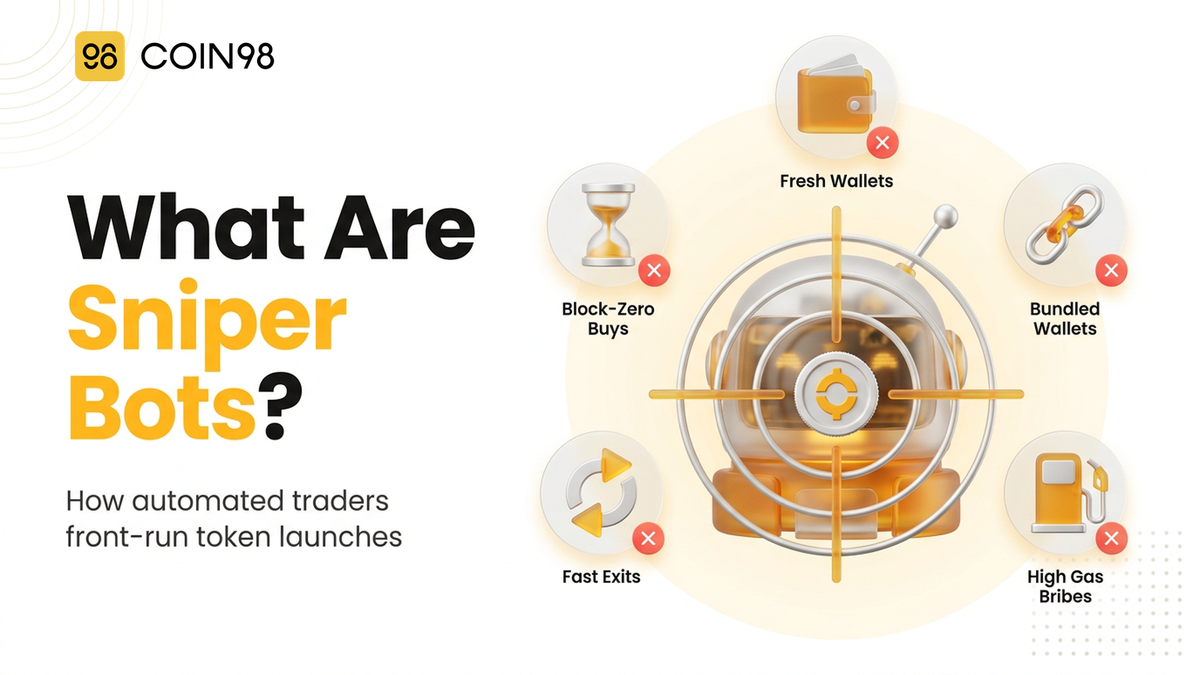
You've found a promising new token, the liquidity just went live, and you hit swap within seconds — only to discover the price already jumped 30% before your transaction confirmed. That wasn't market demand. It was a sniper bot. These automated scripts buy tokens in the same block they launch, pocket the early gains, and exit before most traders notice the listing. On-chain data from over 41,000 launches shows that 84% of sampled token launches had bot purchases within the first five blocks — roughly two seconds. This guide breaks down how sniper bots work, how to spot them on-chain, and what you can do to protect yourself.
What Are Sniper Bots and How Do They Work?
A sniper bot is an automated script that monitors blockchain networks for new token launches and executes buy orders in the earliest possible blocks — often the same block as the liquidity event itself. Unlike a human trader refreshing a DEX interface, these bots scan the mempool (where unconfirmed transactions wait for processing) and submit transactions with elevated gas fees or validator bribes to guarantee priority execution. Most are written in Rust or TypeScript and run on dedicated infrastructure with millisecond response times.
How a Sniper Bot Executes a Trade
The process follows a predictable pattern. The bot monitors the mempool for specific events: liquidity-add transactions on DEX factory contracts, presale claim windows, or oracle price updates. Once it detects a target, it submits a buy transaction with enough gas to land in the same block. The bot acquires a large share of the token's initial float — sometimes 25% or more — before any retail buyer's transaction confirms. Within minutes, it sells into the buying pressure from organic traders arriving afterward.
Data from over 15,000 tracked launches on one Solana launchpad found that 85% of sniper positions closed within five minutes of purchase, and 90% exited within one or two trades. Those positions were profitable 87% of the time.
Sniper Bots vs. MEV Bots and Sandwich Attacks
Sniper bots are one flavor of a broader category called MEV (Maximal Extractable Value) extraction. The differences come down to timing and target:
| Type | What it does | When it acts |
|---|---|---|
| Sniper bot | Buys a token at launch before other buyers | At liquidity creation or listing |
| MEV/sandwich bot | Brackets a pending swap with a front-run buy and back-run sell | During any DEX swap |
| Arbitrage bot | Exploits price gaps between exchanges | Whenever a gap appears |
Sandwich attacks target individual swaps on established tokens, while sniper bots focus specifically on new listings. Both extract value from regular traders, but through different mechanics. Cumulative MEV extraction on Ethereum alone passed $1.8 billion by mid-2025, with sandwich bots responsible for roughly 1.2% of all DEX trades on the network. One particularly active sandwich bot accumulated approximately $295 million in profits since 2023.
The defenses differ too. Slippage controls help against sandwich attacks, but a sniper bot doesn't manipulate your existing trade — it simply buys before you do.
How to Spot a Sniped Token Launch
A sniped launch leaves clear on-chain fingerprints. Blockchain explorers and analytics tools can surface these patterns even after the fact, helping you decide whether a token's early price action was organic or manufactured.
Block-Zero Absorption and Wallet Clustering
The strongest signal is block proximity: wallets that purchased within zero to three blocks of the token's contract deployment are almost certainly automated. When block-zero absorption clears 25% of the token's float, the launch is structurally hostile to organic buyers — the price moved before anyone could react naturally.
Across over 41,000 tracked launches, coordinated bundled wallets held an average of 36.5% of supply. Bundling increased the concentration of the top ten holders by a median of 24 percentage points on the most affected launches. These aren't separate buyers arriving at the same time — they're clusters of wallets controlled by the same operator.
Funding Patterns and Gas Behavior
Beyond timing, five detection heuristics help identify bot activity:
| Signal | What to look for |
|---|---|
| Block proximity | Purchases within 0–3 blocks of token creation |
| Wallet age | Recently created wallets making early purchases |
| Funding source | Wallets receiving funds from unknown sources just before launch |
| Gas behavior | Abnormally high priority fees or MEV bundle submissions |
| Post-purchase flow | Tokens later consolidated into a single wallet |
When three or more wallets share these patterns, they're likely part of a bundled operation. The top 1% of coordinated funding groups on one major Solana launchpad created 58.6% of all tokens on the platform — and one in three tokens flagged as rug pulls traced back to deployers with 20 or more prior launches.
The Real Cost for Regular Buyers
Sniper bots are part of a broader extraction ecosystem that drains value from regular DeFi participants. Even if you never buy a newly launched token, sandwich attacks on routine swaps cost the average affected Ethereum trader roughly 0.41% per transaction. On $1 million in annual DEX volume, that adds up to $5,000–$30,000 in execution losses.
The numbers behind sniping are stark. Between 2024 and 2025, approximately $60 million in sandwich losses accumulated across Ethereum DEX trades, with 60,000 to 90,000 attacks monthly. On Solana, a single 30-day measurement window recorded 77,188 sandwich attacks targeting 49,247 traders, extracting over 10,752 SOL.
For token launches, the math is even more lopsided. With 87% of sniper positions profitable and 84% of launches showing bot activity within five blocks, the odds are stacked heavily against manual buyers who arrive in the first few minutes. Retail participants pay an inflated entry price because bots absorbed the cheapest supply before anyone else could access it.
How to Protect Yourself from Sniper Bots
You can't outrun a bot with millisecond execution on dedicated infrastructure. But you can make smarter decisions about when and how you trade.
Adjust Slippage and Use Private Relays
Setting a realistic slippage tolerance is your first defense against sandwich attacks on regular swaps. For stable pairs like USDC/USDT, 0.1–0.5% is reasonable. For volatile altcoins, 1–3% works — anything higher signals to bots exactly how much profit they can extract from your trade. Coin98 Super Wallet's SwapX lets you adjust slippage tolerance per swap across 10 supported networks including Ethereum, Solana, and BNB Smart Chain, and the wallet warns you when settings are dangerously high.
For Ethereum transactions, private mempool relays route your trade through a private channel instead of the public mempool, hiding it from front-running bots entirely. On Solana, similar validator-level relay services do the same. These tools don't eliminate sniping at launch, but they prevent your individual swaps from being sandwiched.
Check Before You Buy
Before buying any newly launched token, we'd recommend a few basic checks:
- Wait past the first few minutes. Skipping the first 60 seconds eliminates the worst sniper-inflated pricing. Let the initial bot activity settle.
- Check the deployer wallet. If the deployer has launched 20 or more tokens previously, that's a pattern associated with coordinated rug pulls.
- Look at early holder distribution. If the top 10 wallets hold 50% or more of supply, and most purchased in the same block, the launch was likely sniped and bundled.
- Review wallet ages. Freshly created wallets making large early purchases are a strong indicator of bot activity.
Look for Anti-Sniping Mechanisms
Some token launches include built-in protections: transaction tax decay (high tax in the first blocks that gradually decreases), bot-list freezes that block known sniper addresses, and allowlist-based launches using Merkle proofs that restrict initial buyers. Stealth liquidity additions — where the deployer adds liquidity without a public announcement — can also reduce sniper effectiveness by limiting the advance notice bots rely on.
None of these mechanisms are foolproof, but they shift the odds back toward legitimate buyers.
Frequently Asked Questions
Are sniper bots legal?
There's no global law specifically banning sniper bots in crypto. They operate in a regulatory gray area. Unlike insider trading in traditional markets, front-running on a public blockchain doesn't violate securities law in most jurisdictions — the information being acted on (pending mempool transactions) is publicly visible. That said, regulators are increasingly paying attention to MEV extraction as DeFi grows, and enforcement positions could change.
Can a regular buyer compete with a sniper bot?
Realistically, no. Competing with co-located bots on dedicated infrastructure is a losing game for manual traders — the speed gap is measured in milliseconds versus seconds. The better strategy is to avoid competing entirely: wait past the initial blocks, trade on platforms with MEV protection, and set slippage limits that don't invite extraction.
Do DEXs or launchpads try to block sniper bots?
Some do. Launchpads have introduced anti-sniping mechanics like transaction tax decay, allowlist-only initial phases, and dynamic fee structures. Validator ecosystems on chains like Solana have also been evolving to reduce the advantage MEV extractors hold. However, 84% of sampled launches still showed sniping activity within the first five blocks as of recent on-chain data, so these defenses remain a work in progress.
What's the difference between sniping and front-running?
Sniping is a specific type of front-running focused on token launches — the bot buys before other buyers at the moment of listing. Front-running is the broader category that includes sandwich attacks on any DEX swap, arbitrage across exchanges, and other MEV strategies. All sniping is front-running, but not all front-running is sniping.
Last updated: November 2026