Stop Loss vs Stop Limit: Which Order Actually Protects You
Stop loss guarantees the exit, stop limit guarantees the price. Which one fails you in a crash, and where to set your levels.
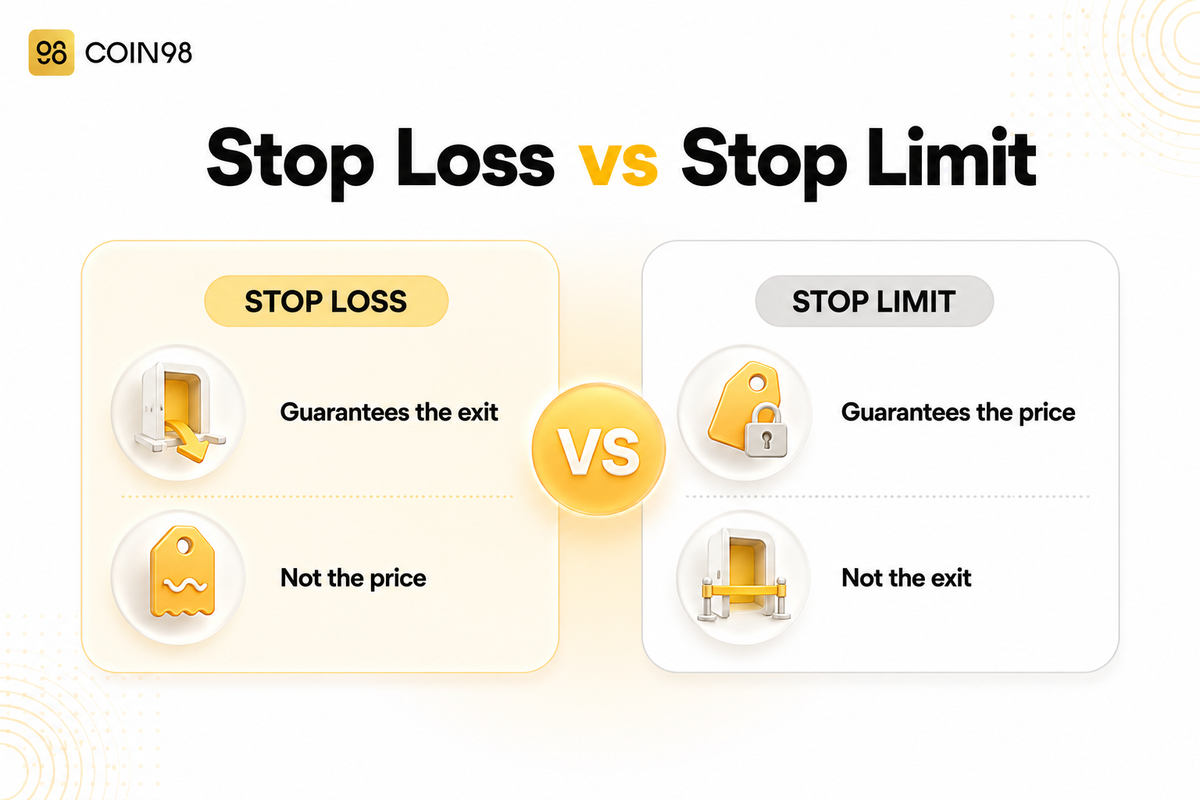
The difference between a stop loss and a stop limit is one trade-off: a stop loss almost always gets you out, but not at a price you choose; a stop limit fixes the price and may never fill at all. That sounds academic until a day like 10 October 2025, when more than $19 billion of crypto leverage was liquidated in roughly a day and BTC top-of-book depth shrank by more than 90% on key venues, according to FTI Consulting. On days like that, one of these orders saves you and the other quietly leaves you holding the bag.
Stop loss vs stop limit: the difference in one table
A stop loss becomes a market order when triggered; a stop limit becomes a limit order. Everything else follows from that single mechanical difference.
| Stop loss | Stop limit | |
|---|---|---|
| Prices you set | One (stop price) | Two (stop price + limit price) |
| What it becomes when triggered | Market order | Limit order |
| Execution | Very likely | Not guaranteed |
| Price you get | Not guaranteed | Guaranteed at your limit or better |
| Main failure mode | Filled far below your stop (slippage) | Never fills at all (gap risk) |
| Best suited to | Getting out, no matter what | Getting a specific price, if available |
| Beginner friendliness | Higher — one parameter to choose | Lower — two parameters that interact |
Neither order type is inherently safer. They fail in opposite directions, and choosing well means deciding which failure you can live with.
What a stop loss order does
A stop loss order sells your position at the market price as soon as a price level you chose is reached. You set one number — the stop price. If the market touches it, the order converts to a market order and fills at whatever the next available price is.
Say you hold ETH at $2,400 and set a stop loss at $2,200. If ETH trades down through $2,200, your position sells at roughly that level in a normal market. In a fast market it may fill at $2,180 or $2,150. That difference is slippage, and it widens exactly when you most want protection — during the sharp moves that trigger stops in the first place. A market order does not fill at one price: it walks down the order book, taking each level until filled, and through a router or aggregator it may cross several venues at once. The thinner the book, the further it walks. In the October 2025 cascade, FTI Consulting recorded spreads widening from single-digit basis points to double-digit percentages at the extremes.
If you trade leverage, the stop loss lives inside the position rather than beside it. Coin98 Futures lets you attach a take profit and a stop loss when you open a position, or add them afterwards. One detail from the docs is worth internalizing: a stop loss is only effective if it sits between the current price and your liquidation price. Set it beyond the liquidation price and the exchange closes you out first — the stop never gets a turn.
A few refinements are worth knowing if your venue offers them: a reduce-only flag keeps a triggered order from opening a position in the opposite direction, trailing stops follow the price up as the trade works, and guaranteed stops — rare in crypto, standard at traditional brokers — remove slippage risk for a premium.
What a stop limit order does
A stop limit order places a limit order at a price you specify once your stop price is touched. You set two numbers: the stop price that arms the order, and the limit price that defines the worst fill you will accept.
Kraken's worked example is a clean illustration: holding 1 ETH bought at $2,000, you set a stop at $1,800 and a limit at $1,750. If ETH falls to $1,800, a limit order goes live and fills only at $1,750 or better. The upside is that you cannot be dumped at a panic price. The downside catches people out — as Kraken puts it, if "the market gaps past your limit price too quickly, the order may not fill." A stop at $50 with a limit at $48 does nothing at all if the asset crashes straight through to $45.
A stop limit that does not fill is not a partial loss; it is no protection at all, and you still own the position at a much lower price.
Which one actually protects you in a crash?
In a genuine crash, a stop loss protects you and a stop limit often does not. Crashes are precisely the conditions — thin books, gapping prices, vertical candles — where a limit order gets skipped over.
That said, "protects you" deserves a caveat. A stop loss protects you from an open-ended loss, not from a bad price. It converts an unknown loss into a known-but-unpleasant one.
A practical way to think about it:
- A stop loss suits large-cap assets you want out of, leveraged positions, and any scenario where the downside is genuinely open-ended.
- A stop limit suits thin, low-liquidity tokens where a market order could fill absurdly low; taking profit rather than cutting losses; and cases where you are willing to stay in the trade if your price is not available.
- Both together is also an option — some traders place a stop limit near their target exit and a wider stop loss further out as a backstop, accepting a worse price on the tail scenario in exchange for a better one in the common case.
Worth noting: a stop order and a liquidation are not the same thing. A stop is your instruction; a liquidation is the exchange closing you out when your margin runs out. Our guide to perpetual DEXs and on-chain leverage covers how that threshold is calculated, and DeFi lending 101 walks through the same mechanic on the lending side.
Where to put your stop price
Your stop belongs at the price that proves your trade wrong, offset far enough to survive normal noise. There are three common methods, and they are not equally good.
Percentage. The simplest and the weakest. Flipster's placement guide puts the workable ranges at 3–8% for Bitcoin and large-cap L1s, 6–12% for mid-caps and DeFi tokens, and 10–15% for low-cap and meme coins — with the caveat that position size shrinks as the stop widens. Stop-placement analysis from Trader's Second Brain is blunt about why percentages underperform: they "ignore the two key inputs that determine stop quality: volatility and structure."
Structure. Place the stop just beyond the level that would invalidate your reason for being in the trade — a swing low, a range boundary, a moving average you were trading off.
Volatility (ATR). Size the stop to how much the asset actually moves. Typical multiples run 1.5–2.0× ATR for day trading and 2.5–3.0× ATR for swing trading, per Trader's Second Brain. The appeal is that it tightens automatically in calm markets and widens in violent ones. These are heuristic ranges, not settings — the right multiple depends on timeframe, the asset's own range, and how much noise you can sit through.
The strongest approach combines the last two: anchor to structure, then add a buffer of roughly 0.3–0.5× ATR beyond the level so ordinary wicks do not touch it.
On the stop-limit gap, the same logic applies in reverse. Setting the limit only a hair below the stop maximizes the chance of no fill. Kraken's guidance is to pick a distance that reflects your risk tolerance and the nearby support or resistance zones, rather than a tight spread that trips on minor fluctuations.
Why your stop triggers and then the price bounces back
Stops cluster at obvious levels, and clustered stops attract traders who profit from triggering them. Ouinex defines stop hunting as "the deliberate act of moving price to a level where a cluster of stop-loss orders sits."
The predictable clusters sit at round numbers, just below recent swing lows, at visible support and resistance, and at the previous day's high or low. The tell is a sharp wick — a spike that reverses inside the same candle.
This is an order-book phenomenon. An AMM has no resting stops to sweep — price follows a curve set by pool reserves — so the equivalent risk there is a large trade or a sandwich pushing you through your level.
Two habits reduce your exposure without much effort. First, we'd suggest not placing stops exactly at round numbers or precisely at the obvious level; a little beyond is where the hunt tends to exhaust itself. Second, if a wider stop is the right call, cutting position size keeps the maximum loss the same. A wider stop on a smaller position risks identical dollars and gets tagged far less often.
The arithmetic argues against letting losses run, too. Flipster's recovery table is a useful reality check: a 10% loss needs about an 11% gain to break even, but a 20% loss needs 25%.
How to set a stop loss and take profit on Coin98
You can attach both when you open a position. Inside Coin98 Futures in the Coin98 Super Wallet, per the official docs:
- Open a Long or Short position using either the Market tab (immediate execution) or the Limit tab (your specified price).
- Enable Take Profit, Stop Loss, or both — during position creation, or later on an open position.
- Enter either a target price or a percentage; the app calculates the other for you.
- Check that your stop loss sits between the current price and the liquidation price, otherwise it will not do anything.
For spot swaps, the equivalent control is slippage tolerance — it caps how far from the quoted price a swap may fill, which is the same "price certainty versus execution certainty" trade-off in a different wrapper. If you are new to leveraged products entirely, our explainer on what perps are is a better first stop than a live position.
FAQ
Is a stop loss or a stop limit better for beginners? A stop loss is generally the better default. It involves one parameter instead of two, and its failure mode — a worse fill than expected — is less damaging than a stop limit's failure mode, which is no exit at all. Stop limits become useful once you are trading thinner markets and understand gap risk.
Can a stop limit order really just never fill? Yes. If price moves through your limit without trading at or above it, the order stays open and unfilled while your position keeps losing value. This is the most common surprise for people switching from stop losses to stop limits.
Does a stop loss protect me from liquidation? Only if it is set between the current price and the liquidation price. Coin98's futures documentation makes this explicit — a stop loss placed beyond the liquidation price never executes, because the position is closed out before the stop is reached.
What's a reasonable stop loss percentage in crypto? Placement guides put roughly 3–8% on Bitcoin and large caps, 6–12% on mid-caps, and 10–15% on low-cap tokens, per Flipster. These work better as sanity-check ranges than as rules — a stop derived from chart structure and volatility usually beats a fixed percentage.
Why did my stop trigger right before the price recovered? Most likely your stop sat in a crowded zone — a round number or an obvious support level. Stop clusters are visible targets, and price often reverses immediately after clearing them. Moving the stop slightly beyond the obvious level and trimming position size to compensate helps.
Can I use a stop loss on a DEX? Native stop orders need a system watching the market and firing the order for you, which is why they are standard on derivatives products and less common in plain on-chain swaps. On-chain workarounds exist — keeper networks and limit-order protocols can watch a price and submit the trade for you — but they add fees, a trust assumption about whoever runs the automation, and front-running risk, since a pending order at a known price is public. On spot swaps, slippage tolerance is the closest equivalent control.
The takeaway
Stop loss versus stop limit is not a question of which order is safer — it is a question of which failure you would rather absorb. A stop loss accepts a worse price to get the exit. A stop limit accepts no exit to hold the price. For most people, most of the time, on assets with real liquidity, the exit is the one worth having. We'd suggest anchoring the level to structure and volatility rather than a round number, and sizing the position so a wider stop stays affordable. If you trade leverage, you can set take profit and stop loss together inside Coin98 Futures.
Last updated: July 2026