Is crypto anonymous? How a name gets linked to a wallet address
Your wallet address has no name on it, but one link exposes its whole history. How names get tied to addresses, and how to keep yours private.
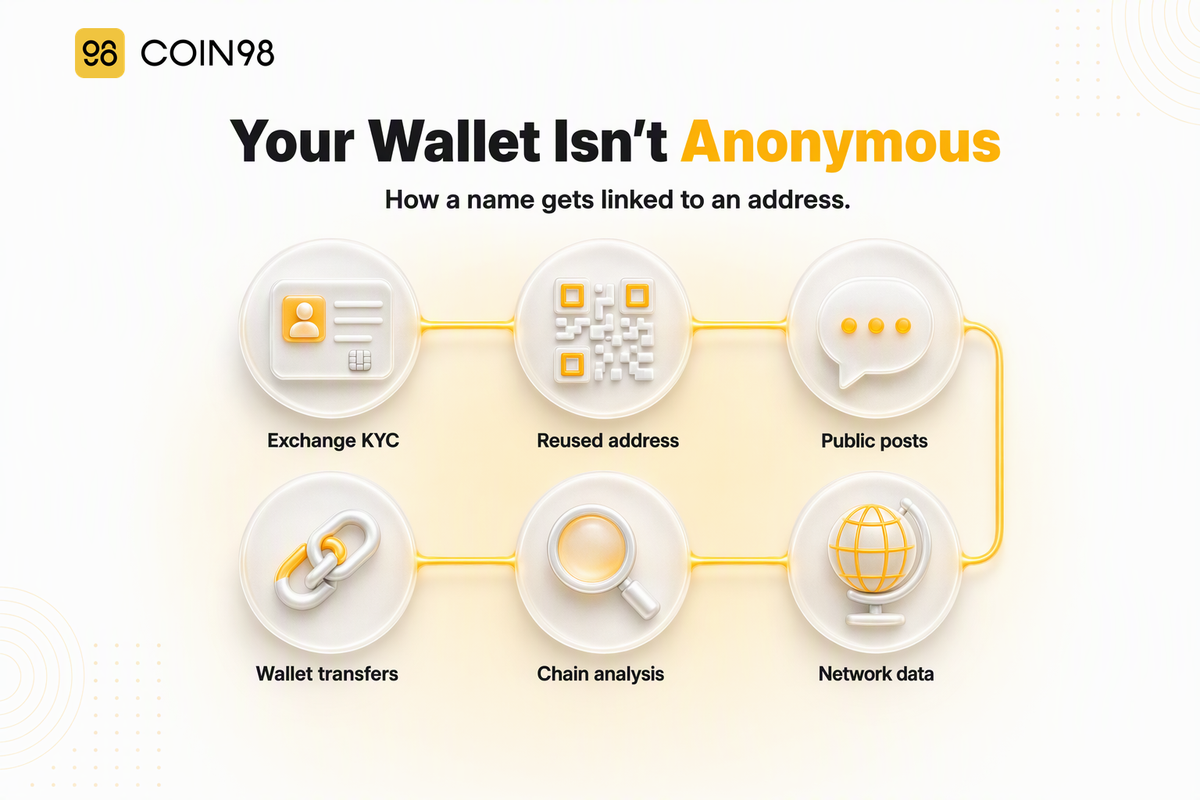
Your wallet address doesn't have your name on it, so it's easy to assume nobody knows it's yours. That's the most common misunderstanding about crypto privacy. Is crypto anonymous? For most public blockchains, no. They're pseudonymous: every transaction is public forever, and the only thing missing is a name. It only takes one link between you and one address to expose its full history. Here's what anyone can see, the everyday actions that create that link, who uses it, and how to keep your wallet more private.
Last updated: October 2026
Is crypto anonymous?
Crypto on public blockchains like Bitcoin and Ethereum isn't anonymous. It's pseudonymous. Your address is a pseudonym: a string of characters with no name attached, but with a complete, public record of everything it has ever sent and received.
Anonymous vs pseudonymous
Anonymous means there's nothing to connect an action to you. Pseudonymous means your actions are all recorded under one consistent label, just not your real name. Think of an online forum handle. Nobody knows who "trader_88" is, until they post a selfie. After that, every past post is theirs too.
Blockchains work the same way. The label is your address, and the record is permanent, so a link made today also exposes everything that happened before.
What anyone can see
Anyone with an internet connection can look up an address on a block explorer. You can try it with your own: in Coin98 Super Wallet, you can open any of your addresses on a blockchain explorer in a few taps and see exactly what a stranger would see.
| Public on-chain | Not on-chain |
|---|---|
| Every address that sent and received funds | Your name, email, or phone number |
| Exact amounts and the current balance | Your location |
| Date and time of every transaction | Which person controls which address |
| Fees paid | Your seed phrase or private key |
| Tokens, NFTs, and apps the address has interacted with | Off-chain records held by exchanges and apps |
The right-hand column is the gap that keeps you private. Everything in the next section is about how that gap gets closed.
How a name gets linked to a wallet address
A name gets linked to a wallet address when an identity and an address meet somewhere: an account, a public post, a payment, or a pattern. Specialist analysis firms then group addresses that are likely controlled by the same person, so one link can spread across many addresses. These are the five most common links.
Exchange accounts
When you buy crypto on a regulated exchange, you complete KYC (know your customer) checks with your ID. When you withdraw to your own wallet, the exchange records that destination address against your account. That's the strongest link most people create, and it's usually their first one. A custodial account is a named account by design.
Reusing addresses
Every payment sent to the same address is visibly connected. If you receive a salary, a refund, and a payment from a friend at one address, anyone who knows one of those payers can see the rest. On Bitcoin, wallets can generate a new address for each payment. On Ethereum-style chains, most people use one address for nearly everything, which makes this link stronger.
What you publish
Many links are self-made. Posting a wallet address for donations, sharing a payment screenshot, or putting a Web3 domain name like an ENS name in your social media bio all connect a public profile to an address. A readable name is convenient, but it also turns your wallet into a public profile.
Moving funds between your own wallets
Using separate wallets for different purposes only helps privacy if they stay unlinked. Sending funds directly from your main wallet to a new one creates an on-chain trail between them. So does spending coins from two of your addresses in a single Bitcoin transaction, which analysts commonly read as both addresses belonging to one owner.
Your network connection
When you send a transaction, your wallet connects to the network through a server or node. Your IP address isn't written on the blockchain, but the service that receives your request can see it. This link is weaker and harder to use, but it exists.
This isn't new. In 2013, university researchers bought goods and services from known Bitcoin businesses to label a small set of addresses, then grouped other addresses around them. Their conclusion: anyone with the power to request customer records from exchanges would be well placed to see who was paying whom. Analysis tools have grown far more powerful since.
Who connects the dots
Three groups use these links: tax authorities, investigators, and criminals. The first two are why crypto is a poor tool for hiding money. The third is why ordinary users should care about privacy.
Tax authorities
Exchanges increasingly report customer activity to tax authorities. In the US, brokers must file Form 1099-DA for digital asset sales from the 2025 tax year, reporting gross proceeds to both the customer and the IRS, and in some cases the cost basis too. Combined with the exchange's record of your withdrawal addresses, that gives tax authorities a starting point on-chain.
Investigators
In 2016, 119,754 BTC were stolen from the Bitfinex exchange. Over the next five years, about 25,000 of those coins were moved through a complex laundering process. In February 2022, US authorities seized more than 94,000 of the remaining bitcoin, worth about $3.6 billion at the time, and arrested two people in New York, who later pleaded guilty. The break came from an off-chain link: agents found a file of about 2,000 addresses and keys in one suspect's cloud storage, and blockchain analysis confirmed almost all of them were tied to the hack.
Scammers and criminals
A balance tied to a name or face can make you a target. That includes phishing and social engineering, but also physical "wrench attacks", where criminals threaten or kidnap holders to force a transfer. One security firm counted 72 verified wrench attacks in 2025, up 75% from 2024, with confirmed losses above $40.9 million. In one case, a French tax official was charged with using government databases to identify crypto investors and passing their details to criminal groups.
Privacy isn't about hiding wrongdoing. It's about not advertising how much you hold and where to find it.
How to keep your wallet more private
You can't make a public blockchain anonymous, but you can control how many links you create. A few habits cover most of the risk for everyday users.
A simple privacy routine
- Separate your public and private activity. Use one wallet for public things (donations, NFT profiles, ENS names) and a different wallet for savings.
- Don't link the wallets directly. We'd recommend against funding a private wallet straight from a public one. Each direct transfer is a visible connection.
- Use fresh addresses where your wallet allows it. On Bitcoin, use a new receiving address for each payment rather than reusing one.
- Think before you post. Screenshots of balances, transaction links, and addresses in bios all create permanent links. Crop or blur them.
- Keep exchange withdrawals in mind. Any address you withdraw to from an exchange is on record with that exchange. Plan which wallet that is.
- Check what's visible. Look up your own address on a block explorer every so often to see what a stranger would see.
We'd also suggest being cautious with crypto mixers. Mixing services have faced sanctions and criminal cases in several countries, and exchanges often flag or freeze funds that have passed through them, which can create more problems than it solves.
Setting up separate wallets in Coin98 Super Wallet
Coin98 Super Wallet is non-custodial, so your keys stay with you rather than in an exchange account. You can create several multichain wallets in one app, each covering 100+ blockchains, and choose from hot, cold, social, and watch-only wallet types. Keep in mind that a social wallet signs in with an email or social account, so for a wallet you want to keep private, a hot wallet with its own seed phrase creates fewer links.
A watch-only wallet is a useful reminder of how public addresses are: you can add any address and follow its balance without holding its keys. Anyone can do the same with yours.
FAQ
Is Bitcoin anonymous? No. Bitcoin is pseudonymous. Addresses don't carry names, but every transaction is public and permanent, so once an address is linked to a person, its whole history is visible. Exchange records, address reuse, and public posts are the most common links.
Can crypto be traced? Yes. Transactions on public blockchains can be followed from address to address, and analysis tools group addresses that likely belong to the same owner. Combined with exchange records, investigators have traced and recovered large amounts of stolen crypto, such as more than 94,000 bitcoin from the 2016 Bitfinex hack.
Can someone find my name from my wallet address? Not from the blockchain alone. But if your address has been linked to you through an exchange withdrawal, a public post, an ENS name, or a payment to someone who knows you, your name and that address can be connected. After that, anyone with the link can see your balance and history.
Is it safe to share my wallet address? It's safe in the sense that nobody can take funds with only your address. But it reveals your balance and transaction history to whoever receives it. For public use, we suggest sharing an address from a separate wallet that doesn't hold your savings.
Does using multiple wallets make me anonymous? Not by itself. Separate wallets help privacy only when they stay unlinked. If you move funds directly between them, or withdraw to both from the same exchange account, they can be connected.
Are privacy coins anonymous? Some privacy-focused coins hide amounts or addresses by design, which makes tracing much harder. They also face regulatory pressure, and some exchanges have removed them in certain regions. Most everyday activity on major chains like Bitcoin and Ethereum stays pseudonymous.
The short version
So, is crypto anonymous? On public blockchains, no. It's pseudonymous, and one link between you and an address is enough to reveal its history. Most links come from everyday actions: exchange withdrawals, reused addresses, public posts, and transfers between your own wallets. Keep public and private activity in separate, unlinked wallets. Coin98 Super Wallet lets you run several non-custodial wallets in one app, each with its own addresses across 100+ chains.