APY vs APR in crypto: why one pool shows two numbers
APR is the simple rate, APY assumes every reward is reinvested. How compounding changes the number, and what neither one tells you.
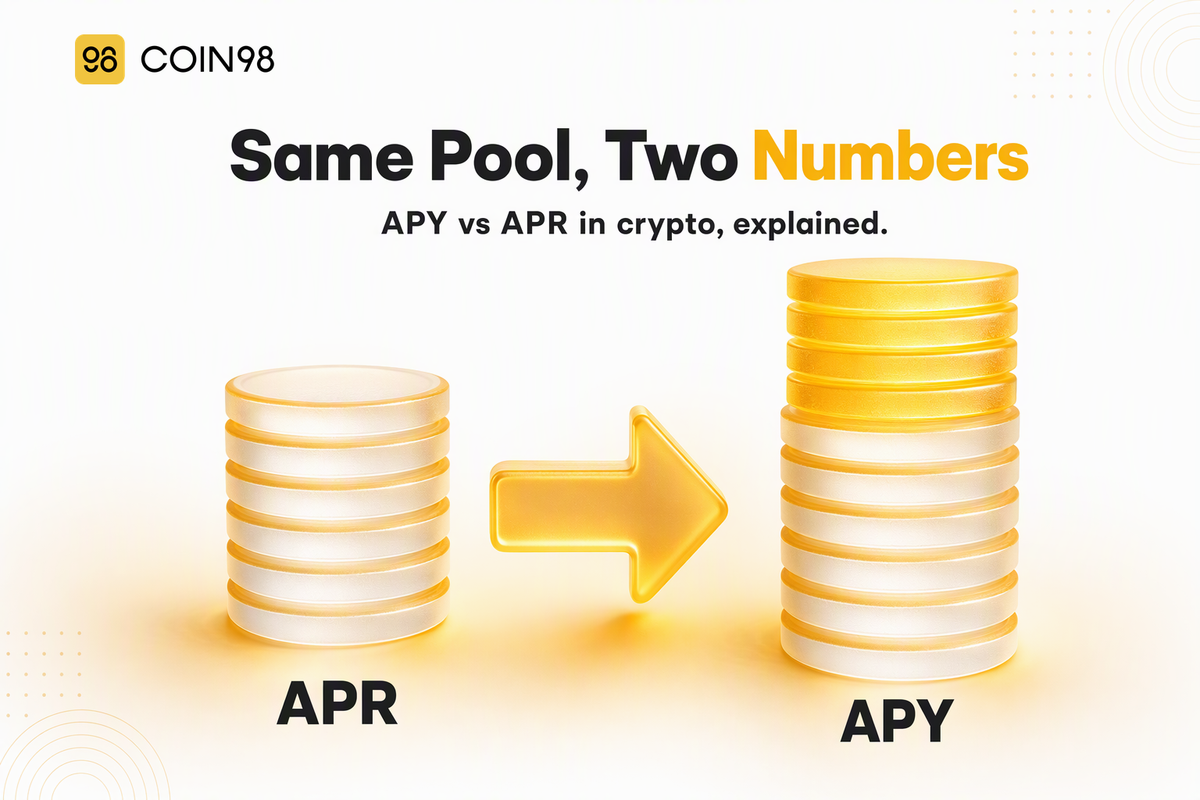
You open a staking page and it says 20% APR. The next app offers the same token at 22% APY. Is the second one better? Not necessarily. In crypto, APY vs APR isn't a choice between two products. It's two ways of describing the same yield. APR is the simple yearly rate. APY is the rate you'd earn if every reward were reinvested on schedule. Here's how to convert between them, how much compounding really adds, and what neither number tells you.
Last updated: October 2026
What's the difference between APY and APR?
APR (annual percentage rate) is the yearly return without compounding. APY (annual percentage yield) is the yearly return with compounding, which means your rewards earn rewards too. For the same pool, APY is always equal to or higher than APR, because it assumes you reinvest every payout.
APR: the simple yearly rate
Stake 1,000 tokens at 10% APR and you earn 100 tokens over a year, as long as you don't reinvest anything. If rewards are paid out to your wallet and you leave them there, APR is your real return.
APY: APR with compounding
APY assumes each reward goes straight back into the pool. At 10% APR compounded daily, those 1,000 tokens become about 1,105 after a year instead of 1,100. That's an APY of about 10.5%.
The catch is the word "assumes". Some products compound automatically, for example by adding rewards to your deposited balance. Many don't. If you have to claim and re-stake rewards yourself, the APY only happens if you actually do it.
The formula
To convert APR to APY:
APY = (1 + APR ÷ n)ⁿ − 1
Here, n is the number of times rewards compound per year: 12 for monthly, 52 for weekly, 365 for daily. Use the rates as decimals, so 10% becomes 0.10.
In traditional banking, APY is a regulated term. US banks must calculate it in a set way, based on the interest rate and how often it compounds over 365 days, so customers can compare accounts. Crypto platforms have no equivalent standard. One app might show APR, another APY, and a third a number based on the last 24 hours. That's why it pays to check which one you're looking at.
How much does compounding really add?
Compounding adds very little at low rates and a lot at high rates. At 5% APR, daily compounding adds about 0.13 percentage points. At 100% APR, it adds more than 70.
| Stated APR | APY, monthly compounding | APY, weekly | APY, daily |
|---|---|---|---|
| 3% | 3.04% | 3.04% | 3.05% |
| 5% | 5.12% | 5.12% | 5.13% |
| 10% | 10.47% | 10.51% | 10.52% |
| 20% | 21.94% | 22.09% | 22.13% |
| 50% | 63.21% | 64.48% | 64.82% |
| 100% | 161.30% | 169.26% | 171.46% |
Small rates, small gap
For typical staking yields, the APR and APY are almost the same. Native ETH staking paid roughly 2.8%–3.3% APR in mid-2026, and at 3% the difference between APR and daily-compounded APY is 0.05 percentage points. On $1,000, that's about 50 cents a year. At these rates, the reward rate matters far more than compounding.
Big rates, big gap
At high rates, compounding transforms the headline. A 100% APR compounded daily shows up as roughly 171% APY. That's one reason high-yield pools and farms tend to advertise APY: the bigger number looks better on a banner. But a triple-digit APY only holds if the rate stays that high all year and every reward is reinvested daily, which rarely happens.
Is 10% APR better than 9% APY?
Yes, on the same asset. Compounding can only push a rate up, so 10% APR is worth at least 10% a year, which beats 9% APY however often either one compounds. Some explainers get this wrong. The fair way to compare two offers is to convert both into the same unit, usually APY, at the same compounding frequency.
Why a crypto APY isn't a bank APY
A bank APY tells you what a fiat balance will earn. A crypto APY is usually a snapshot of a variable rate, paid in a token that can change in price. Five things sit outside the number.
Rates move
Most crypto yields are variable. In lending protocols, the rate depends on how much of the pool is borrowed, so it changes every time someone borrows or repays. In staking, the rate often falls as more people join: more ETH staked means each validator gets a smaller share of new issuance. A displayed APY is what the pool is paying now, not what it will pay over the year.
Rewards can lose value
A pool can pay 50% APY in its own reward token. If that token halves in price over the year, your dollar return is roughly cut in half too. Some lending protocols also pay extra incentive tokens on top of the base rate, and those incentive rewards may not compound at all. We suggest checking which token the rewards are paid in, and whether it has real demand beyond the pool itself.
Impermanent loss isn't in the number
Liquidity pool APYs show fee and reward income. They don't include impermanent loss, the gap between providing liquidity and simply holding the two tokens. In a standard 50/50 pool, if one token doubles in price against the other, you end up about 5.7% worse off than if you'd held. At a 5× move, the gap is about 25.5%. A 15% APY doesn't mean much if a price swing takes back 25%.
Compounding costs gas
If you compound manually, every claim and re-stake is a transaction. At 5% APR on $500, daily compounding adds only about 63 cents a year over simple interest, so a single $2 network fee more than cancels it. Compounding only pays when fees are small compared with the extra rewards.
Lock-ups
Some products lock your tokens for a set period or make you wait to withdraw. A slightly higher APY with a 90-day lock may be worth less to you than a lower rate you can exit any time, especially in a volatile market.
How to compare two yield offers
To compare two offers fairly, convert both to the same unit, then check what each number leaves out. This checklist takes a few minutes.
A quick comparison checklist
- Find out which number you're looking at. APR or APY? If it's APY, how often does it compound, and is that automatic?
- Convert to the same unit. Use the formula above, or compare APR with APR.
- Check if the rate is fixed or variable. A variable rate is a snapshot. Look at how it has moved over recent weeks, not just today.
- Check the reward token. Are rewards paid in the token you deposited, or in a separate token whose price can fall?
- Count the costs. Network fees to deposit, claim, compound, and withdraw, plus any lock-up or withdrawal wait.
- Ask where the yield comes from. Trading fees, borrower interest, and network rewards are real sources. If you can't find one, we'd recommend staying away. Our guide to earning stablecoin yield safely covers this in more detail.
An unusually high, fixed APY with no clear source is one of the most common signs of a scam. We've covered how fake staking sites use this to lure deposits.
How Coin98 staking shows rates
Staking inside Coin98 Super Wallet runs through Stake Master, and you claim rewards with a Harvest button. Fixed Rate and Dynamic Rate Staking both quote their rates as APR, so your real return is the APR unless you re-stake what you harvest. The two work differently:
- Fixed Rate Staking locks your tokens at a fixed APR for the staking period, so the rate won't change after you join.
- Dynamic Rate Staking has an APR that can rise or fall depending on how many tokens are staked in the pool.
If you want to compound by hand, network fees matter. Coin98 PowerPool supports zero gas fees for staking, unstaking, and harvesting C98 on the Viction network, so re-staking your rewards doesn't cost you a fee each time.
FAQ
Is APY always higher than APR? For the same rate, yes, or equal. APY includes compounding, and compounding can only add to the return. If an offer compounds once a year, its APY and APR are the same.
How do I convert APR to APY? Use APY = (1 + APR ÷ n)ⁿ − 1, where n is how many times a year rewards compound, with rates as decimals. For example, 10% APR compounded daily is (1 + 0.10 ÷ 365)³⁶⁵ − 1, or about 10.52% APY.
Why did my pool's APY drop overnight? Most crypto yields are variable. A lending rate falls when fewer people borrow, a staking rate can fall when more people stake, and a farm's APY drops when its reward token loses value or its emissions are reduced. The number shown is a snapshot of current conditions.
Is a 1,000% APY real? It can be real for a short time, but it rarely lasts. Very high APYs usually come from new reward tokens, and they shrink as more money enters the pool or as the reward token's price falls. An extremely high fixed APY with no clear source of yield is a common warning sign of a scam.
Should I compound my staking rewards? It depends on your rate and your costs. At low rates, compounding adds little, and network fees can cancel it out. At higher rates, or where fees are close to zero, regular compounding makes a noticeable difference over a year.
What's a realistic staking yield? It varies by network and changes over time. Native ETH staking paid roughly 2.8%–3.3% APR in mid-2026. Yields far above the network's normal range usually come with extra risk, such as leverage, a new reward token, or a lock-up.
The short version
APY vs APR in crypto comes down to one assumption: whether your rewards get reinvested. Convert offers into the same unit, then look past the number at what it leaves out: variable rates, reward-token prices, impermanent loss, fees, and lock-ups. When you're ready to stake, Coin98 Super Wallet lets you choose between a fixed APR and a dynamic one, and PowerPool removes gas fees for harvesting and re-staking C98 on Viction.