What Is Hyperliquid? A Beginner's Guide to the On-Chain Perp DEX
Hyperliquid is the largest on-chain perp DEX. Here's how it works, what the HYPE token does, and the risks before you trade.
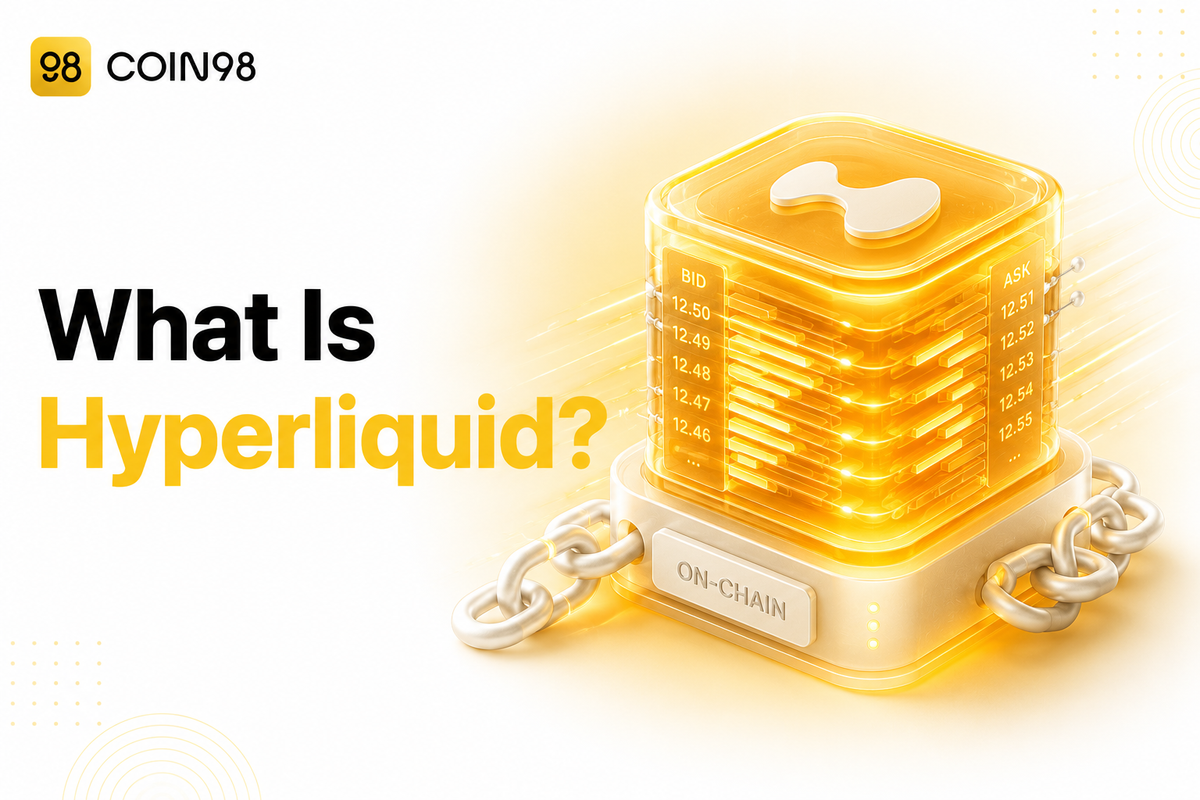
Hyperliquid is a decentralized exchange for perpetual futures that runs on its own Layer 1 blockchain, and by mid-2026 it had become the largest venue of its kind — processing roughly $195 billion in trading volume over a rolling 30-day window. If you've seen "HYPE" trending and wondered what the fuss is about, the short version is this: Hyperliquid put a full trading order book directly on a blockchain, something most projects said couldn't be done at speed. This guide breaks down what it is, how it works, what the HYPE token does, and the risks worth knowing before you touch it.
What is Hyperliquid, in plain terms?
Hyperliquid is both a blockchain and an exchange built on top of it. Most crypto projects are one or the other — Ethereum is a blockchain, Binance is an exchange. Hyperliquid is a purpose-built Layer 1 whose main job is to run a perpetual futures exchange with the speed of a centralized platform and the self-custody of DeFi.
"Perp DEX" is the label you'll see most often. It's shorthand for a decentralized exchange for perpetual futures — a place to trade leveraged long or short positions on assets like Bitcoin, Ethereum, and Solana without owning the underlying coin, and without handing your funds to a company. If terms like leverage and funding rate are new, our perpetual DEX guide covers the mechanics in depth.
One detail sets Hyperliquid apart from most of crypto: Hyperliquid Labs took no venture capital funding and ran no presale. The project distributed a large share of its token directly to early users instead — more on that below.
How does Hyperliquid work?
Hyperliquid runs on three tightly integrated pieces: HyperCore, HyperEVM, and HyperBFT. Together they let an order book — the list of every buy and sell order — live entirely on-chain, which older blockchains were too slow to support.
HyperCore — the trading engine
HyperCore handles all the trading: matching orders, tracking margin, and executing liquidations. Every order placement, cancellation, and fill is recorded on the blockchain itself rather than on a company's private servers. This is what makes Hyperliquid a genuinely on-chain exchange rather than a website with a wallet-connect button.
HyperEVM — the developer layer
HyperEVM is an Ethereum-compatible layer that lets developers build apps — lending protocols, stablecoins, and more — that tap directly into HyperCore's trading liquidity. It isn't a separate chain; it's secured by the same consensus. As of July 2026, HyperEVM held roughly $1.36 billion in total value deposited.
HyperBFT — the speed
HyperBFT is the consensus mechanism that keeps every validator in agreement. It confirms a new block roughly every 0.07 seconds, and the network processes about 200,000 orders per second — fast enough to feel like a centralized exchange. For comparison, Ethereum settles a block roughly every 12 seconds.
The practical payoff: you get near-instant trades and an order book you can independently verify on-chain, without trusting a custodian to hold your balance honestly.
The HYPE token explained
HYPE is Hyperliquid's native token. It pays for network fees, secures the chain through staking, and captures a share of the protocol's trading revenue. Its origin story is the reason so many people know the name.
In November 2024, Hyperliquid ran one of the largest airdrops in crypto history: 31% of HYPE's total supply — roughly 310 million tokens — went directly to more than 90,000 early users, per CoinLedger. At launch, the average airdrop was worth around $28,000 per recipient. No VCs, no presale — just users who had traded on the platform.
Here's how the pieces fit together:
| HYPE function | What it does |
|---|---|
| Gas & fees | Pays for transactions on the Hyperliquid L1 |
| Staking | Validators self-stake to secure the network and earn rewards |
| Buybacks | A large share of trading fees is used to buy HYPE on the open market |
| Governance | Holders weigh in on protocol parameters |
The buyback mechanism is central to the "real yield" story. An estimated 97–99% of trading fees fund open-market HYPE purchases, and roughly 44.4 million HYPE — worth about $2.2 billion — had been repurchased through June 2026, according to on-chain buyback data. That ties the token's demand to actual platform usage rather than pure speculation.
One caveat worth flagging: starting November 29, 2025, approximately 238 million HYPE (about 23.8% of total supply) began unlocking over a 24-month period, per CoinLedger. New supply entering circulation can create downward price pressure, which is one reason the token is volatile.
How to start trading on Hyperliquid
Getting started follows a familiar DeFi pattern. Here's the typical flow:
- Fund with USDC. Hyperliquid uses USDC as collateral. You bridge USDC in — commonly from Arbitrum — using Hyperliquid's native bridge. BTC, ETH, and SOL can also be deposited from their native chains.
- Choose a market. Hyperliquid lists 350+ markets spanning crypto, commodities, forex, and equity indices.
- Set your position. Pick long or short, choose isolated or cross margin, and set your leverage. Headline maximum leverage is 50x, though the platform has trimmed limits on major assets — around 40x on BTC and lower on others after a large liquidation event — high enough to amplify both gains and losses sharply.
- Manage funding. Because perps never expire, you pay or receive a small "funding rate" periodically to keep the contract price tethered to the spot price.
Fees are low by design. Trading fees start around 0.045% for takers and 0.015% for makers, per CoinLedger — below many centralized competitors — and placing or cancelling an order costs no network fee.
A practical note for some readers: Hyperliquid is not available to users in the United States due to derivatives trading restrictions.
Is Hyperliquid safe?
Hyperliquid is non-custodial and secured by a validator network, but "safe" depends on which risk you mean — the protocol's security is a different question from the risk of leveraged trading. Here's a balanced view.
On the security side, the network uses 27 validators, and transactions require agreement from more than two-thirds of staked HYPE. Validators must self-stake a minimum of 10,000 HYPE locked for a year, and a 7-day unstaking queue guards against sudden coordinated exits. You keep custody of your funds throughout — the same self-custody principle that underpins a non-custodial wallet.
On the risk side, three things deserve caution. First, leverage is a double-edged sword: a small adverse price move can trigger a liquidation that wipes out your margin. Second, the platform has had reliability hiccups — a July 2025 outage lasted 37 minutes and led to roughly $2 million in user refunds, per CoinLedger. Third, HYPE itself is highly volatile, and the multi-year token unlock adds ongoing supply pressure.
Bottom line: the infrastructure is credible and genuinely self-custodial, but perpetual futures with leverage are an advanced product. Beginners should size positions carefully and treat leverage with respect.
Hyperliquid vs. a simpler starting point
Hyperliquid dominates its niche — it commands roughly 36% of decentralized perp-DEX volume as of July 2026, ahead of rivals like Aster and Lighter (earlier figures put its share above 60%). But its power-user interface and leverage aren't the gentlest on-ramp for someone new to derivatives.
If you want to explore perps in a more guided, mobile-first environment, Coin98 Perps lets you trade futures directly inside the self-custody Coin98 Super Wallet, with a straightforward step-by-step flow for placing a futures trade. You stay in control of your keys the whole time — the same non-custodial principle Hyperliquid is built on, wrapped in an interface aimed at newer traders.
FAQ
What does "perp DEX" mean? It's a decentralized exchange for perpetual futures — leveraged contracts that track an asset's price and never expire. "Decentralized" means you trade from your own wallet instead of depositing funds with a company.
Did I miss the HYPE airdrop? The main airdrop happened in November 2024 and distributed 31% of supply to over 90,000 early users. That specific event is over, but Hyperliquid and its ecosystem have run additional distributions since, so it's worth watching official channels rather than assuming the door is fully closed.
Is HYPE a good investment? It has strong fundamentals — market leadership and a fee-buyback model that ties demand to usage. But it's a young, highly volatile asset with a multi-year token unlock adding supply pressure. Treat it as a high-risk position, not a savings account, and never invest more than you can afford to lose.
Can I use Hyperliquid in the US? No. As of 2026 it's not available to US users because of restrictions on derivatives trading.
Do I keep custody of my funds? Yes. Hyperliquid is non-custodial — you trade from your own wallet, and the protocol never takes ownership of your keys.
The takeaway
Hyperliquid proved that a full trading order book can live on-chain at centralized-exchange speed, which is why it became the leading perp DEX and made HYPE a household name in crypto. It's genuinely self-custodial and technically impressive — but leveraged perps are an advanced product, and HYPE is a volatile asset. If perps interest you and you'd rather start with a simpler, mobile-first tool, you can trade futures in your own self-custody wallet with Coin98 Perps.
Last updated: July 2026