What is a stablecoin? A beginner's guide to digital dollars
A stablecoin is crypto built to stay worth $1 — here's how the peg works, the three types, whether they're safe, and how to buy them.
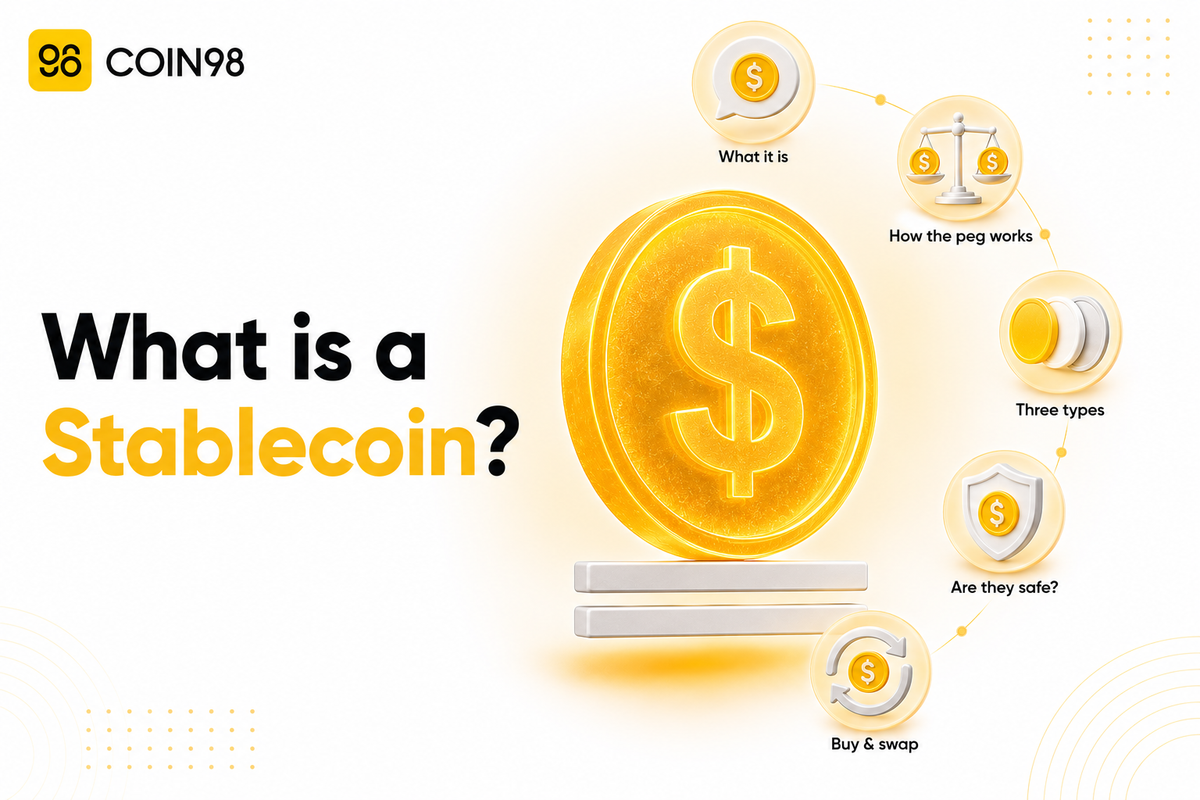
A stablecoin is a cryptocurrency designed to hold a steady value — almost always 1 token to 1 US dollar — so it behaves like digital cash instead of a speculative bet. That single design choice has made stablecoins one of the largest categories in crypto: the total stablecoin market sat at roughly $315 billion in mid-2026, according to DefiLlama, and stablecoins moved about $28 trillion in real economic volume during 2025, per Chainalysis. This guide explains what a stablecoin actually is, how it stays pegged to a dollar, the main types, whether they're safe, and how to buy, store, and swap them.
What is a stablecoin, in simple terms?
A stablecoin is a crypto token engineered to track the price of a stable asset — usually the US dollar — so that one token is worth about $1 at all times. J.P. Morgan Global Research defines it plainly as "a cryptocurrency designed to maintain a stable value relative to a certain asset." The dollar dominates: dollar-denominated stablecoins make up roughly 99% of the entire stablecoin market, according to J.P. Morgan.
This is what separates a stablecoin from Bitcoin or Ethereum. Bitcoin's price floats freely and can swing 5–10% in a day; a stablecoin is built to not do that. You hold a stablecoin for the same reasons you'd hold cash in a checking account — to pay, save, or move money — while keeping it on a blockchain where it settles in minutes, any hour of any day.
Coin98 Super Wallet treats stablecoins like any other asset you self-custody: USDT, USDC, and similar tokens live across the 150+ blockchains the wallet supports, under a single recovery phrase, so the same app that holds your Bitcoin also holds your digital dollars. Because it's non-custodial, you hold the keys — our documentation confirms the wallet never takes custody of your funds.
How do stablecoins work?
Stablecoins hold their value by being redeemable for — or backed by — something worth a dollar, so the market has a reason to keep trading them at $1. The mechanism that keeps the price glued to the dollar is called the peg, and "pegged to the dollar" simply means the token is designed to always be exchangeable for roughly $1 of value.
For the most common type, the peg works through reserves and arbitrage. The issuer holds $1 of real assets for every token it creates. If the token ever trades below $1, buyers step in to scoop up the discount and redeem tokens for a full dollar, which pushes the price back up; if it trades above $1, the issuer mints more tokens to meet demand, pushing the price back down. This constant two-way pressure is what holds the line at a dollar.
Not every stablecoin backs its peg the same way, though — and the how is exactly what determines how safe it is.
Types of stablecoins
There are three main types of stablecoins, distinguished by what backs the peg: fiat-backed, crypto-backed, and algorithmic. The backing model matters more than the logo — it's the single biggest factor in whether a stablecoin holds up under stress.
| Type | What backs it | Example use | Relative risk |
|---|---|---|---|
| Fiat-backed | Cash and short-term government securities held 1:1 in reserve | USDT, USDC | Lower — depends on issuer honesty and reserve quality |
| Crypto-backed | Other cryptocurrencies locked as over-collateral (e.g. $150 of crypto per $100 issued) | DAI | Medium — transparent on-chain, but exposed to crypto volatility |
| Algorithmic | No real reserves; code mints and burns tokens to chase the peg | (largely defunct) | High — prone to "death spiral" collapse |
Fiat-backed stablecoins are the simplest and by far the largest model. A centralized issuer holds reserves of cash or short-term government securities and issues one token per dollar held, redeeming and burning tokens when holders cash out, as Circle describes in its own breakdown. Tether (USDT) and Circle (USDC) together make up around 90% of the market, per J.P. Morgan — USDT alone holds roughly 59% dominance and USDC about 24%, according to DefiLlama.
Crypto-backed stablecoins lock up more crypto than they issue — over-collateralizing to absorb price swings — and manage everything transparently on-chain through smart contracts rather than a company's bank account.
Algorithmic stablecoins hold no real reserves at all. They rely purely on code that mints or burns tokens to nudge the price, as Kraken explains — and that's the model with the worst track record, for reasons the next section makes clear.
Are stablecoins safe?
Stablecoins are generally reliable for everyday use, but "stable" is a design goal, not a guarantee — and the safety gap between types is enormous. The clearest warning in stablecoin history is TerraUSD (UST), an algorithmic stablecoin that collapsed in May 2022 and erased roughly $50 billion in value in days when its code-based peg entered a "death spiral" it couldn't escape.
That failure reshaped the rules. The US GENIUS Act, signed in July 2025, established a federal framework that permits only stablecoins backed by real, liquid, verifiable assets — effectively banning purely algorithmic models. For a beginner, the practical takeaway is straightforward: the risk you're actually taking depends on the type.
The main risks worth understanding:
- Depeg risk — a stablecoin can temporarily trade below $1 if the market doubts its backing. Even large fiat-backed coins have briefly wobbled during banking scares before recovering.
- Reserve risk — with fiat-backed coins, you're trusting the issuer to actually hold the reserves it claims. Transparency and third-party attestations matter here.
- Issuer control — centralized issuers can freeze token balances flagged for sanctions or fraud, which is a feature for compliance but a consideration for users who prize censorship-resistance.
- No deposit insurance — stablecoins are not bank deposits and are not covered by government deposit insurance schemes.
A reasonable rule of thumb: we'd suggest sticking to large, well-established fiat-backed stablecoins with published reserve reporting, and treating any coin promising a stable value with no clear backing as a red flag.
What are stablecoins used for?
Stablecoins are used to send money, save in dollars, earn yield, and trade — anywhere the speed of crypto is useful but the volatility of crypto is not. Their real-world traction is now substantial: stablecoins settled about $28 trillion in real economic volume in 2025 and have grown at a 133% compound annual rate since 2023, according to Chainalysis.
The most common uses:
- Cross-border payments and remittances. Sending a stablecoin settles in minutes for a fraction of traditional wire or remittance fees, which is why the IMF has highlighted their appeal for cheaper cross-border transfers.
- A dollar store of value. In economies with high local inflation, people hold dollar stablecoins as a digital safe haven, a use case the IMF notes has driven adoption across emerging markets.
- Trading and DeFi. Traders park funds in stablecoins between trades to sit in "cash" without leaving the blockchain, and lending protocols pay yield on deposited stablecoins.
- Everyday spending. A growing number of cards and merchants accept stablecoin settlement directly.
How to buy, store, and swap stablecoins
Getting stablecoins takes one of two paths: buy them with regular money, or swap crypto you already hold into a stablecoin. Both end with the tokens sitting in a wallet you control.
Buying with fiat. Coin98 Super Wallet has a built-in fiat purchase flow powered by MoonPay: choose the token and amount, the app compares provider rates, you complete identity verification (KYC), pick a payment method, and the crypto lands directly in your wallet address — no separate exchange withdrawal step, according to our documentation. Expect provider-set minimum and maximum amounts and a fee that varies by token and network.
Swapping into a stablecoin. If you already hold crypto, you can convert it using SwapX, our native swap that aggregates multiple DEX aggregators across 7 chains — Ethereum, BNB Smart Chain, Polygon, Solana, Arbitrum, Base, and Sui. Its Smart Routing analyzes liquidity sources to find the most efficient path and reduce slippage; a typical swap is something like BNB into USDT on the same network, per our documentation.
Which chain to hold on. The same stablecoin exists on multiple blockchains, and network fees differ. Holding USDT on a low-fee chain like Solana or BNB Smart Chain makes small transfers cheap, while Ethereum can cost more per transaction — worth weighing before you move funds.
Storing safely. Because stablecoins are self-custodied tokens, your security is your recovery phrase. A multi-chain wallet like Coin98 Super Wallet holds stablecoins across 150+ chains under one seed phrase, so the same backup that protects your other crypto protects your digital dollars too.
FAQ
What is a stablecoin in simple terms? A stablecoin is a cryptocurrency built to stay worth about $1 by tracking the US dollar. It behaves like digital cash on a blockchain — useful for paying, saving, and sending money — without the price swings of Bitcoin or Ethereum.
Are stablecoins the same as real dollars? No. A stablecoin is a private token designed to be redeemable for or backed by a dollar's worth of assets, but it is not government-issued money and is not covered by bank deposit insurance. Its stability depends on the issuer's reserves or the mechanism backing it.
Are stablecoins safe to hold? Large fiat-backed stablecoins with published reserves are generally reliable for everyday use, but they carry depeg and issuer risk and are not insured. Algorithmic stablecoins have a far worse record — TerraUSD erased about $50 billion when it collapsed in May 2022 — and the US GENIUS Act of July 2025 now effectively bans purely algorithmic models.
What is the difference between USDT and USDC? Both are fiat-backed stablecoins pegged to the US dollar and together make up roughly 90% of the market. USDT (Tether) is the larger by circulation at around 59% market dominance, while USDC (Circle) holds about 24% and is often cited for its regulatory and reserve-reporting posture.
Can a stablecoin lose its peg? Yes. A stablecoin can trade below $1 if the market doubts its backing or during a liquidity scare, and even major coins have briefly wobbled before recovering. Purely algorithmic stablecoins can lose the peg permanently in a "death spiral."
The bottom line
A stablecoin is crypto's answer to holding dollars on a blockchain — steady in value, fast to move, and useful for payments, saving, and trading, which is why the market reached roughly $315 billion in 2026. The key is knowing what backs the coin you hold: large fiat-backed stablecoins are the practical default, while algorithmic experiments carry outsized risk. Coin98 Super Wallet lets you buy stablecoins with fiat, swap into them across 7 chains with SwapX, and store them under one recovery phrase alongside 150+ blockchains. Explore Coin98 Super Wallet to hold your first digital dollars.
Last updated: July 2026