What is Bitcoin? A beginner's guide to how it works
Bitcoin's supply is 95.4% mined and capped at 21 million forever — here's how it works, and how to buy and store it safely.
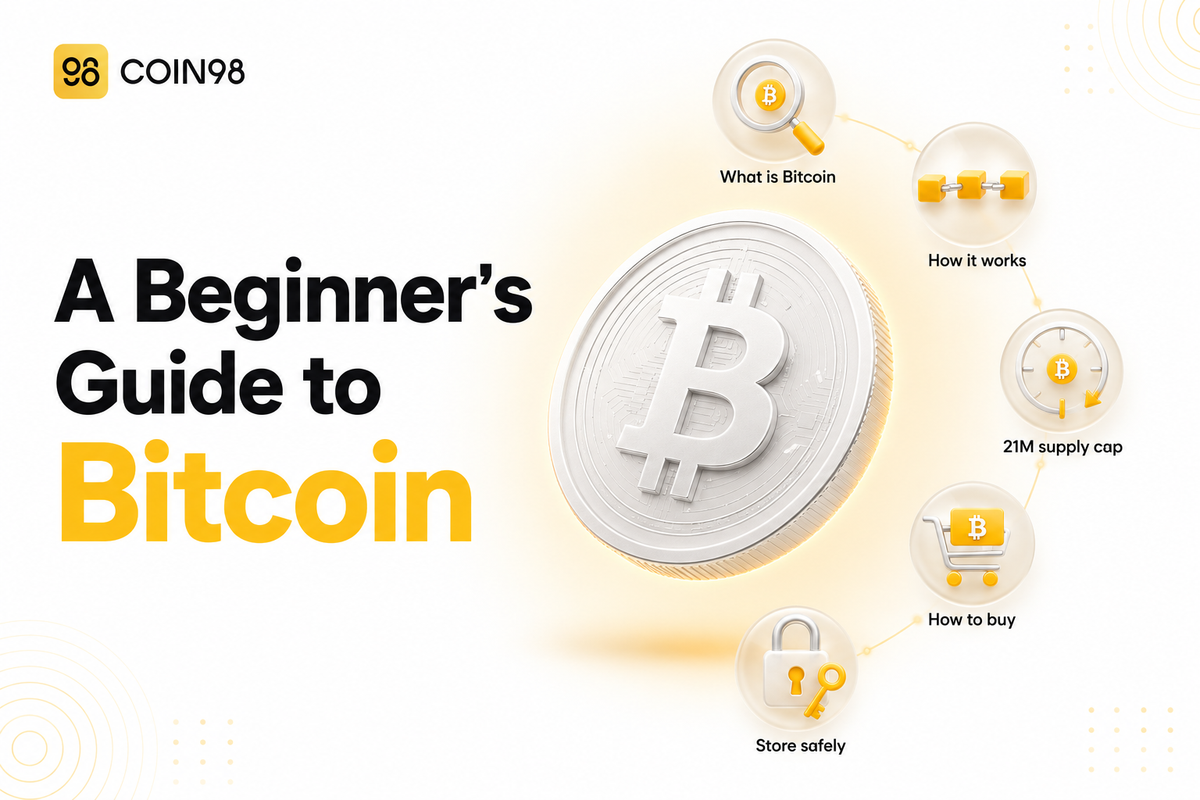
Bitcoin is digital money that nobody — no bank, no company, no government — can issue more of on a whim, because the rules limiting it to 21 million coins are baked into the software every computer on its network runs. Roughly 95.4% of that supply was already mined as of June 2026, according to Bleap Finance, with fewer than 960,000 BTC left to enter circulation, ever. This guide explains what Bitcoin actually is, how it works under the hood, why its supply behaves the way it does, and how to buy and store your first BTC safely.
What is Bitcoin?
Bitcoin is a decentralized digital currency built on a shared public ledger called the blockchain, where every confirmed transaction is recorded and verified by independent computers rather than a single company or bank. Wallets use this shared ledger to calculate balances and confirm that whoever is spending actually owns the funds, per Bitcoin.org's official documentation.
What separates Bitcoin from a bank balance is who can move it. Each Bitcoin wallet holds a private key — secret data used to cryptographically sign transactions — and that signature is the only thing that proves ownership and authorizes a transfer. There's no customer service line that can reverse a payment or freeze an account on Bitcoin's base layer; the network itself is the only authority.
How does Bitcoin work?
Bitcoin works by having a global, peer-to-peer network of computers agree on one shared transaction history without any of them needing to trust each other individually. When you send Bitcoin, the transaction broadcasts to the network and typically begins confirming within 10 to 20 minutes, according to Bitcoin.org.
Getting that agreement requires mining, which Bitcoin.org describes as a distributed consensus system: computers called miners group pending transactions into a block and compete to solve a cryptographic puzzle that lets them add the block to the chain. That competition — a kind of lottery that resets with every block — is what stops any single miner or group from controlling which transactions get included or rewriting past blocks, since doing so would mean out-computing the rest of the network simultaneously.
The winning miner earns newly issued bitcoin plus the transaction fees attached to that block. This is also how new bitcoin enters circulation: there's no central bank printing it, only miners earning a fixed, shrinking reward over time.
Why is Bitcoin's supply capped at 21 million?
Bitcoin's protocol caps total supply at 21 million coins and enforces it the same way it enforces everything else — through code every node on the network runs and checks. As of June 2026, the circulating supply sits at roughly 20,043,290 BTC, or about 95.4% of that cap, with fewer than 960,000 BTC left to mine, according to Bleap Finance.
The mechanism that controls the pace is called halving. Roughly every four years, the reward miners earn per block is cut in half, which directly slows how fast new bitcoin is created. The current block reward is 3.125 BTC, and at the network's pace of about 144 blocks per day, that works out to roughly 450 new BTC entering circulation daily, per Bleap Finance's June 2026 figures. The next halving is projected for April 12, 2028, at block 1,050,000, when the reward drops to 1.5625 BTC, according to CoinWarz — whose tracker put the current block height at 955,874 at time of writing.
| Metric | Figure (mid-2026) |
|---|---|
| Maximum supply | 21,000,000 BTC |
| Circulating supply | ~20,043,290 BTC (~95.4%) |
| BTC left to mine | Fewer than 960,000 |
| Current block reward | 3.125 BTC |
| New BTC issued per day | ~450 |
| Next halving | April 12, 2028 (block 1,050,000) |
This stepped-down issuance schedule is why Bitcoin is often compared to a depleting resource rather than a currency a central bank can expand — the last fraction of a coin won't be mined for well over a century at the current pace, simply because each halving stretches the remaining supply further into the future.
How to buy Bitcoin for the first time
There are two practical paths to a first BTC purchase, and they both end with the same result: bitcoin sitting in a wallet you control.
- Buy on an exchange, then withdraw. Set up an account on a regulated exchange, complete identity verification, fund it from a bank account or card, then withdraw the BTC to a wallet where you hold the private key.
- Buy directly inside a non-custodial wallet app. Some wallets, including Coin98 Super Wallet, have a built-in fiat purchase flow: select the token and amount, the app compares rates across integrated providers like MoonPay, complete identity verification with the provider, and the BTC lands directly in the wallet address you control — skipping the separate withdrawal step entirely, according to Coin98's documentation.
Either way, expect identity verification (KYC) before completing a purchase on a regulated platform, and expect a fee that varies by payment method — bank transfers are typically cheaper than instant card purchases. A whole coin isn't required to start; Bitcoin can be purchased and held in fractional amounts.
How to store Bitcoin safely
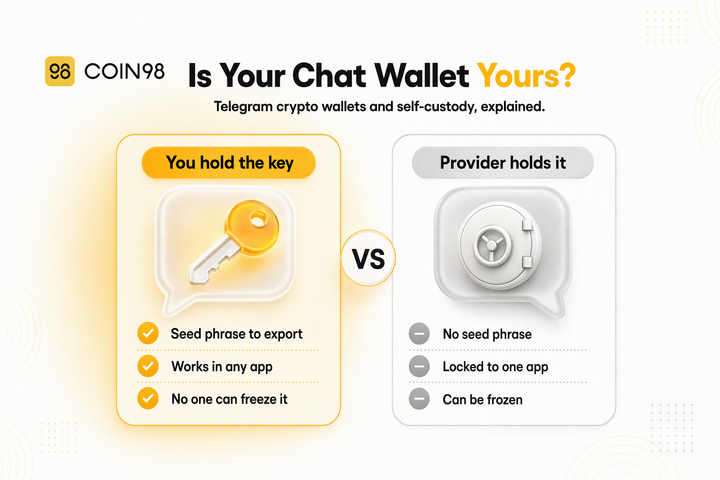
Once BTC is purchased, the wallet holding it manages two related but distinct pieces of secret data: the private key and the seed phrase. A private key is a long string of characters that functions like a password and is generated from the seed phrase, while the seed phrase is a sequence of 12 to 24 plain-English words that can recreate that private key — and any others tied to the same wallet, per Coin98's documentation. The seed phrase sits above the private key in this hierarchy: it can regenerate a private key, but a private key can't regenerate the seed phrase it came from.
For day-to-day convenience, we'd suggest using Coin98 Super App rather than juggling a separate wallet for every network. It supports more than 100 blockchains — including Bitcoin — under a single 12- or 24-word seed phrase, so the same backup that protects BTC also covers any other supported chain held in the same wallet, according to Coin98's documentation. We'd also suggest writing the seed phrase down on paper rather than storing it digitally, and avoiding photos or cloud notes of it, since anyone who obtains those words gains the same control over the wallet as the owner.
FAQ
What is Bitcoin in simple terms? Bitcoin is decentralized digital money secured by a public ledger called the blockchain, with a hard-coded maximum supply of 21 million coins. No bank or company controls it — a global network of computers verifies every transaction instead.
Is Bitcoin safe to use? Bitcoin's network has maintained roughly 99.98% uptime since its 2009 launch and has never suffered a successful 51% attack, according to live uptime trackers like Bitbo. Safety at the user level still depends on how the private key or seed phrase is protected — losing or exposing either one is the most common way people actually lose funds, not a flaw in the network itself.
How is Bitcoin different from Ethereum? Bitcoin has a fixed 21 million coin supply and is designed mainly as digital money and a store of value. Ethereum has a dynamic, partly-burned supply and is designed to run programmable smart contracts — different goals on similar decentralized-network foundations.
What happens when all 21 million Bitcoin are mined? Miners will stop earning new-coin rewards and rely on transaction fees alone. Because each halving cuts the reward in half roughly every four years, the very last fraction of a coin isn't expected to be mined for well over a century at the current issuance pace.
Do I need a different wallet for Bitcoin than for other crypto? Not necessarily. A multi-chain wallet like Coin98 Super Wallet holds Bitcoin alongside 100+ other blockchains under one seed phrase, which is simpler than running a dedicated Bitcoin-only app for anyone holding other assets too.
The bottom line
Bitcoin's core idea is simple even though the mechanics underneath aren't: a shared public ledger, secured by competing miners, enforces a 21 million coin limit that no single party can override. With roughly 95.4% of that supply already mined and the next halving not due until April 2028, the remaining bitcoin will keep entering circulation more slowly with each passing cycle. Coin98 Super Wallet's multi-chain support allows buying BTC directly with a built-in fiat flow and storing it under the same seed phrase as 100+ other blockchains. Explore Coin98 Super Wallet to set up a first wallet.
Last updated: June 2026