Stablecoin Types Explained: Fiat, Crypto-Backed & USDe
Not all stablecoins are like USDT. Explore the differences between fiat-backed, crypto-backed (DAI), and algorithmic types like Ethena's USDe to find new yields.
You probably think of stablecoins as a safe harbor, a simple digital dollar like USDT or USDC to park your funds between trades. For years, that was their primary use case. But what if we told you that some stablecoins are evolving into yield-generating assets themselves? The rise of projects like Ethena and its USDe token is forcing a crucial conversation: you need to understand what's actually backing your stablecoin.
Holding the wrong type of stablecoin during a market crisis isn't just an inconvenience; it can lead to significant losses. This guide will break down the three core models so you can navigate this complex landscape with confidence.
The Foundational Layer: Fiat-Backed Stablecoins
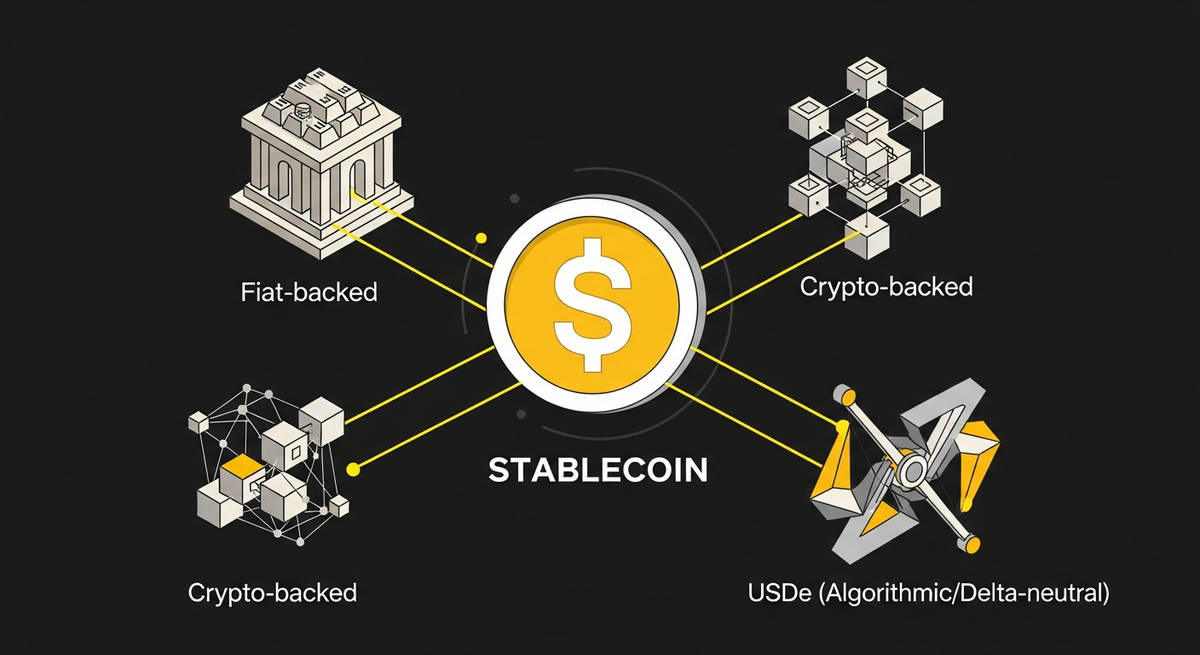
This is the category you're most familiar with. Think USDT (Tether) and USDC (Circle). The concept is straightforward and has been the bedrock of crypto liquidity for years.
- Mechanism: For every 1 USDT or 1 USDC in circulation, there is (in theory) one US dollar or an equivalent highly liquid, low-risk asset held in a real-world bank account by the issuing company.
- Pros: Simple to understand, trusted by the majority of the market, and generally holds its peg very well under normal conditions.
- Cons: The biggest drawback is centralization. The reserves are held by a single company, requiring you to trust their attestations and audits. These assets can be frozen or censored at the request of governments, a risk that goes against the core ethos of decentralization.
These stablecoins are excellent for trading and as a temporary store of value. You can easily acquire and trade them on the integrated Coin98 Exchange, which aggregates liquidity to ensure you get the best rates with minimal slippage.
The Decentralized Alternative: Crypto-Backed Stablecoins (DAI)
What if you could create a stablecoin without relying on traditional banks? That's the problem MakerDAO set out to solve with its stablecoin, DAI. This model represents the first major step towards a truly decentralized stable asset.
DAI is not backed by dollars in a bank; it's backed by an excess of other crypto assets locked in smart contracts.
How does it work?
The mechanism is called over-collateralization. To mint $100 worth of DAI, a user must lock up more than $100 worth of a volatile asset like Ethereum (ETH) in a Maker Vault. For example, they might need to lock $150 of ETH to mint $100 of DAI. This 150% collateralization ratio acts as a buffer. If the price of ETH starts to fall, the system has a cushion before the value of the collateral drops below the value of the issued DAI.
- Pros: Decentralized and transparent. Anyone can view the collateral backing DAI on the blockchain. It's censorship-resistant and lives entirely within the DeFi ecosystem.
- Cons: Capital inefficiency. Over-collateralization ties up a lot of capital that could be used elsewhere. It also carries a risk of de-pegging during a “black swan” event where the collateral’s value drops too quickly for the system to react.
Storing your DAI in a non-custodial wallet like the Coin98 Super Wallet gives you full control over your assets, ensuring you are the only one who can access them.
The New Frontier: Algorithmic & Synthetic Stablecoins (USDe)
This is where the innovation—and the risk—truly accelerates. Unlike the other two types, these stablecoins often aren't directly backed by the asset they're pegged to. The most talked-about example today is Ethena's USDe, which it calls a 'synthetic dollar'.
How USDe generates yield
The USDe model is brilliant but complex. It maintains its dollar peg and generates yield through a 'cash and carry' trade, also known as a delta-neutral position.
- Backing: Ethena takes user deposits (like stETH - staked Ether) and holds them as collateral.
- Hedging: Simultaneously, it opens a short perpetual futures position for the same amount of ETH on a derivatives exchange.
This combination creates a delta-neutral position. If the price of ETH goes up, the value of the collateral (stETH) increases, but the short position loses value. If the price of ETH goes down, the collateral loses value, but the short position gains value. The net result is that the total value of the backing remains stable, pegged to the dollar.
The yield comes from two sources: the staking rewards from the stETH collateral and, more significantly, the funding rates paid by traders who are long ETH in the perpetuals market. In a bull market, these funding rates can be extremely high, leading to the attractive APY offered by Ethena.
- Pros: Scalability and high yield potential. It doesn't rely on inefficient over-collateralization and can scale quickly. The yield is generated from real market activities.
- Cons: Complexity and new risks. This model introduces several new risk factors: smart contract risk within the Ethena protocol, custody risk with the institutions holding the assets, and especially funding rate risk. If funding rates turn negative for a prolonged period, the yield could disappear or even become negative.
Conclusion: Choose Your Stablecoin Wisely
The term 'stablecoin' now covers a diverse range of assets, each with a unique risk-reward profile. Fiat-backed coins offer simplicity and trust in a centralized entity. Crypto-backed coins like DAI offer decentralization at the cost of capital efficiency. Synthetic dollars like USDe offer high yield and scalability but introduce complex, market-dependent risks.
As builders and users in Web3, it's our responsibility to look under the hood. Don't just chase the highest yield; understand the mechanism that generates it. Managing these different assets, swapping between them, and interacting with DeFi protocols is becoming a core skill.
We built the Coin98 Super Wallet to be your command center for this new multi-chain world. Securely store all types of stablecoins, use our built-in dApp browser to explore protocols like Ethena and MakerDAO, and manage your entire portfolio from one place. Download Coin98 today and take control of your stablecoin strategy.
Frequently Asked Questions (FAQ)
What are the three main types of stablecoins?
The three main types are fiat-backed (like USDT), crypto-backed (like DAI), and algorithmic or synthetic stablecoins (like USDe). Each uses a different mechanism to maintain its peg to a fiat currency.
Is USDe a traditional algorithmic stablecoin?
Not exactly. USDe is better described as a 'synthetic dollar'. It's backed by a delta-neutral derivatives position using staked ETH, not by a seigniorage algorithm that adjusts supply based on demand.
How does DAI maintain its peg to the dollar?
DAI maintains its peg through a system of over-collateralization. Users must lock up a greater value of crypto assets, like ETH, in a MakerDAO smart contract than the amount of DAI they wish to mint.
Are all stablecoins completely safe?
No. Each type carries unique risks. Fiat-backed stablecoins have centralization and censorship risks. Crypto-backed ones have smart contract and depeg risks. Algorithmic types have risks related to their complex models and market conditions.