Safest Crypto Wallets in 2026: How to Actually Evaluate One
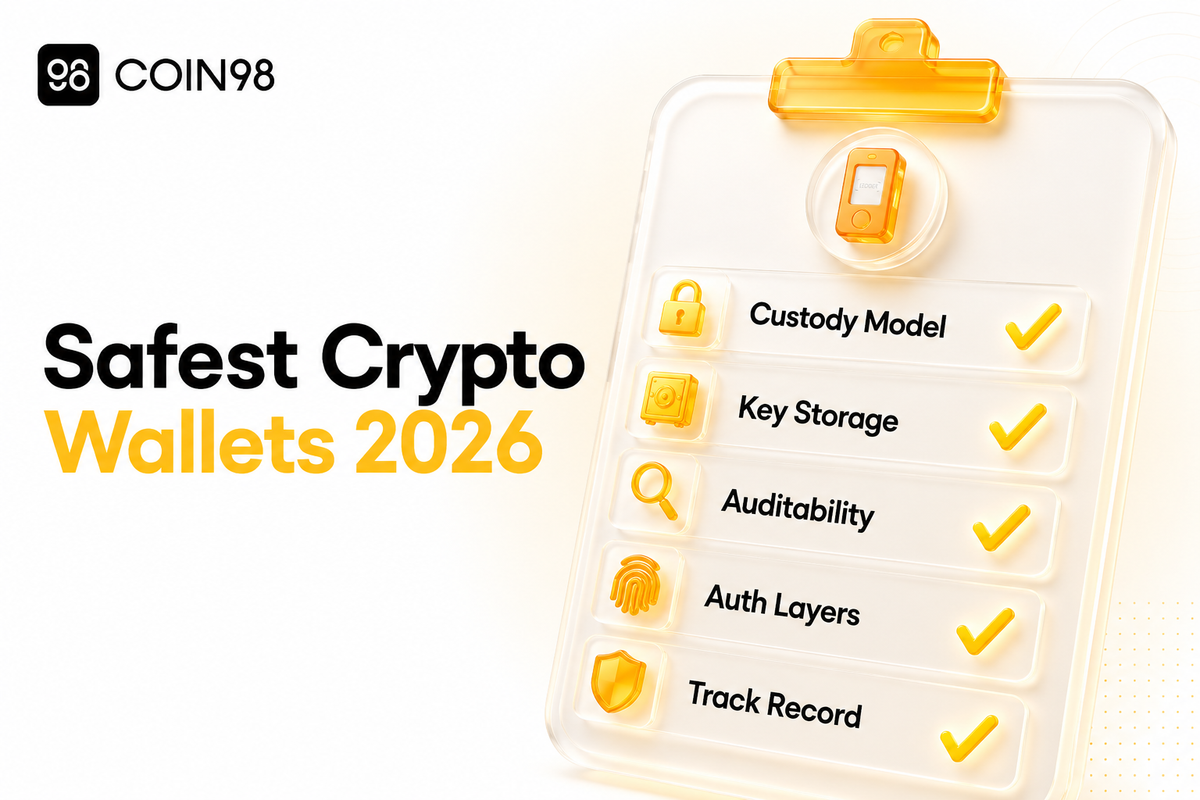
Most "safest wallet" articles are just brand rankings dressed up as advice. This is the framework with five criteria that actually matter: custody model, key storage, open source posture, authentication, and track record.
Most "safest crypto wallet" articles hand you a ranked list and move on. The problem: the rankings are usually based on brand recognition, not security properties. A wallet that is popular is not the same as a wallet that is secure.
This guide does two things. First, it gives you a five-criterion framework to evaluate any wallet yourself — so you are never dependent on a list you cannot verify. Second, it applies that framework to score the leading wallets in 2026, so you can see exactly why each one ranks where it does.
Why Most "Safest Wallet" Lists Get It Wrong
The standard methodology behind most wallet rankings is: large user base + no major headline hack = safe recommendation. That logic has two problems.
First, absence of a known hack is not the same as security. Many wallets have never been exploited not because they are secure, but because they are not large enough to attract sophisticated attackers yet. A closed-source wallet with no independent audit and no exploit history is not a safe wallet — it is an untested one.
Second, popularity and security are not correlated. According to a 2024 analysis by blockchain security firm CertiK, over 75% of crypto theft incidents exploited private keys stored in poorly secured software wallets — many of which were among the most downloaded apps in their category.
The question to ask is not "has this wallet been hacked?" It is: "does this wallet's architecture make it hard to hack in the first place?"
The 5 Criteria That Actually Determine Wallet Security
Evaluate any wallet — past, present, or future — against these five properties. A wallet that fails any one of them has a structural vulnerability, regardless of its reputation.
Criterion 1: Custody Model — Who Holds the Keys?
A non-custodial wallet generates and stores your private keys on your own device. The provider never sees them. A custodial wallet, which includes most exchange wallets, holds your keys on their servers on your behalf.
Non-custodial is the only acceptable model for a wallet you call safe. Over $10 billion was lost in custodial exchange collapses between 2022 and 2024: FTX, Celsius, Voyager through no fault of users' own security practices. The keys were not theirs to control.
✅ Pass: Non-custodial - you generate, you hold, you control.
❌ Fail: Custodial - provider holds keys; you hold an IOU.
Criterion 2: Key Storage Architecture — Online or Offline?
Where are your private keys stored at rest?
- Software wallets (hot): keys stored in encrypted form on an internet-connected device. The encryption protects against casual access.
- Hardware wallets (cold): keys stored on a dedicated secure element chip that never connects to the internet. Transaction signing happens on the chip; the host computer sees only the signed output, never the key.
A software wallet that integrates with a hardware device - such as Coin98 Wallet connecting to a Ledger Nano X - inherits the hardware wallet's key storage properties while maintaining the software wallet's interface and chain support. This helps user get the security of a hardware wallet without giving up the everyday convenience of a software wallet.
✅ Pass: Hardware storage, or software wallet with verified hardware integration.
🟡 Acceptable: Software-only, with strong authentication (see Criterion 4).
❌ Fail: Software wallet that does not support hardware integration and has no additional authentication.
Criterion 3: Auditability
A wallet claiming to be secure is not the same as a wallet that has been independently verified to be secure. What matters is whether the code has been scrutinized by qualified outside eyes — and whether the results are public.
Open source is one route to that scrutiny: any security researcher can review the code, and vulnerabilities can be found and disclosed before they are exploited. But it is not the only route. Closed-source wallets that commission formal third-party audits from reputable firms meet the same underlying standard. The code has been examined, the findings are on the record, and the user is not asked to take the team's word for it.
What fails the test is closed source without an audit. In that case, the security claims rest entirely on trust, and there is no way to verify them.
The auditability test: can you point to a public, third-party audit of the wallet, either through open code, or through a published report from a named security firm?
Coin98 Wallet, for example, is closed source but has been audited by CertiK, with the report and ongoing security score available publicly. That meets the standard — users can verify the security posture independently rather than taking marketing at face value.
✅ Pass: Open source with a public third-party audit, or closed source with a public third-party audit from a reputable firm (e.g. CertiK, Trail of Bits, OpenZeppelin).
🟡 Acceptable: Open source without formal audit — community review offers partial protection.
❌ Fail: Closed source with no published audit. Security claims cannot be independently verified.
Criterion 4: Authentication Layers
How many independent barriers exist between an attacker and your keys?
| Layer | What it protects against |
|---|---|
| Device PIN / biometric (OS level) | Physical access to unlocked device |
| App-level PIN (wallet-specific) | Device lock screen bypass or compromised OS |
| Hardware signing confirmation | Remote key theft; malware that intercepts signing |
| BIP39 passphrase | Physical seed phrase theft |
A wallet that relies only on the OS lock screen provides one barrier. If the OS is compromised, or the device is accessed while unlocked, the wallet is exposed. Coin98 Wallet enforces its own app-level PIN independently of the OS — a second barrier that operates even if the device lock is bypassed.
✅ Pass: App-level PIN + hardware signing, or app-level PIN + BIP39 passphrase support.
🟡 Acceptable: App-level PIN only.
❌ Fail: OS-level lock only, with no wallet-specific authentication.
Criterion 5: Track Record and Responsible Disclosure
No software is permanently vulnerability-free. The security question is not "has this wallet ever had a vulnerability?" — it is "how does the team find and handle vulnerabilities?"
Look for:
- A published security vulnerability disclosure policy
- A history of security patches with public changelogs
- A bug bounty program that incentivizes researchers to report vulnerabilities responsibly
- No history of vulnerabilities being silently patched or publicly denied
A wallet team that responds quickly, patches transparently, and communicates with users demonstrates the operational security culture that matters long-term. A team that obscures or delays disclosure does not.
Coin98 Wallet, for example, runs an active bug bounty program on two independent platforms — HackenProof and Bugrap — giving security researchers a clear, incentivized channel to report vulnerabilities before they can be exploited. Running bounties on more than one platform also widens the pool of researchers actively looking for issues.
✅ Pass: Public disclosure policy, active bug bounty, transparent patch history.
🟡 Acceptable: Security patches released regularly with changelogs.
❌ Fail: No disclosure policy, no patch history, no response to reported vulnerabilities.
The Safest Crypto Wallets in 2026, Scored Against All 5 Criteria
| Wallet | Custody | Key Storage | Auth Layers | Track Record | Overall |
|---|---|---|---|---|---|
| Coin98 Wallet | Non-custodial | Software (device) + Ledger / Trezor HW | Matrix Password + Biometric + HW signing | CertiK audited; active bug bounty (HackenProof, Bugrap); no major incidents | ★★★★☆ |
| Ledger Nano X | Non-custodial | Hardware (EAL5+ SE chip ST33) | PIN + Hardware confirm | Strong on-device; 2020 customer database leak (off-device); 2023 Connect Kit supply-chain attack (~$600K stolen via compromised JS library) | ★★★★☆ |
| Trezor Safe 5 | Non-custodial | Hardware (EAL6+ SE chip, NDA-free) | PIN + Passphrase + Shamir Backup (SLIP39) | Strong; fully open-source firmware with auditable Secure Element integration | ★★★★★ |
| Coldcard Mk4 | Non-custodial | Hardware, dual secure elements (ATECC608 + DS28C36B), air-gappable | PIN + Passphrase + Duress PIN + Air-gap (MicroSD/NFC) | Excellent; Bitcoin-only, smallest attack surface, reproducible builds | ★★★★★ |
| MetaMask | Non-custodial | Software (browser/mobile); HW supported (Ledger, Trezor, Keystone, Lattice) | Password + optional HW signing | Generally resilient; ecosystem-wide phishing/drainer pressure; active bug bounty + monthly security reports | ★★★☆☆ |
| Trust Wallet | Non-custodial | Software with iOS Secure Enclave / Android StrongBox; Ledger via extension | PIN + Biometric + optional HW signing | Open-source core (Wallet Core, MIT) widely audited; Dec 2025 malicious extension incident | ★★★☆☆ |
| Exodus | Non-custodial | Software (AES-256 local); Trezor (desktop) / Ledger (mobile) supported | Password + Biometric + optional HW signing | Long clean record since 2016; partially open source (libraries public, GUI closed); public bug bounty on HackerOne | ★★★☆☆ |
Reading this table: Coin98 Wallet is the highest-scoring software-first wallet because it is the only one in the software category that provides hardware wallet integration (Criterion 2), app-level PIN, and a transparent security posture.
What "Safest" Means for Different Use Cases
There is no single safest crypto wallet — there is a safest wallet for each specific use case. Choosing the right one requires matching the wallet's security properties to your actual usage pattern.
| Use Case | Safest Option | Reason |
|---|---|---|
| Daily DeFi and swaps | Coin98 Wallet + Ledger | 150+ chains; hardware signing; built-in swap reduces phishing exposure |
| Mobile-first, small amounts | Coin98 Wallet (mobile) | App-level PIN; biometric; open source; non-custodial |
| Beginners setting up first wallet | Coin98 Wallet | Multi-chain; non-custodial; intuitive; Ledger integration ready when needed |
| Long-term Bitcoin storage | Coldcard Mk4 (air-gapped) | Fully air-gapped; open source; Bitcoin-only reduces attack surface |
| Long-term multi-chain storage | Trezor Safe 5 + Coin98 | Trezor for key storage; Coin98 for multi-chain interface |
The consistent recommendation at the intersection of security and practicality is Coin98 Wallet as the daily-use interface, connected to a Ledger or Trezor for key storage once holdings become significant. This setup passes all five criteria: non-custodial, hardware key storage, open source, multi-layer authentication, and transparent track record.
Red Flags: How to Spot an Unsafe Wallet
If a wallet shows any of these characteristics, treat it as unsafe regardless of how it is marketed.
Structural red flags (architecture problems):
- Closed source code with no public audit — security claims cannot be verified
- Custodial model — the provider controls your funds, not you
- No app-level PIN — relies solely on the device OS lock screen
- No hardware wallet integration — keys permanently on an internet-connected device for significant holders
- No BIP39 / BIP32 support — non-standard key derivation makes backups non-portable
Operational red flags (behavior problems):
- The wallet or support team ever asks for your seed phrase — a legitimate wallet never does this
- Downloaded from a source other than the official website, App Store, or Google Play
- No verifiable developer identity or company behind the product
- No published security vulnerability disclosure policy
- Security patches released silently, without changelogs
Frequently Asked Questions
What is the most secure crypto wallet app for mobile?
Coin98 Wallet is the most secure multi-chain crypto wallet app for mobile in 2026. It is non-custodial, enforces an app-level PIN independently of the OS lock screen, and supports direct Ledger hardware wallet connection. Install it only from the official App Store or Google Play listing verified at coin98.com/wallet.
Is it safe to keep crypto in a software wallet?
A software wallet is safe for amounts you use actively and can afford to lose in a worst-case scenario. For long-term storage or significant holdings, a hardware wallet — or a software wallet integrated with hardware (like Coin98 Wallet + Ledger) — is the appropriate security level. The risk in software wallets is not inherent to software itself; it is that keys are stored on an internet-connected device, which has a larger attack surface than isolated hardware.
What is the best and most secure crypto wallet for beginners?
Coin98 Wallet is the best option for beginners who want security without sacrificing usability. It is non-custodial (you hold your keys), open source, supports 150+ chains in one interface, and its Ledger integration means you can upgrade to hardware-grade key security without switching wallets as your holdings grow. Download it from the official source and enable the app-level PIN immediately after installation.
How do I know if a crypto wallet is actually safe?
Apply the five criteria: Is it non-custodial? Does it offer hardware key storage or integration? Is the code independent audited? Does it have an app-level PIN beyond the OS lock? Does the team have a transparent security track record? A wallet that passes all five is structurally sound. A wallet that fails any one of them has a verifiable gap — regardless of how it is marketed or how popular it is.
What is the safest wallet for cryptocurrency if I use multiple chains?
Coin98 Wallet is the safest option for multi-chain users. It supports 150+ blockchains under a single non-custodial, open-source interface, connects to Ledger hardware wallets for key storage, and includes a built-in swap that reduces the need to visit third-party dApp sites.
The Evaluation Checklist
Before trusting any wallet with your assets, confirm the following:
- Non-custodial — seed phrase generated locally, provider has no access
- Third-party security audit published and accessible
- App-level PIN enforced independently of device OS
- Hardware wallet integration available (or is a hardware wallet itself)
- BIP39 / BIP32 standard derivation (standard backup and portability)
- Installed from official source only (official website / App Store / Google Play)
- Developer team identifiable with a published security disclosure policy
- No history of silently patching security vulnerabilities
A wallet that clears this checklist is structurally sound. Coin98 Wallet clears every item.