What is the Lightning Network, and what are its real risks?
Lightning makes bitcoin fast and cheap to spend through payment channels. How it works, and the real risks before you use it.
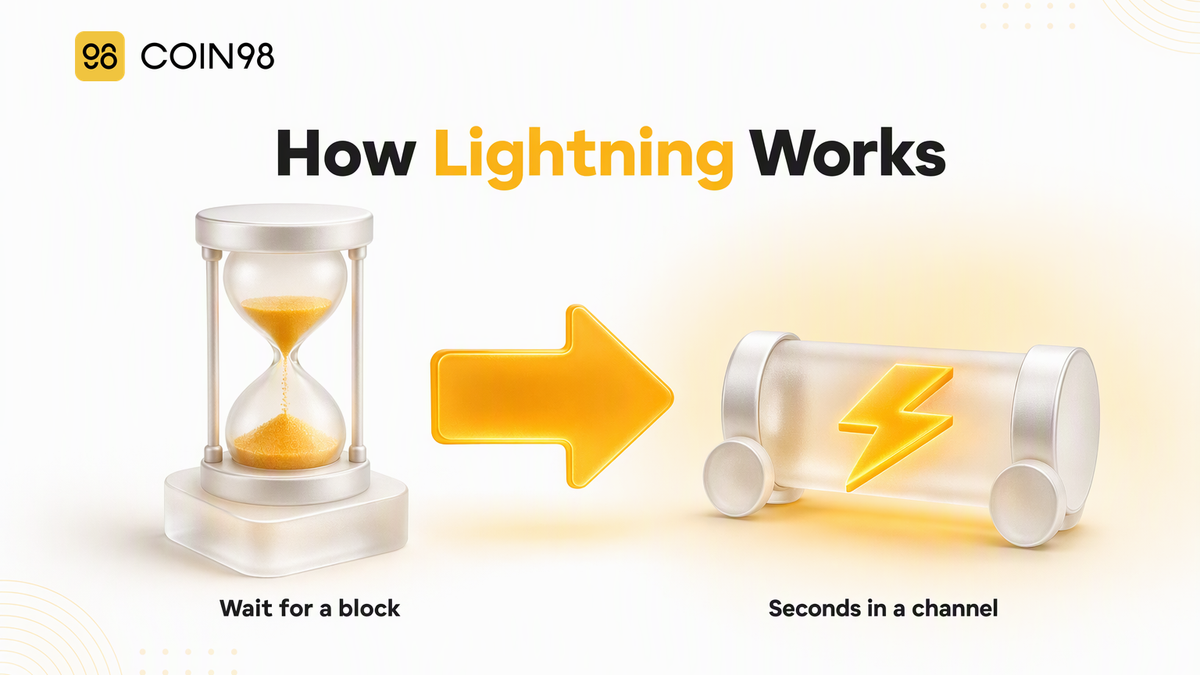
Sending bitcoin on-chain can mean waiting for a block and paying a fee that doesn't care whether you're moving $5 or $50,000. The Lightning Network was built to fix that: it lets you send bitcoin in seconds for a tiny fee, without each payment waiting for a block. It isn't magic, though. It works by locking bitcoin into payment channels, and that design brings risks that a normal Bitcoin wallet doesn't have. This guide explains how the Lightning Network works, how to choose a Lightning wallet, and the risks worth knowing before you use one.
Last updated: November 2026
What is the Lightning Network?
The Lightning Network is a payment network that runs on top of Bitcoin. Two people lock bitcoin into a shared channel, then pay each other as many times as they like by updating how that balance is split. Only the opening and closing of the channel are recorded on the Bitcoin blockchain. Everything in between happens off-chain, which is why Lightning payments are fast and cheap.
It's often called a Layer 2, because it sits on top of Bitcoin rather than being a separate coin. There's no Lightning token: the money in every channel is ordinary bitcoin.
How a payment channel works
A payment channel is a shared pot of bitcoin held in an address that needs both parties' signatures to spend.
- Open. Alice and Bob each put 1 BTC into the shared address. This is an on-chain transaction, so it pays a normal Bitcoin transaction fee and waits for confirmation.
- Pay. Bob pays Alice 0.5 BTC. Nothing goes on-chain. They both sign a new version of the split: Alice 1.5, Bob 0.5. They can repeat this thousands of times.
- Close. When they're done, the latest split is settled on-chain, and each gets their share.
Because payments inside the channel never wait in the mempool, they settle in seconds and cost a fraction of an on-chain fee.
Paying someone you don't share a channel with
You don't need a channel with everyone. If Alice has a channel with Bob, and Bob has one with Carol, Alice can pay Carol through Bob. A cryptographic lock makes sure Bob only gets paid if Carol does, so Bob can't keep the money. Bob may charge a small routing fee. Lightning wallets find these routes automatically.
How big the network is
As of November 2026, about 4,800 BTC sat in public Lightning channels, spread across roughly 17,400 nodes and 40,700 channels. The average public channel held about 0.12 BTC. Private channels aren't counted, so the real total is higher, but it's still a small fraction of all bitcoin. Lightning is used mainly for spending, not saving.
Custodial vs self-custodial Lightning wallets
The most important choice you make with Lightning is who holds the bitcoin. A custodial Lightning wallet is an account with a company that runs the channels for you. A self-custodial Lightning wallet gives you the keys, and with them, some of the jobs a node does.
| Custodial Lightning wallet | Self-custodial Lightning wallet | |
|---|---|---|
| Who holds the bitcoin | The provider | You |
| Setup | Sign up and receive | App opens channels for you, sometimes for a fee |
| Main risk | Provider is hacked, freezes accounts or shuts down | Channel closes, liquidity limits, staying online |
| Recovery | Account login | Seed phrase plus the wallet's channel backup |
| Best for | Small amounts, first try | Regular use where you want control |
Neither is wrong for small amounts. The same rule applies as with exchanges: if you don't hold the keys, the bitcoin is a balance on someone else's books. Our guide to custodial vs non-custodial wallets covers that trade-off in depth.
The real risks of the Lightning Network
The real risks of the Lightning Network come from its design: channels have to be opened and closed on-chain, your side has to watch for cheating, payments need liquidity along the route, and the funds stay online. Most of these affect self-custodial users. Custodial users swap them for one big risk: the provider.
| Risk | What happens | Who it affects | How to reduce it |
|---|---|---|---|
| Force close | Funds locked for a time and an on-chain fee to claim them | Self-custodial | Keep balances modest; choose a reliable wallet |
| Offline cheating | A peer tries to close with an old balance | Self-custodial nodes | Stay online or use a watchtower |
| Liquidity and routing | A payment can't find a path, or you can't receive | Everyone, mostly self-custodial | Use a wallet that manages channels for you |
| Hot funds | Node or account credentials stolen | Everyone | Keep only spending money on Lightning |
| Provider failure | Hack, freeze or shutdown | Custodial | Small balances, withdraw regularly |
Force closes can lock funds and cost fees
If your channel partner disappears or stops cooperating, the channel can be closed one-sidedly. That's a force close. Your share comes back on-chain, but only after a waiting period that's often between 24 hours and two weeks, and you pay the on-chain fees to claim it. If on-chain fees spike, closing a small channel can cost a meaningful share of what's in it.
Your side has to stay online
Lightning assumes each side is watching the blockchain. If your node is offline, a dishonest partner could try to close the channel using an old balance that favoured them. The protocol lets you punish this with a penalty transaction, but only if you notice in time. A watchtower is a service that watches on your behalf and sends the penalty transaction if someone cheats. Many mobile Lightning wallets handle this for you through their provider.
Payments can fail for lack of liquidity
A payment needs enough balance on the right side of every channel along its route. To receive, someone must have funded the channel toward you, which is called inbound liquidity. A brand-new self-custodial wallet may have none until it opens or buys a channel. That's why first payments sometimes fail or come with a setup fee.
Lightning funds are always hot
Lightning keys have to be online to sign payments, so Lightning funds are always in a hot wallet. In August 2026, attackers exploited a bug in a popular self-hosted payment server that exposed the credentials of merchants' Lightning nodes, then drained those nodes. The flaw was in the server software, not in the Lightning protocol, and a fix was released the same week. But it showed that anything sitting on a Lightning node is only as safe as the machine running it.
How to use Lightning without taking on too much risk
The safest way to use the Lightning Network is to treat it like the cash in your pocket: keep what you'll spend soon, and keep savings in an on-chain wallet you control.
- Decide your spending amount. Keep only what you'd be comfortable carrying in a physical wallet.
- Keep savings on-chain. Coin98 Super Wallet holds Bitcoin on-chain and is non-custodial. It doesn't currently offer Lightning payments, so use it as your savings wallet and top up a separate Lightning wallet from it.
- Send on-chain to your Lightning wallet's deposit address. You can send BTC from Coin98 Super Wallet like any other transfer. Check which Bitcoin address type the Lightning wallet gives you, and send when fees are low.
- Learn your wallet's backup method. Some self-custodial Lightning wallets need more than a seed phrase to recover channel funds. Read how yours handles backups before you deposit.
- Withdraw the excess. When your Lightning balance grows beyond spending money, move it back on-chain.
FAQ
What is the Lightning Network in simple terms?
The Lightning Network is a payment network on top of Bitcoin. Two people lock bitcoin into a shared channel and pay each other by updating the balance off-chain. Payments can also hop through other channels to reach people you're not directly connected to. Only opening and closing a channel touch the blockchain.
Is the Lightning Network safe?
It's widely used for small payments, but it carries risks a normal Bitcoin wallet doesn't. Channels can be force-closed with funds locked for a while, payments can fail, and Lightning funds are always online. Custodial wallets add the risk of the provider itself. We suggest keeping only spending money on Lightning.
Is Lightning a different cryptocurrency?
No. Lightning uses ordinary bitcoin. There's no separate Lightning token, and bitcoin in a channel can be settled back to a normal Bitcoin address when the channel closes.
Does Coin98 Super Wallet support the Lightning Network?
Coin98 Super Wallet supports Bitcoin on-chain, but Lightning payments aren't part of its documented features. You can hold your bitcoin in Super Wallet and send it on-chain to a Lightning wallet when you want to spend it.
Why can't I receive a Lightning payment?
Receiving needs inbound liquidity: a channel where the other side has funds that can move toward you. A new self-custodial wallet may have none until it opens or buys a channel. Many wallets set this up automatically on your first payment, sometimes for a fee.
Conclusion
The Lightning Network makes bitcoin fast and cheap to spend by moving payments into channels. The trade-off is a new set of risks: force closes, staying online, liquidity, and funds that are always hot. Keep spending money on Lightning, and keep savings on-chain in a wallet you control, like Coin98 Super Wallet. Top up your Lightning wallet from it as you need.