Crypto Recovery Scams: How the "Help" After a Hack Becomes the Second Attack
Crypto recovery scams target victims twice. Here's how they find you, the advance-fee playbook they run, and the red flags to know.
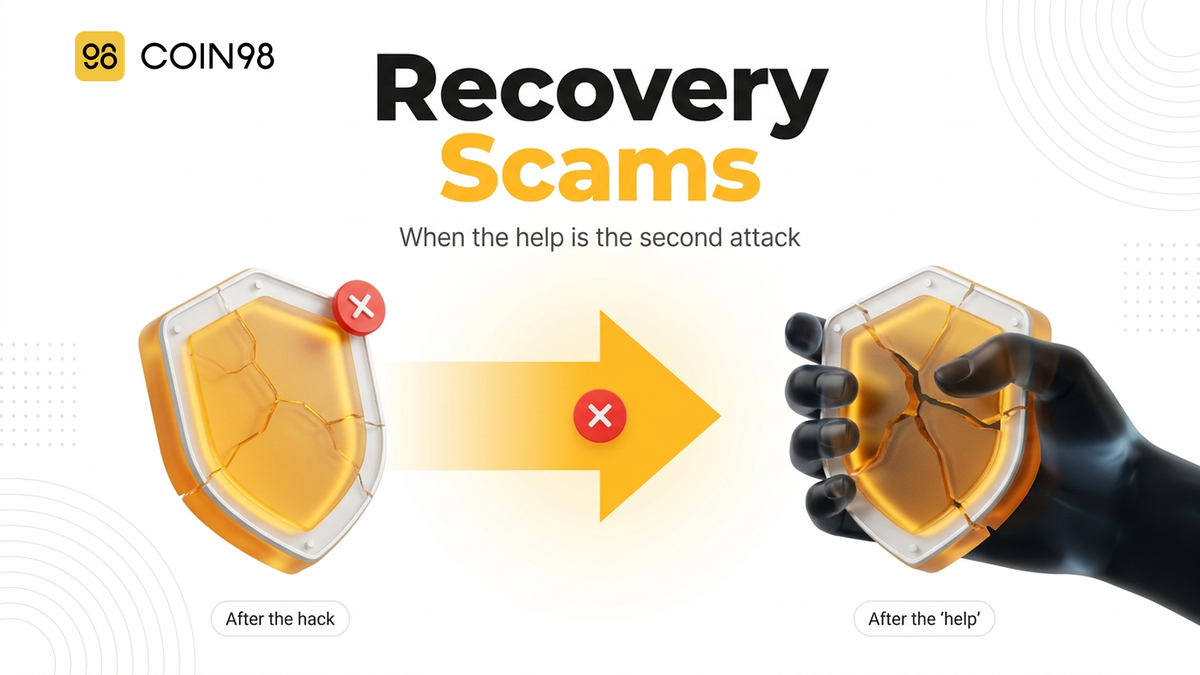
Losing crypto to a scam is devastating enough. But for many victims, the worst hit comes next — from a stranger who claims they can get it all back. Crypto recovery scams are a growing category of advance-fee fraud that specifically targets people who've already been robbed, using desperation as the entry point for a second attack that can be just as expensive as the first.
This guide explains how crypto recovery scammers find their victims, the playbook they run, the technical tricks they use to look credible, the clearest red flags, and what legitimate recovery actually looks like.
How Recovery Scammers Find You Before You Find Them
The first thing that surprises most victims is how quickly — and how specifically — a "recovery specialist" gets in touch. They seem to know the amount you lost, the platform it happened on, and sometimes even the transaction hash. That accuracy isn't coincidence; it's intelligence gathering.
Recovery operators use several methods to identify fresh targets. They actively monitor public forums like Reddit, Telegram groups, Discord servers, and X for posts describing theft or fraud. When someone posts publicly about a loss, they can receive private messages within hours from multiple accounts offering help. This manufactured consensus — several strangers all recommending the same "expert" — is itself part of the script.
Beyond social monitoring, criminal networks buy and sell "sucker lists": databases compiled from previous fraud victims that include names, contact details, the amount lost, the platform involved, and sometimes wallet addresses. These lists circulate among fraud operators, which is why a victim of one scam may start receiving targeted pitches for unrelated schemes within days. The same network that arranged your first loss may be selling your details to the people running the recovery pitch.
Scammers also invest heavily in search engine optimisation and paid advertising, targeting terms like "recover stolen bitcoin" and "how to get back stolen crypto." Victims who search for help themselves walk directly into the top results — most of which are bait.
The Advance-Fee Playbook, Step by Step
Once contact is established, crypto recovery scams follow a predictable sequence. Understanding this structure is one of the best defences against it.
Step 1 — Empathetic opening. The initial message is sympathetic and professional. The scammer introduces themselves as a "blockchain forensic analyst," a "crypto recovery attorney," or a representative of a well-known firm. They claim a high success rate — often "90%" — and may show fabricated client testimonials or fake credentials.
Step 2 — Gathering details. You're asked to share the transaction hash, sending and receiving wallet addresses, the amount lost, and the platform involved. This information is freely available on any block explorer, but presenting it back to you later makes the scammer appear knowledgeable.
Step 3 — The false success announcement. Days or hours later, the scammer produces a fake dashboard, a forged court order, or a letter on what appears to be official government or law firm letterhead stating that your funds have been "located" and are ready for release.
Step 4 — The first fee. To "release" or "process" the recovery, you're asked to pay an upfront fee — typically framed as a legal retainer, a tax clearance payment, a gas fee, or a processing charge. Ranges reported to law enforcement run from around $500 to $5,000, or 10–20% of the stolen amount.
Step 5 — The escalating charges. After the first payment, new obstacles appear. Each one requires another fee: a "compliance deposit," a "withdrawal unlock," a "government clearance." Each payment is framed as the final one before funds are released. The fees compound until the victim stops paying or runs out of money.
Step 6 — Disappearance or pivot. The scammer vanishes after extracting maximum value. In some cases, a new contact emerges offering to "recover" the money just lost to the recovery scam — the third layer of the same fraud.
The FBI's Internet Crime Complaint Center (IC3) recorded 10,516 recovery fraud complaints in 2025, with approximately $1.4 billion in reported losses — a figure that reflects only what gets reported. Victims aged 60 and over filed 2,529 of those complaints and accounted for approximately $540.5 million in losses, suggesting that older adults bear a disproportionate share of the harm.
The Seed Phrase Angle: When the "Recovery" Is Just the Original Phish
A more technically sophisticated version of the crypto recovery scam skips the fee-escalation cycle entirely and goes straight for your remaining assets.
In this variant, the scammer requests your seed phrase, claiming they need it to "trace incoming transactions" or "verify wallet ownership." Handing over a seed phrase gives full control of every asset in that wallet, immediately and permanently. This is the same mechanic as the original phishing attacks most victims have already encountered — it's just reframed as a recovery step.
A related tactic involves directing victims to a fake "recovery portal": a website that prompts a wallet connection. These portals are wallet drainers. When you connect and approve a transaction, you're signing a contract that grants the scammer unlimited spending approval across your tokens. Funds can be emptied within seconds of approval. As our article on sweeper bots explains, automated scripts can drain funds the moment any asset arrives in a compromised wallet — a recovery portal drainer operates on the same principle.
No legitimate service needs your seed phrase. No legitimate recovery process asks you to connect your wallet to an unfamiliar site. These requests are unambiguous theft attempts, regardless of how they're framed.
Why Desperation Makes This Work
Crypto recovery scams succeed because they reach people at the worst possible moment. The emotional context — shame, grief, financial stress — degrades the scepticism that would normally filter out obvious fraud.
Victims may also carry a genuine misunderstanding about how blockchains work. Transactions feel reversible in the way a bank wire can sometimes be recalled, but confirmed blockchain transactions are immutable. No private firm can reverse them. No court order compels a protocol to return funds. No "blockchain hacker" can overwrite a confirmed transaction. Scammers benefit directly from this confusion: the idea of recovery feels plausible because victims don't yet fully understand why it shouldn't be.
Desperation also shortens the due-diligence window. A victim eager to retrieve $10,000 in stolen funds may not stop to verify whether a "recovery firm" has a registered legal entity, a verifiable track record, or publicly named operators — all things they'd check before hiring any other professional service.
Red Flags: How to Identify a Fake Recovery Service
The following signals, individually or together, suggest a crypto recovery scam is in play:
- Unsolicited contact — they reached out to you, not the other way around
- Guaranteed results — no legitimate service can promise recovery; blockchain outcomes aren't predictable
- Upfront fees — payment demanded before any work is completed or verified
- Fees described as "tax," "gas," "processing," or "clearance" — invented bureaucratic language used to justify payments
- Requests for your seed phrase or private keys — an immediate and unambiguous red flag
- Requests to connect a wallet to any unfamiliar site
- Remote access software — requests to install AnyDesk, TeamViewer, or similar tools
- Communication via Telegram, WhatsApp, or Signal only — no verifiable business address or publicly listed contact information
- Impersonation of legitimate firms — fake blockchain analytics firm branding or counterfeit government agency letterhead
- Fake testimonials — stock photo "clients," copied reviews, fabricated success stories
- Artificial urgency — "act within 24 hours or the funds are forfeited"
A legitimate recovery-related service, such as a law firm pursuing civil asset recovery, charges on a no-recovery-no-fee or contingency basis. It has a named operator, a registered legal entity, a written contract, and does not accept cryptocurrency or gift cards as payment. Those standards aren't aspirational — they're the minimum bar for any credible professional service.
What Legitimate Recovery Actually Looks Like
Genuine recovery of stolen crypto is rare and almost always requires official channels. That's an uncomfortable truth, but understanding it is the best protection against paying a scammer to tell you otherwise.
Here's what can realistically help:
Report to law enforcement promptly. File a complaint with the FBI's IC3 (ic3.gov), the FTC (reportfraud.ftc.gov), and your country's national cybercrime unit. Speed matters: the IC3's Recovery Asset Team froze approximately $679 million in 2025 by acting quickly after reports were filed. If stolen funds reach a regulated exchange before being withdrawn, there is a narrow window in which law enforcement can request a freeze.
Contact the exchange involved. If your funds were sent to an address associated with a known exchange, contacting that platform's compliance team is worth doing. Many exchanges co-operate with law enforcement on asset freezes when presented with a valid complaint reference number.
Flag the addresses. You can submit suspect wallet addresses to blockchain analytics services that work with exchanges and law enforcement. These services can flag addresses across their networks, which may slow or impede conversion to fiat at regulated platforms.
Stick to official reporting channels. For US-based victims, that means ic3.gov and reportfraud.ftc.gov. For non-US victims, national equivalents include Action Fraud (UK), the ACCC's Scamwatch (Australia), and similar agencies. Our step-by-step guide on what to do if you've been scammed in crypto covers the full documentation and reporting process in detail.
What doesn't help: paying any private firm upfront, sharing your seed phrase with anyone, or connecting your wallet to an unverified site. The scale of crypto fraud losses — $11.37 billion reported to the FBI in 2025 alone, up 22% from the prior year — reflects in part how effectively recovery scams re-victimise people who've already lost funds once.
FAQ
What is a crypto recovery scam? A crypto recovery scam is a form of advance-fee fraud targeting people who've already lost cryptocurrency. The scammer poses as a recovery specialist, claims to have located the stolen funds, and demands upfront fees — then disappears or demands more. Victims typically lose additional money on top of their original loss.
How do I know if a recovery service is legitimate? Legitimate services charge on a no-recovery-no-fee or contingency basis. They have a verifiable legal entity, named operators, published contact details that go beyond a Telegram handle, and a written contract. They don't ask for your seed phrase, private keys, or remote access to your device. If a service contacts you first after you've publicly posted about a loss, treat that as a strong signal it isn't legitimate.
Can stolen cryptocurrency actually be recovered? Genuine recovery is possible but uncommon. It typically requires stolen funds to reach a regulated exchange quickly (before conversion or withdrawal), co-operation from law enforcement, and a valid legal mechanism. Recovery through a private firm charging upfront fees is almost never legitimate — this category of service is widely documented as fraudulent by the FBI and consumer protection agencies.
Why do recovery scammers seem to know the details of my original loss? Scammer networks buy and sell victim databases compiled from previous fraud campaigns. These databases can include the amount lost, the platform, wallet addresses, and contact details. That's why a recovery pitch can feel personalised — the specificity is designed to lower your defences, not proof of genuine investigative capability.
What should I do immediately if I suspect a recovery scam contact? Stop all communication. Don't send any payment. Don't share any wallet credentials. Report the contact to IC3.gov (or your national equivalent) and to the platform where the contact occurred. If you've already sent money, document every transaction and report it straight away.
Can connecting my wallet to a recovery portal drain my funds? Yes. Fake recovery portals function as wallet drainers. Connecting your wallet and approving a transaction can grant unlimited token-spending access to the scammer's smart contract. Assets can be emptied within seconds. Only connect your wallet to sites you've independently verified, and check what permissions any transaction is actually requesting before you sign.
Protect Your Remaining Assets — Before Another Approach Arrives
The best time to strengthen your defences is before a second contact arrives. Using a non-custodial wallet like Coin98 Super Wallet keeps your private keys in your hands and off any third-party server — reducing the attack surface that recovery scammers depend on. The Coin98 AI Wallet also includes built-in fraud detection through its Cypheus Assistant, which can help surface suspicious transaction requests before you approve them.
If you're working through the aftermath of a loss and want a methodical plan for what to do next, our immediate action guide for scam victims walks through every step — from documenting the incident to reporting to the right authorities — without the false promise of a miracle recovery.
Download Coin98 Super Wallet for a fresh start with a secure, self-custody wallet that puts you back in control.