What Is a Wallet Drainer? Anatomy of a Single Malicious Signature
Wallet drainers stole $494M in 2024 with one malicious signature per victim. Learn the kill chain and how to stop it.
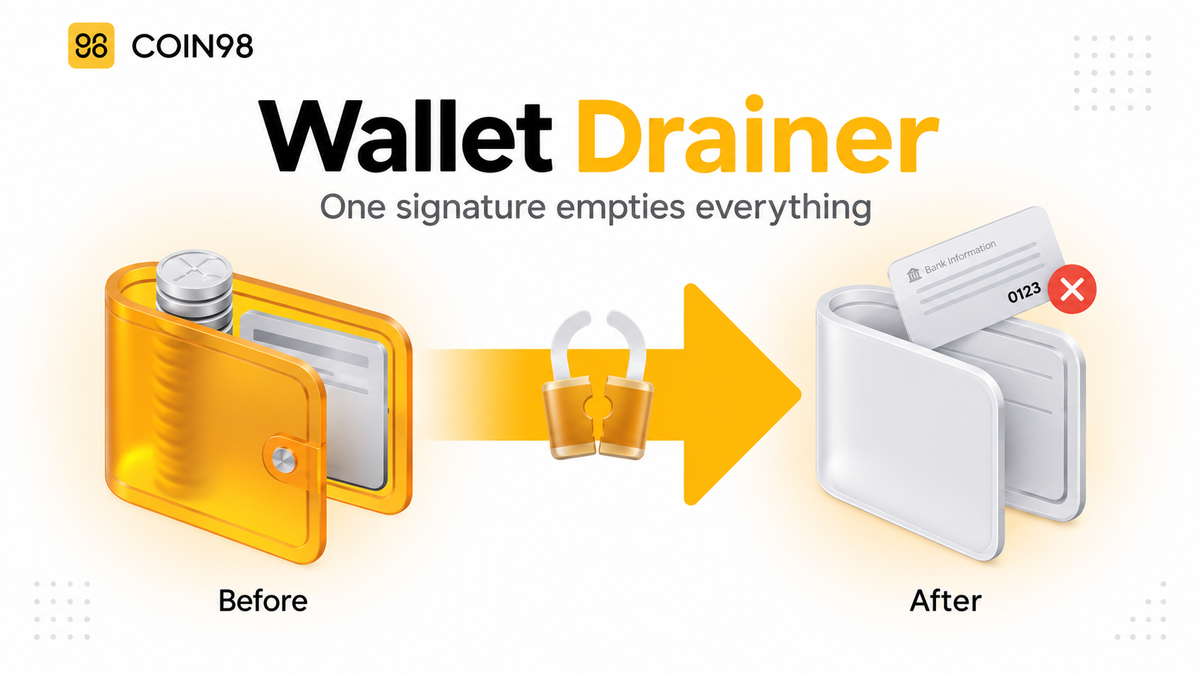
Wallet drainers are malicious scripts that empty your crypto wallet in seconds — often with a single signature. In 2024, they stole $494M from more than 332,000 wallets, the worst year on record for this type of attack. This article walks you through exactly how a wallet drainer works, which signatures it exploits, and what you can do before you connect to any site.
What a wallet drainer is and how a single signature empties a wallet
A wallet drainer is on-chain malware embedded in a phishing site that, once you approve one transaction, can transfer every token or NFT you own to an attacker's address. It doesn't need your seed phrase. It doesn't need ongoing access. One signature is enough.
The attack follows a predictable kill chain:
- Lure — A fake mint page, a fraudulent airdrop, or a hacked Discord server pushes a link with artificial urgency ("Mint closes in 10 minutes").
- Connect — The site calls
window.ethereum.request()to trigger a standard wallet popup. This step looks identical to any legitimate dApp connection. - Malicious request — Instead of a small transaction, the site requests a signature that grants unlimited permission over your assets — an approval, a Permit2 signature, or a raw
eth_signcall. - Sweep — The drainer script submits the signed permission on-chain and transfers everything of value to the attacker's wallet.
The whole sequence can complete in under a minute. Because the drainer uses your own granted permission to move funds, the transactions appear legitimate on-chain. There's no hack in the traditional sense — you authorized the transfer.
This model has been commercialized through drainer-as-a-service (DaaS) — packaged kits sold to non-technical operators that include phishing site templates, smart contract scripts, hosting infrastructure, and dashboards. Operators typically pay the kit developer a 20–30% commission on stolen funds. This arrangement lowers the skill barrier dramatically: you don't need to write smart contracts to run a wallet drainer crypto scam.
Operations like Inferno Drainer (responsible for over $80M stolen, with 16,000+ malicious domains) and Pink Drainer ($85M+ stolen before retiring in May 2024) operated on this commercial model, recruiting affiliates who handled social engineering while the kit handled the technical execution.
The signatures that drainers exploit
The core of every crypto drainer scam is an approval — a permission you grant that lets a contract move your assets on your behalf. Drainers target four specific signature types. Understanding what each does explains why a single click can be catastrophic.
| Signature type | What it authorizes | Why drainers love it |
|---|---|---|
setApprovalForAll |
Grants a contract unlimited access to every NFT in an entire collection | One approval covers hundreds of assets |
approve / increaseAllowance |
Grants a contract the right to spend a specific ERC-20 token, often set to unlimited amount | Standard and familiar — users approve it routinely |
| Permit2 (EIP-2612) | An offline signature that creates a token allowance without a separate on-chain approval transaction | No second confirmation prompt; users don't see a gas fee and lower their guard |
eth_sign |
Produces a raw cryptographic signature that can authorize arbitrary transactions | The most dangerous type — can be used for almost anything; many wallets now warn against or block it |
The Permit2 case deserves extra attention. Standard ERC-20 approvals require an on-chain transaction you can see and cancel. A Permit2 signature is off-chain — it looks like a "Sign" message rather than a transaction, so there's no gas fee to signal that something real is happening. The drainer presents this as a harmless confirmation, then submits the signed payload on-chain to drain your tokens. We cover the mechanics in more detail in our guide on blind signing and why it keeps draining wallets.
For a deeper look at how approvals work and why unlimited amounts are dangerous, our article on token approvals explained is worth reading before interacting with any new dApp.
How to protect your wallet from drainers
The most effective protection happens before you connect. Here's a layered approach we recommend.
Before connecting to any site
- Verify the URL character by character. Phishing sites use homoglyphs (e.g.,
cоin98.comwith a Cyrillic "о") or extra subdomains. - Check the domain age and social proof. A mint site launched 48 hours ago with no history is a red flag.
- Confirm the link against the project's official channels — not what someone in Discord DMed you.
- Review what permissions the site is requesting before you sign. Our guide on dApp permissions and safe connecting covers what to look for.
Use a burner wallet for high-risk interactions
A burner wallet is a fresh address you fund with only what's needed for a specific interaction — a mint, an airdrop claim, a new protocol trial. If the site is malicious, the drainer only reaches what's in the burner. Your main wallet with long-term holdings stays untouched.
Simulate transactions before signing
Modern wallets and browser extensions can preview what a transaction will actually do before you confirm. If the simulation shows an unlimited token approval going to an unknown contract, that's a signal to stop. Coin98 Super Wallet includes a Wallet Approval feature that lets you review and revoke existing token allowances directly in the app — a useful step both before and after any interaction. You can find it at coin98.com/wallet.
Audit and revoke approvals regularly
Every approval you've ever granted stays active until you revoke it. A drainer site you visited months ago and walked away from may have left an active permission on a token you've since accumulated more of. We suggest reviewing approvals at least monthly. Our walkthrough on how to revoke wallet permissions explains the process step by step.
For a broader picture of attack types that target crypto wallet users, our article on common attacks in 2026 covers phishing alongside other vectors.
What the numbers tell us: drainer losses 2023–2026
The data shows a clear arc — rapid growth through 2024, a sharp decline in 2025, and new warning signs emerging in early 2026.
| Year | Total losses | Wallets affected | Avg loss per wallet |
|---|---|---|---|
| 2023 | ~$295–300M | ~320,000–324,000 | ~$920 |
| 2024 | $494M | 332,000+ | ~$1,488 |
| 2025 | $83.85M | 106,106 | ~$790 |
The 83% decline in losses from 2024 to 2025 is significant, but the picture is more nuanced than it looks. The drop in average loss per wallet — from ~$1,488 in 2024 to ~$790 in 2025 — suggests attackers were either hitting smaller targets or that improved wallet warnings were interrupting high-value drains. Only 11 incidents exceeded $1M in 2025, down from 30 in 2024. The largest single incident in 2025 was $6.5M, compared to $55.4M in 2024.
Q3 2025 had the highest losses of the year at $31M, coinciding with Ethereum's price rally — a consistent pattern where rising asset prices attract more operators.
Research covering March 2023 to April 2025 identified 32,819 phishing sites linked to drainer activity and tracked approximately $135M drained from 76,582 victim wallets on Ethereum alone, with victims exceeding 100 per day at peak periods.
The 2025 decline is partly attributed to major operations shutting down — Pink Drainer retired in May 2024 — and to wallet providers deploying better transaction simulation and clearer approval warnings. The first weeks of 2026 are worth watching: signature phishing losses jumped 207% month-over-month to $6.27M, suggesting the lull may be ending.
The DaaS economics explain why these operations persist. A 20% commission on $494M is roughly $99M distributed to kit developers in 2024 alone — enough to fund continued development, infrastructure, and recruitment of new operators.
FAQ
What's the difference between a wallet drainer and a regular phishing attack?
Traditional phishing tries to steal your login credentials or seed phrase directly. A wallet drainer doesn't need either. It tricks you into signing a legitimate-looking transaction that grants an on-chain permission, then uses that permission to sweep your assets. The blockchain processes the transfers, which makes recovery nearly impossible.
Can a wallet drainer steal funds without me signing anything?
No — you have to authorize something. Drainers can't move funds from a wallet without a signature or prior approval. The deception is in making the signature request look harmless, routine, or time-sensitive. This is why reading what you're signing — not just where you're signing — matters.
What is Permit2 phishing specifically?
Permit2 is a token approval standard (EIP-2612) that lets you create token allowances through an off-chain signature rather than an on-chain transaction. Because there's no gas cost, it doesn't feel like a "real" action. Drainers present Permit2 requests as innocuous confirmation prompts, then submit the signed payload on-chain to drain tokens. The absence of a gas fee is a cue to be more cautious, not less.
Is a burner wallet actually effective against drainers?
Yes, as a containment strategy. If you use a burner wallet with only the assets needed for a specific interaction, a drainer can only access what's in that wallet. Your main holdings are unaffected. The tradeoff is friction — you need to bridge or transfer funds to the burner for each risky interaction. For high-value situations like new mints or unaudited protocols, the tradeoff is worth it.
What should I do immediately if I think I've been drained?
Move any remaining assets from the compromised wallet to a new address as quickly as possible — the drainer script may not have swept everything. Then revoke all active approvals on the compromised address to cut off any lingering permissions. Document the transaction hashes and report to the platform where you encountered the phishing link. Revoking approvals prevents ongoing exposure if the wallet still holds anything.
A wallet drainer turns your own signature against you. The attack is fast, the permissions are real, and the on-chain trail looks legitimate. Losses peaked at $494M in 2024 before declining in 2025, but early 2026 data shows the threat is active. Checking URLs, using burner wallets for risky interactions, and auditing approvals regularly through tools like Coin98 Super Wallet are the layers that matter. One careful minute before you sign is worth more than any recovery attempt after.