ZK-Rollups vs Optimistic Rollups: The Ethereum Scaling Battle
Explore the key differences between ZK-Rollups and Optimistic Rollups. Learn which Ethereum Layer 2 solution offers faster speeds and lower fees.
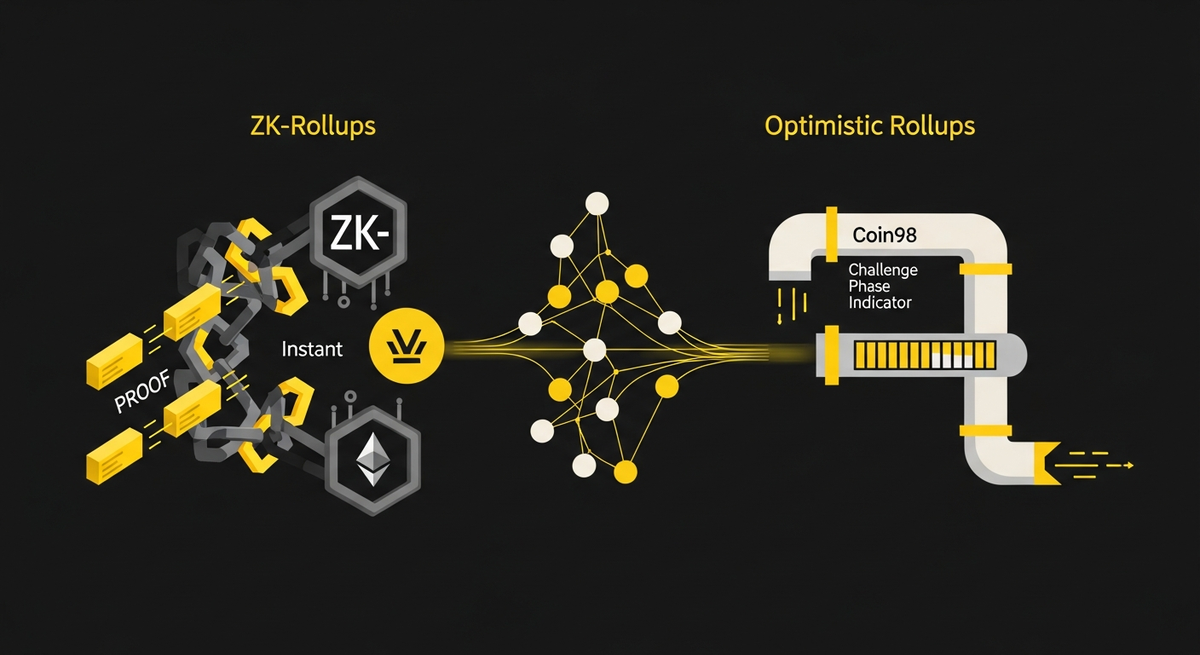
This article is part of our DeFi 101 series, designed to help you navigate the world of decentralized finance. This is not financial advice.
If you've tried using Ethereum during peak hours, you've felt the pain: transaction fees that cost more than the transaction itself. This isn't a bug; it's a bottleneck. Ethereum can only process so many transactions at once, leading to a bidding war for block space. The solution isn't to abandon Ethereum, but to build on top of it. This is where the Layer 2 scaling battle between ZK-Rollups and Optimistic Rollups begins.
What Are Rollups and Why Should You Care?
Imagine a busy highway with only one tollbooth. The result is a massive traffic jam. Rollups act like a multi-lane express route built alongside the main highway. They take a large batch of transactions, process them off the main Ethereum chain (Layer 1), and then post a compressed, single summary of those transactions back to it. The result? Drastically lower fees and significantly faster confirmation times for you, the end-user.
Both ZK-Rollups and Optimistic Rollups share this goal, but they achieve it through fundamentally different security models. Understanding this difference is key to navigating the Layer 2 landscape.
Optimistic Rollups: The “Innocent Until Proven Guilty” Approach
Optimistic Rollups, used by networks like Arbitrum and Optimism, operate on a principle of trust. They optimistically assume that all transactions bundled in a batch are valid and post them to Ethereum without immediate proof.
To keep everyone honest, there's a safety mechanism: a challenge period (typically around 7 days). During this window, anyone can submit a “fraud proof” if they spot an invalid transaction. If the proof is valid, the fraudulent transaction is reverted, and the malicious actor is penalized. If no one challenges the batch within the window, it's considered final on Ethereum.
Key Characteristics:
- Pros: High EVM-compatibility makes it easier for developers to migrate existing DApps from Ethereum. The technology is generally considered less complex to implement initially.
- Cons: The main drawback for users is the long withdrawal period. If you want to move your funds from an Optimistic Rollup back to Ethereum, you must wait for the entire 7-day challenge period to end. This is a major user experience friction point.
ZK-Rollups: The “Trust, But Verify with Math” Approach
ZK-Rollups (Zero-Knowledge Rollups), used by networks like zkSync, StarkNet, and Polygon zkEVM, take a more rigorous, trust-minimized approach. Instead of assuming transactions are valid, they use complex cryptography to generate a validity proof (specifically, a ZK-SNARK or ZK-STARK).
This proof mathematically guarantees that all transactions in the batch are correct, without revealing the actual data of the transactions themselves (hence “zero-knowledge”). When this proof is posted to Ethereum, the mainnet can instantly verify its correctness without re-executing the transactions. There is no need for a lengthy challenge period.
Key Characteristics:
- Pros: Near-instant finality and withdrawals. Since validity is proven mathematically, you can move your funds back to Layer 1 in minutes, not days. This provides a much higher degree of security and capital efficiency.
- Cons: The technology is incredibly complex and computationally intensive. Historically, achieving full EVM compatibility has been a challenge, though zkEVM solutions are rapidly closing this gap.
Head-to-Head: The Key Differences
Let's break it down simply:
- Security Model: Optimistic relies on economic incentives and a fraud proof system. ZK relies on cryptographic validity proofs.
- Withdrawal Time: This is the big one. Optimistic Rollups have a long delay (e.g., 7 days), while ZK-Rollups are fast (minutes to hours).
- Capital Efficiency: ZK-Rollups win here. Your funds are not locked up for a week just to bridge back to the mainnet.
- Technology: Optimistic is currently simpler and more EVM-native. ZK is more advanced but is quickly evolving to become more developer-friendly.
Navigating the Layer 2 Maze: Your Wallet is Your Compass
The rise of Layer 2s has created a new problem: fragmentation. To interact with Arbitrum, Optimism, and zkSync, you need a wallet that can seamlessly switch between them. While foundational tools like MetaMask are powerful, they often require you to manually find and add RPC details for each new network—a process that is tedious and prone to error for even experienced users.
This is where we designed the Coin98 Super Wallet to excel. We believe that accessing the future of Web3 shouldn't be a technical chore. Coin98 automatically integrates with a massive list of Layer 2 networks, including all the major Optimistic and ZK-Rollups. There's no need to hunt for RPCs or worry about configurations. You just select the network you want to use from a dropdown, and you're ready to go.
Furthermore, managing assets across these chains is simplified with our built-in Coin98 Exchange. You can swap and bridge assets between Ethereum, Arbitrum, and other Layer 2s directly within the wallet, saving you time and reducing the risk of using untrusted third-party bridges.
The Future is Multi-Rollup, Not a Winner-Takes-All
The debate isn't about which rollup technology will “win.” The future is a multi-chain, multi-rollup ecosystem where different solutions cater to different needs. Your challenge is no longer picking a winner but equipping yourself with a tool that can access them all effortlessly.
A unified experience is critical. That's why we're building tools like OneID, your universal Web3 identity that can work across all these chains, simplifying your digital footprint. Imagine having one name that represents you on every Layer 2, without needing to manage dozens of different addresses.
Your Next Step into the Layer 2 World
Optimistic and ZK-Rollups are both incredible innovations solving Ethereum's scalability problem. One prioritizes ease of implementation, while the other prioritizes mathematical certainty and speed. As a user, the most important thing is having secure and simple access to both.
Stop wrestling with network configurations and fragmented experiences. It's time to explore the low-fee, high-speed world of Layer 2s with a wallet built for the multi-chain future.
Ready to experience seamless Layer 2 access? Download the Coin98 Super Wallet today and unlock the full potential of Ethereum scaling.
Frequently Asked Questions (FAQ)
What are Ethereum rollups and why are they important?
Rollups are Layer 2 scaling solutions that process transactions off the main Ethereum chain (Layer 1) and then post a compressed summary back. They significantly reduce transaction fees and increase confirmation times by bundling many transactions into one.
What is the main difference between Optimistic Rollups and ZK-Rollups?
Optimistic Rollups optimistically assume transactions are valid and rely on a challenge period (e.g., 7 days) for fraud proofs, causing withdrawal delays. ZK-Rollups use complex mathematical proofs to instantly verify transaction validity, offering immediate finality and eliminating the long waiting period.
Which networks use Optimistic Rollups?
Networks like Arbitrum and Optimism utilize Optimistic Rollups. They operate on an "innocent until proven guilty" principle, allowing a challenge period for invalid transactions before finalization on Ethereum.
What is the main drawback of Optimistic Rollups for users?
The primary drawback for users of Optimistic Rollups is the mandatory challenge period, typically around 7 days. This means users must wait this full duration to move their funds from the rollup back to the main Ethereum chain, creating significant user experience friction.