Address Poisoning: Why the Address in Your History Isn't the One You Used
Over 65M poisoned transactions planted since January 2025. One wrong copy-paste cost a single user $50 million.
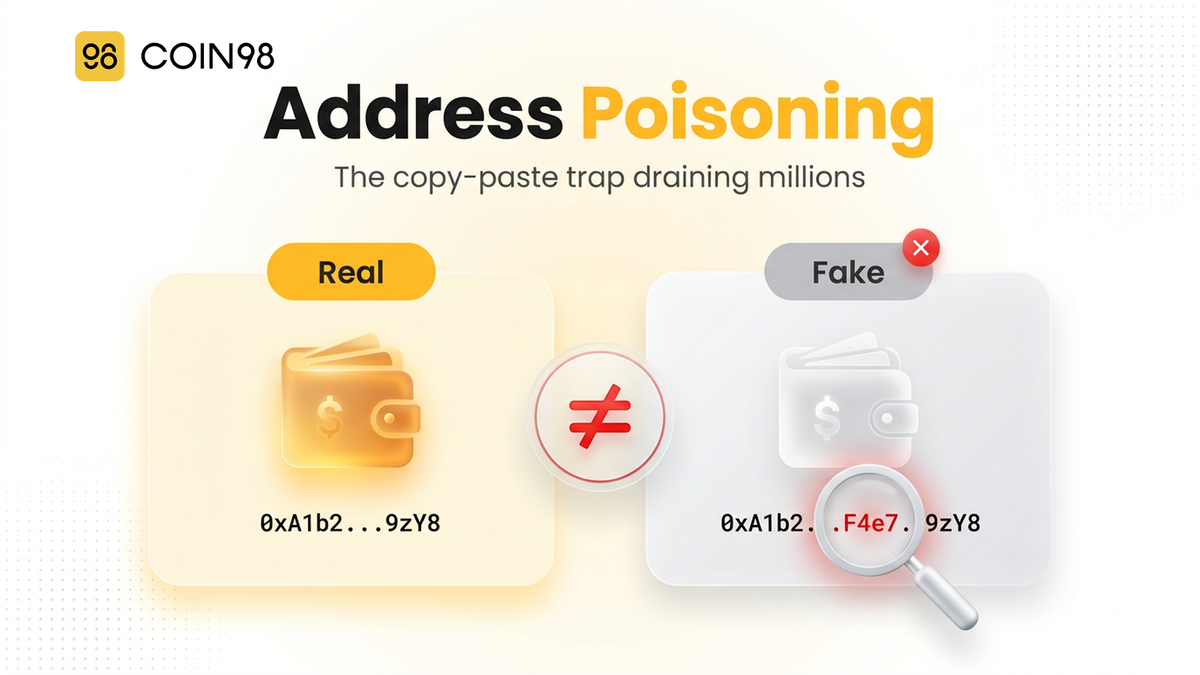
Address poisoning crypto scams exploit one of the most common habits in Web3 — copying an address from recent transaction history. Since January 2025, over 65.4 million address poisoning transactions have been flagged, with roughly 316,000 confirmed thefts. This article breaks down how the attack works, why it scaled sharply in late 2025, and what you can do to avoid becoming a statistic.
What Address Poisoning Is and How It Works
Address poisoning is a scam where an attacker inserts a fake transaction into your wallet history so that a lookalike address appears among your recent activity. When you later go to send funds, you copy from that list — and the funds go to the attacker.
The mechanics depend on a property of wallet interfaces: they almost always display only the first four to six and last four to six characters of an address. That's usually enough to feel familiar. Attackers exploit this by generating a vanity address — a wallet address that shares those visible characters with a real address you've used before — then sending a zero-value or dust transfer from it to your wallet. That tiny transaction plants the lookalike address in your history.
Here's the step-by-step flow:
- The attacker identifies a high-value wallet and scans its transaction history for frequently-used counterparty addresses.
- A vanity address generator brute-forces combinations until it produces an address matching the first and last few characters of the real target address.
- The attacker sends a zero-value transfer or small dust amount from the fake address to your wallet. This costs almost nothing and requires no access to your funds.
- When you next go to send, the poisoned address appears in your recent history. You copy it, the wallet shows the matching prefix and suffix, the transfer goes through — and the funds are gone.
No phishing link. No malware. No wallet access. The only thing exploited is your trust in your own transaction history.
Address poisoning shares DNA with dusting attacks — both use unsolicited low-value transfers as a tool — but where dusting typically tries to deanonymize wallets, address poisoning is a direct theft setup. It also overlaps with clipboard hijacking, which replaces a copied address in memory rather than planting a fake in history. Together, they're the two dominant copy-paste attack vectors in crypto.
Why Address Poisoning Got Significantly Worse in 2025–2026
The attack scaled sharply in a short window. Attempts spiked from 628,000 in November 2025 to 3.4 million in January 2026 — a 5.4x increase in two months. Ethereum surpassed BNB Chain as the most-poisoned network for the first time in January 2026, with Ethereum-related losses reaching $62 million over the late 2025 to early 2026 period.
Two factors drove this expansion.
The economics are asymmetric. A single attacker contract sent 3 million dust transfers for a total of $5,175 — about $0.0017 per poisoning attempt. Even at a 1-in-200 success rate, a single successful theft against a mid-sized wallet pays back the entire campaign many times over.
Ethereum's Fusaka upgrade removed a natural brake. When Fusaka shipped on December 3, 2025, it reduced transaction fees by approximately six times. What was a moderate cost-per-attempt became negligible, and attackers who'd been constrained by fee economics could run mass campaigns with almost no overhead.
Low cost, low effort, real payoff — that's why the attack has spread across toolkits. It's not new, but it's gotten cheap enough to run at industrial scale. Our broader breakdown of common attacks targeting wallet users in 2026 covers how this trend fits into the wider threat landscape.
Real Incidents and What They Cost
The incidents below illustrate both scale and sophistication.
| Date | Chain | Amount | Method |
|---|---|---|---|
| December 2025 | Ethereum | $50M USDT | Attacker detected a $50 test transaction, generated a matching address, planted dust — victim sent $49,999,950 USDT 26 minutes later |
| January 30, 2026 | Ethereum | $12.4M (4,556 ETH) | 2-month dusting campaign; strategic final dust planted 32 hours before the victim made the transfer |
| Late 2025–Early 2026 | Ethereum (aggregate) | $62M | Mass campaign across multiple targets |
| Ongoing | Multi-chain | Undisclosed | ~15,000 malicious nested proxy addresses created targeting Safe{Wallet} users |
The $50 million theft wasn't a lucky guess — it was precise mempool surveillance. The attacker watched for small test transactions (a habit many users develop as a safety check) and used that signal to time the poison. The 26-minute window between detection and execution shows how automated these campaigns have become.
The Safe{Wallet} campaign is a different variant: attackers created malicious Safe smart contract accounts with lookalike addresses, exploiting the nested proxy structure to pass casual inspection. This shows the attack extending beyond simple EOA wallets.
The January 30 incident illustrates long-horizon patience. A two-month dusting campaign means the attacker kept refreshing the poisoned address in the victim's history, waiting for a large enough transfer to act on.
How to Verify an Address and Protect Your Wallet
The most effective defense is changing where you retrieve addresses from. We recommend treating your transaction history as read-only context, not a copy-paste source.
Primary recommendations:
- Use an address book. Save verified counterparty addresses under named labels. The Coin98 Super Wallet has a built-in address book — entries there come from a source you controlled, not from inbound transactions.
- Retrieve from the original source. Go back to the original confirmation email, the exchange interface, or the contact's own published address rather than the last-used shortcut.
- Verify the middle characters, not just the ends. Attackers match the prefix and suffix. The middle 20–30 characters are where a vanity address diverges — that's where it's worth looking when spot-checking.
- Treat your test transaction habit carefully. Sending a small test before a large transfer is sensible — but if the attacker is watching the mempool, that test signals the main transfer is coming. We suggest verifying the recipient address independently via a separate channel (a phone call, a different messaging app) rather than relying on the test alone to confirm.
- Check token approvals and revoke unnecessary permissions regularly. These don't prevent address poisoning directly, but clean wallet hygiene limits your exposure across attack vectors.
Worth avoiding:
- Copying from the "Recent Transactions" or "History" tab without cross-checking
- Relying only on first and last characters to verify
- Assuming a zero-value transfer in your history is harmless spam with no implication
Address poisoning works because the wallet interface makes the poisoned address look legitimate. The countermeasure isn't a smarter interface — it's a different retrieval habit.
FAQ
What is address poisoning in crypto? Address poisoning is a scam where an attacker sends a zero-value or dust transaction from a wallet address that looks nearly identical to one you've previously used. The goal is to get the lookalike address into your transaction history so you accidentally copy it during a future transfer. The attacker needs no access to your wallet — the entire attack relies on mistaking the fake address for the real one.
How does the vanity address match look so convincing? Most wallets display only the first four to six and last four to six characters of an address. Attackers use automated vanity address generators that brute-force combinations until they produce an address matching those visible portions. Because the middle section is hidden by default, the match looks perfect at a glance. It's not cryptographic compromise — it's a UI design assumption being abused.
Is address poisoning the same as a dusting attack? They're related but different. Dusting attacks typically use small token drops to track wallet activity or link addresses together. Address poisoning uses dust or zero-value transfers specifically to plant a lookalike address in your history with the intent of intercepting a future transfer. Both exploit unsolicited transactions, but address poisoning has a more direct theft mechanism.
Can I recover funds sent to a poisoned address? In practice, recovery is extremely unlikely. Blockchain transactions are irreversible once confirmed, and the attacker controls the destination wallet. Unless law enforcement can identify and freeze the attacker's funds at an exchange withdrawal point — which is rare and slow — the funds are gone. This is why prevention is the only reliable strategy.
Does sending a small test transaction protect me? A test transaction reduces the risk of typos, but it doesn't protect against address poisoning if you copied the wrong address in the first place. Worse, the $50 million USDT theft in December 2025 showed that attackers monitor the mempool for test transactions and use them as signals to time their poisoning. We recommend combining test transactions with independent address verification through a separate channel — not using the test alone as confirmation.
Address poisoning crypto scams are cheap to run, hard to spot, and costly when they land. The 65.4 million flagged transactions since January 2025 aren't a future threat — they're the current baseline. The defense is straightforward but requires a habit change: retrieve addresses from verified sources, save regulars to your address book, and check the middle characters before confirming. For wallets you use frequently, the Coin98 Super Wallet address book is the simplest way to remove transaction history from the equation entirely.