Token Standards 101: ERC-20 vs BEP-20 vs TRC-20 vs SPL Explained
Confused by ERC-20, BEP-20, TRC-20, and SPL? Learn the difference between these token standards to safely withdraw crypto from exchanges to your Web3 wallet.
Why Your Crypto Disappears: The Cost of Ignoring Token Standards
Ever stared at the 'Select Network' dropdown on an exchange and felt a cold sweat? You select USDT, but then it asks: ERC-20, BEP-20, TRC-20, or SPL? Choosing the wrong one isn't just a simple mistake; it's a direct path to potentially losing your funds forever. This isn't FUD; it's a hard lesson many have learned.
Understanding token standards isn't just technical jargon for developers. For a user, it's the single most important piece of knowledge for safely moving assets from a centralized exchange (CEX) to a non-custodial wallet. Let's break down what they are and why they are critical for your crypto security.
What Exactly is a Token Standard?
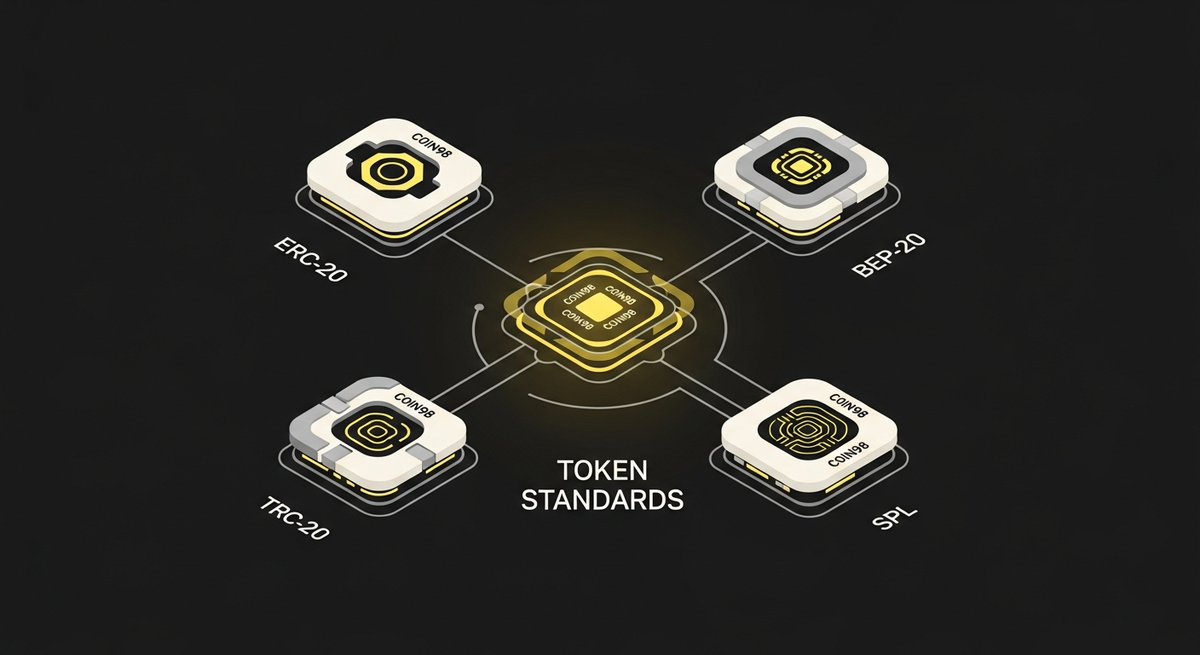
Think of a token standard as a blueprint or a set of rules for creating and issuing tokens on a specific blockchain. It ensures that all tokens created under that standard can interact seamlessly with each other, with DApps, and with wallets within that same ecosystem.
A good analogy is the USB-C standard. Before USB-C, every device had a different, proprietary charging port. Now, a single standard allows for universal compatibility. Token standards do the same for digital assets on a blockchain, guaranteeing that a new token will function predictably with existing infrastructure like decentralized exchanges (DEXs) and wallets.
The Big Four: A Practical Breakdown
When you withdraw from an exchange, you're usually faced with a few common choices. Here’s what you need to know about each one.
ERC-20: The Ethereum Original
The ERC-20 (Ethereum Request for Comment 20) standard is the original blueprint for fungible tokens on the Ethereum blockchain. Most of the tokens you know from the 2017 ICO boom and the DeFi summer of 2020 are ERC-20 tokens (e.g., UNI, LINK, SHIB).
- Blockchain: Ethereum
- Pros: Massive ecosystem, highest liquidity, supported by virtually every wallet and exchange.
- Cons: High transaction fees (gas) during periods of network congestion.
- Wallet Reality: While MetaMask is the default for many, its user experience for managing assets on other chains can be clunky, requiring manual network additions and often leaving users confused.
BEP-20: The BNB Smart Chain Powerhouse
The BEP-20 standard is the equivalent of ERC-20 but for the BNB Smart Chain (BSC). Because BSC is EVM-compatible (Ethereum Virtual Machine), BEP-20 tokens function almost identically to ERC-20 tokens. This is a critical point of confusion for new users.
Key Difference: A common point of confusion is differentiating BEP20 and ERC20. They both use the same '0x...' address format. However, they live on two completely separate blockchains. Sending an ERC-20 token to your address via the BEP-20 network means the token will only be accessible on the BNB Smart Chain, not on Ethereum.
- Blockchain: BNB Smart Chain
- Pros: Significantly lower transaction fees and faster confirmation times compared to Ethereum.
- Cons: More centralized than Ethereum, which can be a concern for some users.
TRC-20: The TRON Standard for Transfers
TRC-20 is the token standard for the TRON blockchain. It gained immense popularity as the network of choice for stablecoins like USDT due to its incredibly low (often near-zero) transaction fees and high throughput.
- Blockchain: TRON
- Pros: Extremely low fees, making it ideal for frequent, small transactions.
- Cons: The ecosystem of DApps is less developed compared to Ethereum and BSC. Many popular non-custodial wallets do not offer native support for TRON.
SPL: The Solana Speedster
SPL (Solana Program Library) is the token standard for the high-performance Solana blockchain. Tokens like USDC, BONK, and WIF on Solana are SPL tokens. A key differentiator is the wallet address format, which looks completely different from the Ethereum '0x...' style.
- Blockchain: Solana
- Pros: Lightning-fast transactions and negligible fees. A rapidly growing ecosystem.
- Cons: Different address format can be confusing. Wallets are often siloed; for instance, Phantom is an excellent wallet but is primarily built for the Solana ecosystem, forcing you to use another wallet for your EVM assets.
The Coin98 Super Wallet: Your Multi-Chain Command Center
Juggling different wallets for different chains is a security risk and a user experience nightmare. You have MetaMask for ERC-20, maybe Trust Wallet for BEP-20, and Phantom for SPL. This fragmentation is where mistakes happen.
We built the Coin98 Super Wallet to solve this exact problem. It was designed from the ground up as a true multi-chain wallet, not an Ethereum wallet with other chains tacked on as an afterthought.
- One Wallet, All Chains: Your ERC-20, BEP-20, TRC-20, and SPL tokens all appear in a single, unified interface. No more switching networks manually to see your assets. Send USDT from Binance via BEP-20, and it appears right next to your Ethereum assets automatically.
- Eliminate Address Confusion: With a multi-chain wallet, your single recovery phrase secures assets across dozens of blockchains. Soon, with our OneID integration, you can even replace those long, intimidating addresses with a single human-readable name that works across chains.
- Seamless Cross-Chain Swaps: Need to swap your BEP-20 BUSD for an SPL token on Solana? You can do it directly within the wallet using the integrated Coin98 Exchange, which finds the best rates and routes for you.
Your Pre-Withdrawal Safety Checklist
Before you click that 'Withdraw' button on any exchange, run through this mental checklist:
- Confirm the Token: Are you withdrawing the correct asset? (e.g., USDT, not USDC).
- Confirm the Destination: Does your receiving wallet support the network you're about to select? (With Coin98 Super Wallet, the answer is almost always 'yes').
- MATCH THE NETWORK: This is the most crucial step. If your token is on your exchange as an ERC-20 asset and you want it on Ethereum, you MUST select the ERC-20 network. Double and triple-check this.
- Verify the Address: Copy and paste the correct receiving address from your wallet. Send a small test amount first if you're dealing with a large sum.
Mastering token standards is a non-negotiable skill for navigating Web3. It's the barrier between secure self-custody and a costly mistake. Stop letting network selection anxiety control your crypto journey.
Ready to simplify your multi-chain life? Download the Coin98 Super Wallet and take control of your assets across every major blockchain, all from one secure place.
Frequently Asked Questions (FAQ)
What is a token standard in cryptocurrency?
A token standard is a set of rules or a blueprint for creating and issuing tokens on a specific blockchain. It ensures tokens can interact seamlessly with wallets, DApps, and other tokens within that ecosystem. It's crucial for predictable functionality and compatibility of digital assets.
Why is understanding token standards critical for crypto users?
Understanding token standards is vital to avoid losing funds. Selecting the wrong network or standard when sending crypto can result in assets being irretrievably lost. It ensures safe and correct transfers between exchanges and non-custodial wallets, guaranteeing compatibility within the blockchain ecosystem.
What is the main difference between ERC-20 and BEP-20 tokens?
ERC-20 tokens are built on the Ethereum blockchain, known for its large ecosystem but higher fees. BEP-20 tokens are on the BNB Smart Chain (BSC). While both are EVM-compatible and function similarly, they operate on different networks with distinct transaction fees and network congestion characteristics.