Impermanent Loss: The Hidden Risk in Liquidity Pools
Ever wondered why your assets decreased after providing liquidity? Learn what impermanent loss (IL) is, how it works, and how to mitigate this hidden DeFi risk.
The Alluring Promise and the Harsh Reality of Liquidity Pools
You've deposited a pair of assets into a liquidity pool, enticed by the promise of high APYs from trading fees. You wait, and while you see fees accumulating, you later withdraw your funds only to discover the total dollar value is less than if you had simply held those assets in your wallet. What happened? You've just met impermanent loss (IL), the silent risk that catches many aspiring yield farmers off guard.
This isn't just a theoretical problem; it's a practical challenge that affects the profitability of anyone participating in decentralized finance (DeFi). At Coin98, we believe in empowering users with knowledge, not just tools. This article will break down what impermanent loss is, why it happens, and how you can approach it with a clear strategy.
A Quick Refresher: What are Automated Market Makers (AMMs)?
Before diving into IL, let's quickly recap how the liquidity pools you're using actually work. Most decentralized exchanges (DEXs) today are Automated Market Makers (AMMs). Unlike traditional exchanges that use order books, AMMs rely on liquidity pools.
- Liquidity Pools: These are smart contracts holding reserves of two or more tokens.
- Liquidity Providers (LPs): Users like you deposit an equal value of two tokens into a pool to provide liquidity. In return, you receive LP tokens, which represent your share of the pool and entitle you to a portion of the trading fees generated.
These pools use a mathematical formula to price assets. The most common is the constant product formula: Token A Balance * Token B Balance = Constant (k). The core idea is that the total liquidity value (k) must remain constant, so as traders swap one token for another, the formula automatically adjusts their prices.
Demystifying Impermanent Loss: A Step-by-Step Example
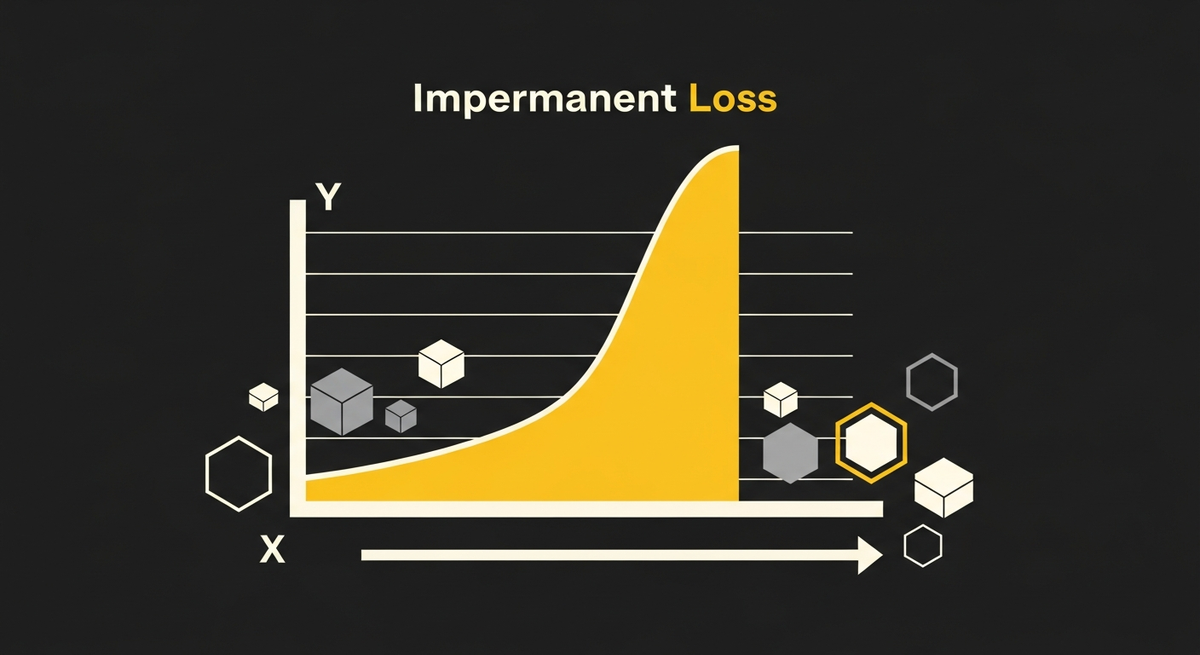
Impermanent Loss is the difference in value between holding tokens in an AMM pool versus simply holding them in your wallet (HODLing). It occurs when the price of the tokens in the pool changes compared to when you deposited them.
Let's walk through a simple scenario:
Imagine a liquidity pool for ETH/USDC on a DEX.
- Initial Deposit: The price of 1 ETH is $2,000. You decide to provide liquidity by depositing 1 ETH and 2,000 USDC into the pool. Your total initial investment is $4,000. Let's say you now own 1% of the pool.
- Price Movement: A week later, the price of ETH doubles on the open market to $4,000.
- Arbitrage in Action: The price in your liquidity pool is still lagging. Arbitrage traders see this opportunity. They will buy the 'cheaper' ETH from the pool and add USDC to it until the pool's price ratio matches the market price of 1 ETH = $4,000.
- The Pool Rebalances: To maintain its constant formula, the pool now has less ETH and more USDC. Your 1% share of the pool is no longer 1 ETH and 2,000 USDC. Due to the rebalancing, your share has become approximately 0.707 ETH and 2,828 USDC.
- Calculating the 'Loss': Now, let's see what happens if you withdraw your funds.
- Value of your LP position: (0.707 ETH * $4,000) + 2,828 USDC = $2,828 + $2,828 = $5,656.
- Value if you had just HODLed: (1 ETH * $4,000) + 2,000 USDC = $6,000.
The difference, $6,000 - $5,656 = $344, is your impermanent loss. It's 'impermanent' because if the price of ETH were to return to $2,000, this loss would disappear. However, if you withdraw at the new price, the loss becomes very real and permanent.
Key takeaway: The greater the price divergence between the two assets in the pool, the larger the impermanent loss. Your profit is a constant battle: Trading Fees Earned vs. Impermanent Loss Incurred.
How to Manage and Mitigate Impermanent Loss
While you can't eliminate IL entirely, you can manage it. This is where strategy and the right tools become critical. Many users start their DeFi journey with basic wallets like MetaMask or Phantom. While they are great for simple transactions, they often lack the integrated tools to give you a clear overview of your complex DeFi positions.
This fragmentation is a real pain point. You have to jump between different DApp interfaces and use third-party trackers to understand your true performance. This is precisely the problem we aimed to solve with the Coin98 Super Wallet.
1. Choose Your Pairs Wisely
The easiest way to reduce IL is to provide liquidity for pairs of assets with low volatility relative to each other. For example, a pool of two stablecoins like USDC/USDT will experience minimal impermanent loss because their prices are pegged to $1 and rarely deviate.
2. A Superior Management Experience
Instead of juggling multiple tabs, the Coin98 Super Wallet offers a unified DeFi dashboard. You can connect your wallet and instantly see all your LP positions across different chains and protocols in one clean interface. This allows you to:
- Track P&L: Get a clearer picture of whether the trading fees you're earning are truly outpacing any potential impermanent loss.
- Act Quickly: A centralized view enables faster decisions. If you notice significant price divergence, you can decide to withdraw your liquidity directly from the wallet's integrated DApp Browser without fumbling for the right website.
3. Optimize Your Swaps
When you're preparing to enter a pool, you often need to swap for the right ratio of tokens. The integrated Coin98 Exchange aggregates liquidity from multiple DEXs to find you the best swap rates. This ensures you start your LP journey with minimal slippage and optimal asset values.
Conclusion: Is Providing Liquidity a Losing Game?
Absolutely not. Providing liquidity remains a fundamental and potentially profitable activity in DeFi. However, it is not the 'set and forget' passive income stream many believe it to be. It requires active management and a deep understanding of the risks involved, chief among them being impermanent loss.
By understanding the mechanics and using a powerful, all-in-one tool to manage your portfolio, you can navigate these complexities with confidence. Don't let hidden risks undermine your DeFi strategy.
Ready to take control of your DeFi investments? Download the Coin98 Super Wallet today to seamlessly track, manage, and optimize your liquidity positions from a single, secure platform.
Frequently Asked Questions (FAQ)
What is Impermanent Loss (IL)?
Impermanent Loss (IL) is the difference in value between holding tokens in an Automated Market Maker (AMM) liquidity pool versus simply holding them in your wallet. It's a "silent risk" that can make the total dollar value of your assets in a pool less than if you had just held them.
How does Impermanent Loss occur?
IL occurs when the price of the deposited tokens in a liquidity pool changes compared to their price at the time of deposit. Automated Market Makers (AMMs) maintain a constant product ratio, meaning arbitrageurs balance the pool, causing the liquidity provider's share to rebalance and potentially result in fewer of the appreciated asset.
What are Automated Market Makers (AMMs) and liquidity pools?
AMMs are decentralized exchange protocols that rely on liquidity pools instead of order books. Liquidity pools are smart contracts holding reserves of two or more tokens. Users (Liquidity Providers) deposit equal values of tokens into these pools to enable trading, earning a share of trading fees.