EVM vs. Non-EVM: Your Guide to Stop Sending Crypto to Wrong Chains
Confused by EVM vs. Non-EVM chains like Ethereum & Solana? Learn the key differences to prevent costly mistakes and manage all your assets in one secure wallet.
Why Your Crypto Disappeared: The Multichain Mistake Everyone Makes
We’ve all felt that heart-stopping moment. You send a transaction, the funds leave your wallet, but they never arrive at the destination. You check the explorer and see a success message, but the balance is still zero. More often than not, this isn't a hack; it's a simple but costly mistake: sending assets to the wrong blockchain network.
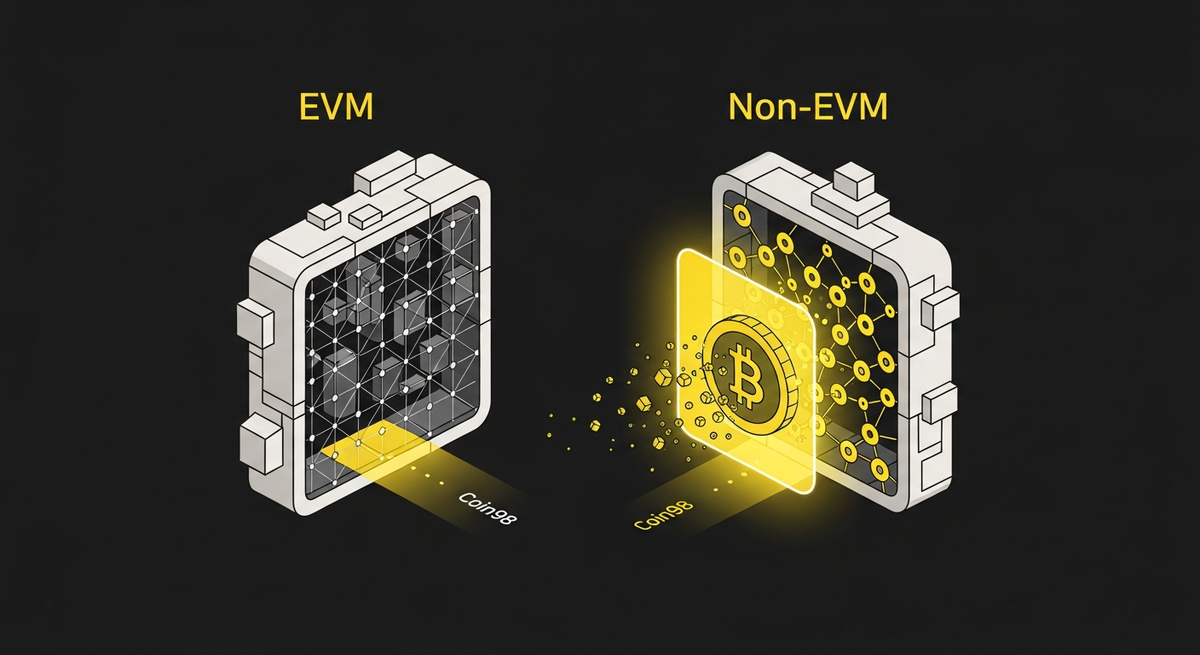
This happens because the crypto world isn't one giant, interconnected system. It's an archipelago of separate islands, each with its own rules and language. Understanding the two main "continents"—EVM and Non-EVM—is the single most important piece of knowledge for safely navigating the multichain landscape.
What Exactly is the Ethereum Virtual Machine (EVM)?
Think of the Ethereum Virtual Machine (EVM) as the operating system for the Ethereum blockchain. It's the environment where all smart contracts are executed and all Ethereum accounts live. It’s the engine that powers the entire ecosystem of decentralized applications (DApps).
The genius of the EVM is that it's a standardized blueprint. Other blockchains saw its success and decided to adopt it. This led to the rise of "EVM-compatible" chains.
The World of EVM-Compatible Chains
An EVM-compatible chain is simply another blockchain that uses the EVM as its core engine. This is incredibly powerful for a few reasons:
- For Developers: They can copy and paste their DApps from Ethereum to another EVM chain like Polygon or BNB Chain with minimal changes.
- For Users: You can use the same wallet address (the one starting with
0x...) across all these networks.
Popular EVM chains include:
- Ethereum (The original)
- BNB Smart Chain (BSC)
- Polygon
- Avalanche (C-Chain)
- Arbitrum
- Optimism
However, this compatibility is also where the danger lies. Your 0x123...abc address on Ethereum is technically a separate wallet from your 0x123...abc address on Polygon. If you send funds from an exchange on the wrong network, they go to an address you control, but on a chain you weren't expecting, leading to confusion and potential difficulty in recovery.
Enter the Non-EVM Chains: A Different Universe
Non-EVM chains are blockchains built from scratch with entirely different architectures. They don't use the EVM and have their own unique rules, programming languages, and consensus mechanisms. If EVM chains are all speaking dialects of the same language, non-EVM chains are speaking completely foreign languages.
The most crucial difference for you, the user, is the wallet address format.
A classic example is the SOL vs ETH debate. An Ethereum address looks like 0x71C7656EC7ab88b098defB751B7401B5f6d8976F. A Solana address, however, looks like So11111111111111111111111111111111111111112. They are fundamentally incompatible.
Prominent non-EVM chains include:
- Solana
- Near Protocol
- Cosmos
- Aptos
- Sui
- Polkadot
Sending an EVM-based asset (like USDT on Ethereum) directly to a Solana address is like mailing a letter with a Japanese address to the German postal service. It simply won't be understood, and your funds will likely be lost forever.
How Wallets Handle This (And Why Most Fail the Multichain Test)
The wallet you choose drastically impacts your ability to navigate this complex world safely.
MetaMask: It's the undisputed king of EVM. It's fantastic for Ethereum and its Layer 2s. But if you want to explore the Solana ecosystem for NFTs or use a DApp on Near, you're out of luck. You need to download a completely separate wallet, like Phantom.
Phantom: The gold standard for Solana. It provides a seamless experience for that specific chain. But again, it's a walled garden. If a new DeFi protocol launches on Arbitrum, your Phantom wallet is useless. You have to switch back to MetaMask.
This forces users into a dangerous habit: managing multiple wallets with multiple seed phrases. Every new seed phrase you write down is another potential point of failure, another risk of being lost or stolen. This is not a user-friendly or secure way to operate in Web3.
The Coin98 Super Wallet: Built for a True Multichain Reality
At Coin98, we built our wallet with the core belief that you shouldn't have to be a blockchain expert to use crypto safely. The Coin98 Super Wallet was designed from day one to be your universal passport to the entire Web3 world, not just one corner of it.
One Wallet, One Seed Phrase, All Chains
This is our foundational principle. With Coin98, you manage one single, secure seed phrase to access over 90 different blockchains. Whether you're interacting with a DApp on Polygon (EVM) or staking on Solana (Non-EVM), it all happens within one unified interface. This massively reduces the mental overhead and security risks associated with juggling multiple applications.
Intelligent and User-Friendly by Design
We've built in safeguards to prevent the common mistakes. When you use our native cross-chain swap inside the Coin98 Exchange, we handle the complex bridging mechanics in the background. Furthermore, our address validation helps you spot when you might be pasting an incompatible address format, giving you a crucial moment to double-check before confirming.
A Unified Identity for a Fragmented World
Remembering complex addresses is a pain. That's why we support services like OneID, allowing you to claim a single, human-readable username (like `yourname.c98`) that works across both EVM and non-EVM chains. Tell your friends to send funds to `yourname.c98`, and the system automatically routes it to the correct address, whether it's for ETH or SOL.
Your Pre-Flight Checklist Before Every Transaction
Until every wallet is as intuitive as Coin98, always follow this simple checklist:
- Check the Address Format: Does it start with
0x? Or does it look like a Solana, Near, or other non-EVM address? - Verify the Network: When withdrawing from an exchange, it will ask you to select a network (e.g., ERC20, BEP20, SPL). Make sure this matches the network your receiving wallet is set to.
- Send a Small Test Amount: For large transfers, always send a small, trivial amount first to confirm everything is working as expected.
Conclusion: Embrace Multichain with Confidence
Understanding the difference between EVM and non-EVM is not just technical trivia; it's a fundamental skill for asset security in Web3. While the landscape is diverse, the right tools can abstract away the complexity, allowing you to focus on exploring new opportunities, not worrying about technical details.
Stop juggling multiple wallets and risking costly mistakes. Download the Coin98 Super Wallet today and experience a truly unified, secure, and user-friendly multichain future. Welcome to Web3, simplified.
Frequently Asked Questions (FAQ)
What is the Ethereum Virtual Machine (EVM)?
The EVM is the operating system for the Ethereum blockchain, executing smart contracts and powering its decentralized applications. It provides a standardized environment that many other blockchains have adopted for compatibility.
What is the difference between EVM and Non-EVM chains?
EVM chains (like Ethereum, Polygon, BSC) use the Ethereum Virtual Machine, allowing for similar smart contract execution and wallet addresses. Non-EVM chains (like Solana, Cardano) have entirely different architectures, rules, and programming languages, making them incompatible with EVM.
Why do funds sometimes disappear when sending crypto between chains?
This often occurs when assets are sent to the wrong blockchain network. While transactions might succeed on one chain, if the destination chain doesn't recognize or support the asset on that specific network, the funds can appear "lost" or inaccessible, even if you control the address.
Can I use the same wallet address across all EVM-compatible chains?
Yes, you can use the same 0x... wallet address across different EVM-compatible chains (e.g., Ethereum, Polygon, BSC). However, it's crucial to understand that these are distinct instances of your wallet on separate networks, and funds sent to the wrong network will not appear on the intended chain.