Custodial vs. Non-Custodial & True Self-Custody
Discover the critical differences between Custodial and Non-Custodial crypto wallets. Learn why self-custody matters and how Coin98 Super Wallet secures your assets.
In 2022, billions of dollars vanished overnight when several major centralized entities collapsed. That single event forced millions of investors to learn a harsh, expensive lesson: if you do not control your private keys, you do not control your money. The phrase "Not your keys, not your coins" is no longer just a cypherpunk slogan; it is the absolute baseline for surviving and thriving in Web3. If you are leaving your assets on an exchange, you are not holding crypto—you are merely holding an IOU.
Understanding how to store your assets securely is the most critical skill a builder or investor can develop. In this guide, we break down exactly what a Crypto Wallet is, compare the realities of Custodial versus Non-Custodial solutions, and show you how to take true ownership of your digital wealth.
What Actually is a Crypto Wallet?
Let us clear up the biggest misconception in Web3: Crypto wallets do not store your cryptocurrency. Your Bitcoin, Ethereum, and Solana live entirely on their respective blockchains.
Instead, a crypto wallet is simply a secure interface that holds your cryptographic keys. Think of it as a digital keychain containing two crucial pieces of data:
- Public Key (Your Address): Similar to a bank account number. You can share this with anyone to receive funds.
- Private Key (Your Seed Phrase): Similar to your bank account's PIN or password. Whoever holds this key has absolute authority to move the funds associated with the public key.
The Convenience Trap: Custodial Wallets (CEX)
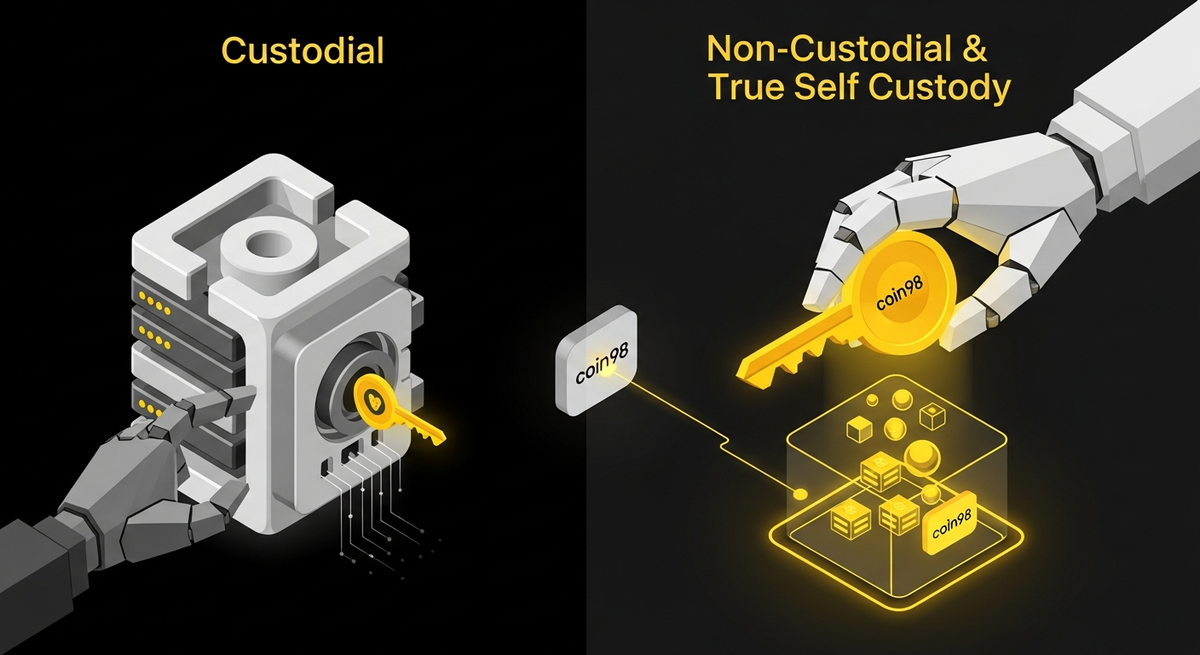
When you create an account on a Centralized Exchange (CEX) like Binance or Coinbase, you are using a Custodial Wallet. The exchange acts as a custodian, holding the private keys on your behalf. You log in with an email and password, much like a traditional Web2 bank.
The Pros of Custodial Wallets
- Familiarity: If you forget your password, you can simply click "Forgot Password" and verify your identity to regain access.
- Zero Network Fees: Trading within the exchange's internal ledger does not require paying blockchain gas fees.
The Fatal Flaws
- Single Point of Failure: You are trusting a third party with your wealth. If the exchange goes bankrupt, gets hacked, or faces regulatory crackdowns, your funds are frozen or lost forever.
- Censorship: A CEX can freeze your account, block withdrawals, or flag your transactions without warning. You are asking for permission to use your own money.
Taking Back Control: Non-Custodial (Self-Custody) Wallets
A Non-Custodial Wallet (or Self-Custody wallet) removes the middleman. When you create one, the software generates a unique private key (usually represented as a 12- or 24-word Secret Recovery Phrase). You are the sole owner of this key.
Major players in the industry have taken different approaches to educating users and building self-custody solutions. Let's look at a few notable examples:
- MetaMask: The pioneer of the EVM ecosystem. While it brought self-custody to the masses, managing multiple networks often requires manually adding RPC endpoints, which creates massive friction and confusion for new users trying to navigate a multi-chain world.
- Phantom: Known for its sleek user interface and seamless onboarding. However, it was historically siloed within the Solana ecosystem. While it has expanded, its core architecture still heavily favors a specific niche, limiting broader Interoperability.
- OKX Wallet: A robust, feature-rich Web3 wallet that integrates deeply with its parent exchange. However, for purists seeking true decentralization, relying on a wallet heavily tethered to a centralized exchange brand can blur the lines of absolute independence.
While these wallets have pushed the industry forward, users often find themselves downloading five different extensions just to interact with different blockchains, leading to fragmented Liquidity and a higher risk of losing seed phrases.
The Ultimate Solution: Coin98 Super Wallet
At Coin98, we believe you shouldn't have to choose between hardcore security and everyday usability. We built the Coin98 Super Wallet to be the definitive non-custodial gateway to Web3, engineered specifically to solve the fragmentation and UX hurdles of older wallet generations.
Why Coin98 Super Wallet is the Superior Choice
- True Self-Custody: We are strictly non-custodial. We do not have access to your private keys, your seed phrase, or your funds. You are the sole custodian of your wealth.
- Seamless Multi-Chain Engine: Forget about manually adding RPCs. Coin98 Super Wallet natively supports over 100+ blockchains (both EVM and non-EVM) right out of the box. Your Bitcoin, Ethereum, Solana, and Cosmos assets live side-by-side in one unified, elegant interface.
- Optimized DeFi Routing: Interacting with DApps directly from your wallet shouldn't result in terrible execution. Our built-in swap features utilize advanced routing algorithms to aggregate liquidity, ensuring you experience minimal Slippage and secure the best possible rates across the market.
Bridging Web3 to the Real World: The Fusion Card
A common critique of self-custody is that it makes spending your crypto in daily life difficult. We solved this. By integrating products like the Fusion Card into our ecosystem, we allow you to bridge the gap between decentralization and real-world utility.
You can maintain your assets securely in your non-custodial Coin98 Super Wallet, and only top-up your Fusion Card when you are ready to spend. This means you enjoy the absolute security of self-custody without sacrificing the convenience of buying a cup of coffee with your crypto.
Conclusion: Your Keys, Your Future
Relying on custodial exchanges is a temporary convenience that carries catastrophic long-term risks. Transitioning to a non-custodial wallet is the most empowering step you can take in your crypto journey. It transforms you from a passive account holder into a sovereign individual.
Are you ready to take true ownership of your digital assets? Download the Coin98 Super Wallet today, securely back up your seed phrase offline, and experience the safest, most comprehensive Web3 ecosystem built for the modern crypto user.
Frequently Asked Questions (FAQ)
What is a crypto wallet, and what does it store?
A crypto wallet is a secure interface that holds your cryptographic keys, not your actual cryptocurrency. Your digital assets reside on their respective blockchains. The wallet provides the public key (your address) for receiving funds and the private key (your seed phrase) for authorizing transactions.
What is the main difference between a custodial and a non-custodial wallet?
In a custodial wallet (e.g., CEX), a third party holds your private keys, meaning they control your assets. With a non-custodial wallet, you retain full control of your private keys and thus, absolute ownership of your funds. This eliminates reliance on intermediaries.
Why is "Not your keys, not your coins" a crucial concept in Web3?
This phrase emphasizes that true ownership of cryptocurrency hinges on controlling your private keys. Without them, you merely hold an IOU, vulnerable to loss if the custodian collapses, is hacked, or freezes your assets, as demonstrated by past market events.
What are the primary risks associated with using custodial wallets?
The main risks include a single point of failure where funds can be lost if the custodian goes bankrupt or is hacked. Custodial wallets also introduce censorship risks, as the third party can freeze accounts or block transactions, meaning you lack true control over your own money.